

Gen Z Drives India’s Credit Card Boom as First-Time Users Expand Beyond Metros

Summarized by AI; it may make mistakes. Check important info
Summarized by AI; it may make mistakes. Check important info

India’s credit card market is witnessing a major shift, with younger consumers and people from semi-urban and rural areas emerging as key drivers of growth. According to a new report by TransUnion CIBIL, half of India’s new-to-credit-card (NTCC) consumers are from Gen Z, while nearly half of first-time card users now live outside major metropolitan cities.
The report, titled “Beyond the Swipe 2026: How India Uses Cards as a Credit Instrument”, found that credit card ownership in India crossed 5.2 crore consumers in March 2026, rising 3.6 times from 1.4 crore in 2016.
The report highlighted the following key findings:
- 50% of NTCC consumers were aged 30 years or below in March 2026, compared with 43% in 2022.
- 46% of new credit card users lived in semi-urban and rural markets, showing wider adoption beyond metros.
- The number of active credit cards grew five times, from 2.1 crore to 10.7 crore during the same period.
The report highlighted that many first-time credit card users are already familiar with formal credit. Around 25% of NTCC consumers already had three or more active credit products before getting their first card, indicating that credit cards are increasingly becoming an addition to existing financial portfolios rather than the first step into borrowing.
Credit Card Usage Becomes More Diverse
Over the past decade, Indian consumers have moved towards holding multiple forms of credit. The share of card-only users declined from 50% in 2016 to 33% in 2026, while consumers with other credit products in their wallets increased.
The share of consumers holding three or more credit cards also rose from 12% to 22%, reflecting deeper engagement with credit products.
TransUnion CIBIL MD and CEO Bhavesh Jain said the growth of the credit card market reflects a more diverse borrower ecosystem, where consumers are using cards alongside personal loans, consumer durable loans and other short-term credit products.
He added that lenders need to focus on expanding access while maintaining affordability, repayment discipline and overall credit quality.
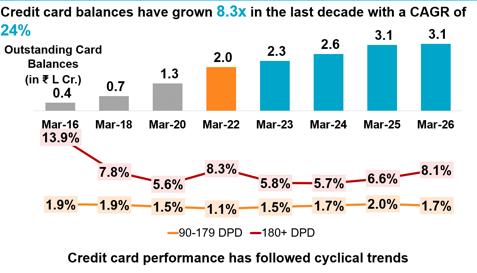
At the same time, outstanding credit card balances increased 8.3 times over a decade, rising from ₹0.4 lakh crore in 2016 to ₹3.1 lakh crore in 2026.
Gen Z Enters Credit Market Earlier
The report found that Gen Z consumers are entering the formal credit system earlier than previous generations.
Among Gen Z consumers aged 24 to 30 who received their first credit card in 2024:
- 31% already had two or more active credit accounts.
- Only 30% had no previous credit history, compared with 56% among similar-age Millennials in 2018.
- 18% already held consumer durable loans, while 23% had small-ticket personal loans.
Gen Z users also showed stronger early engagement with credit cards. Around 28% of Gen Z first-time card users had balances above ₹25,000 within three months of receiving their card, compared with 20% among Millennials in 2018.
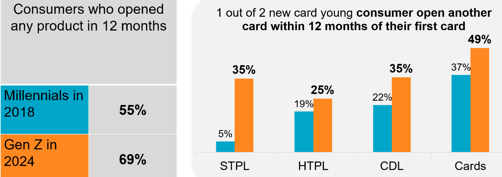
Within a year of receiving their first card, 69% of Gen Z NTCC consumers opened another credit product, compared with 55% of Millennials at the same stage.
India Still Has Room for Credit Growth
Despite rapid expansion, India’s credit card penetration remains lower than several global markets. The report noted that credit cards accounted for 25% of credit-active consumers in March 2026, compared with higher levels in countries such as the United Kingdom, Colombia and Hong Kong.
The findings suggest that India’s growing young population, increasing digital adoption and wider access in smaller towns could continue to support responsible credit card expansion in the coming years.


