

Why India is unlikely to see auroras during upcoming solar storm?

Summarized by AI; it may make mistakes. Check important info
Summarized by AI; it may make mistakes. Check important info

A large group of sunspots has turned to face Earth, while a fast stream of charged particles from the Sun is also moving towards the planet, as per reports. Because of this, scientists are closely monitoring the situation and have said a minor geomagnetic storm could occur around June 25 and 26. The storm is expected to be at the G1 level, which is considered minor and is not seen as a major threat.
What creates solar storms?
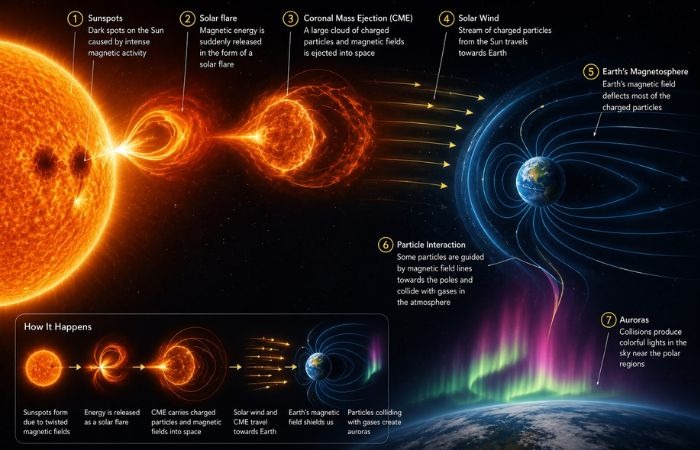
Sunspots are dark patches that appear on the Sun’s surface because of strong magnetic activity. They look darker than the surrounding areas as they are slightly cooler. The Sun is made of hot plasma, and as it rotates, its magnetic field gets twisted. When these twisted magnetic fields break through the Sun’s surface, sunspots are formed.
According to reports, these magnetic fields can sometimes suddenly snap and reconnect, releasing a huge amount of energy known as a solar flare. In some cases, a solar flare also throws out a massive cloud of charged particles called a coronal mass ejection (CME). While the light from a solar flare reaches Earth in about eight minutes, a CME can take between 15 hours and three days to arrive. Earlier this month, on June 3, one active region on the Sun produced three powerful solar flares, leading to a strong geomagnetic storm watch.
What creates auroras?
Earth is protected by its magnetic field, called the magnetosphere, which blocks most of the charged particles coming from the Sun. However, if these particles interact strongly with Earth’s magnetic field, they can trigger a geomagnetic storm. These storms are measured on a scale from G1, which is minor, to G5, which is extreme.
When charged particles move towards the Earth’s poles and collide with gases in the atmosphere, they create colourful lights known as auroras, or the northern and southern lights. However, reports suggest India is unlikely to witness auroras during this event. A minor geomagnetic storm usually limits the lights to high-latitude regions such as northern parts of the United States or Scotland. India has seen auroras only during very rare and extremely powerful storms, when faint red lights were visible in the skies over Ladakh.
Scientists say the latest solar activity is another sign that the Sun is moving towards its solar maximum, the busiest phase of its 11-year cycle, when solar flares and geomagnetic storms become more frequent.


