

‘Come Out Of Hindu-Muslim Mindset’: Kangana Ranaut Responds To Sharmila Tagore On Vande Mataram

Summarized by AI; it may make mistakes. Check important info
Summarized by AI; it may make mistakes. Check important info

The debate over Vande Mataram has taken a fresh turn after actor Kangana Ranaut criticised veteran actor Sharmila Tagore’s views on the national song, arguing that its religious references should be seen through the lens of poetry and symbolism.
Tagore, 81, had recently said that the first two stanzas of Vande Mataram were more appropriate for everyone to sing, as the later portions refer to Hindu deities and could make people belonging to monotheistic faiths uncomfortable.
Kangana questions Tagore’s interpretation
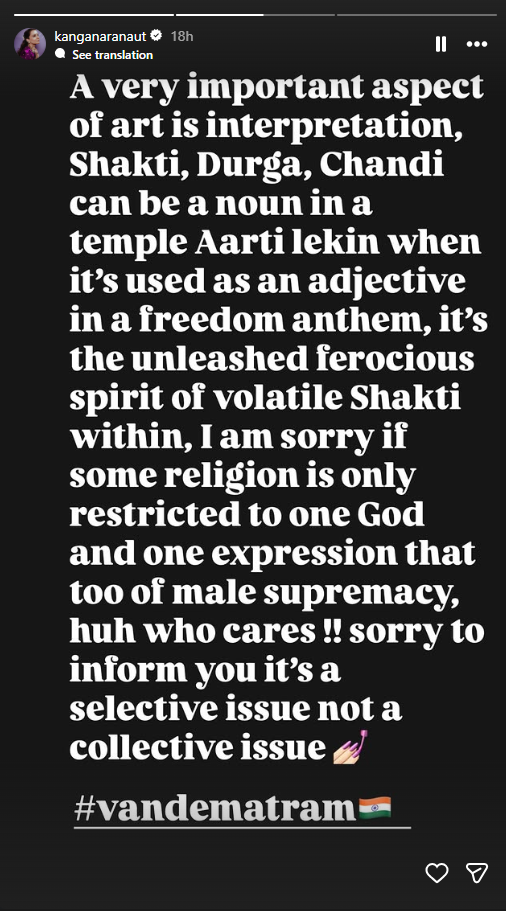
Reacting to Tagore’s interview on Instagram Stories, Kangana said she respected her decision to raise the issue but disagreed with the way she had interpreted the song.
Kangana argued that poetry does not always convey its message through literal descriptions. According to her, artists use imagery and metaphors to communicate ideas that can have a meaning beyond the words themselves.
She said Vande Mataram should be viewed in the context of the freedom movement and Bankim Chandra Chatterjee’s attempt to awaken a sense of strength among Indians.
Kangana wrote, “Vande Matram is the spirit of freedom struggle Bankim Chandra ji is compelling the nation to awaken the Shakti within.”
She questioned whether references to Hindu goddesses should automatically be treated as religious instructions rather than artistic expressions.
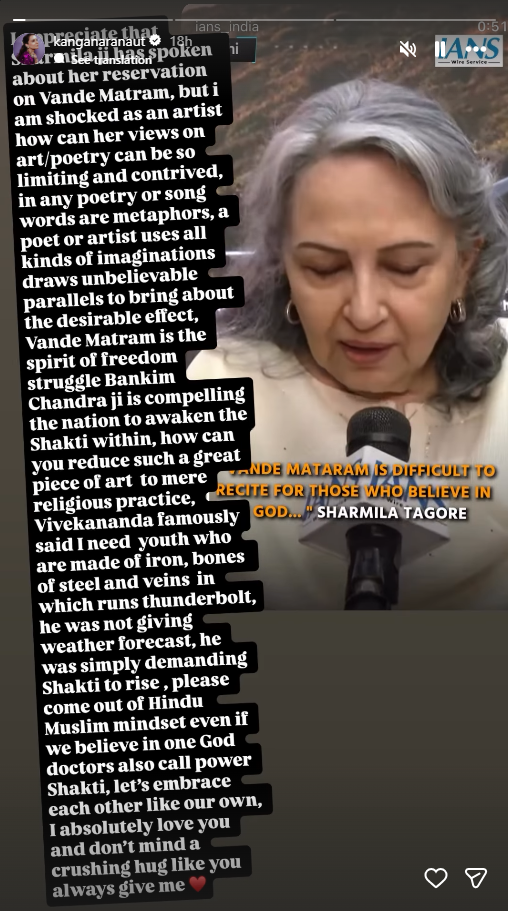
‘Please come out of Hindu Muslim mindset’
Kangana also referred to Swami Vivekananda’s descriptions of physical and inner strength to explain her point about the use of “Shakti” in artistic expression.
“Vivekananda famously said I need youth who are made of iron, bones of steel and veins in which runs thunderbolt, he was not giving weather forecast, he was simply demanding Shakti to rise,” she wrote.
She concluded her response by appealing to Tagore to look beyond the religious divide while interpreting the song.
“Please come out of Hindu Muslim mindset even if we believe in one God doctors also call power Shakti, let’s embrace each other like our own,” Kangana wrote.
Why Sharmila Tagore questioned the later verses
Tagore had raised the issue while discussing whether the complete version of Vande Mataram could be accepted by people of different religious beliefs.
She said references to multiple deities in the later portions could pose a difficulty for those who follow a monotheistic faith.
“My point of view is that there are many religious people who believe in one single God, not many Gods. In Vande Mataram, there is a stanza which says that many Gods are mentioned in Vande Mataram,” Tagore said.
She added that the first two stanzas, which focus primarily on the motherland, could be more broadly accepted.
Vande Mataram debate gains political attention
The exchange between the two actors comes as Vande Mataram is once again at the centre of a political debate.
Written by Bankim Chandra Chatterjee in the 1870s and later published as part of Anandamath, the song became an important part of India’s freedom movement. Its later verses invoke Hindu deities including Durga, Lakshmi and Saraswati.
The Congress has maintained its 1937 position that only the first two stanzas should be sung at party programmes.
Mukesh Khanna enters the debate
Actor Mukesh Khanna has also recently voiced his views on the issue, arguing that Vande Mataram should be made India’s National Anthem instead of Jana Gana Mana.
Khanna has praised Vande Mataram and Lata Mangeshkar’s rendition of the song while arguing for a change in its official status. His remarks have added another dimension to the wider discussion surrounding India’s national symbols.


