




New clues to how solar storms are born as NASA flies close to sun
Updated: Apr 16th, 2026


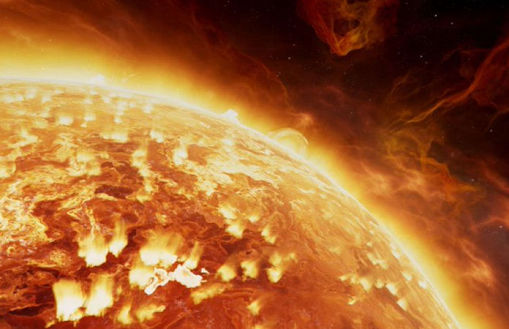
NASA's Parker Solar Probe, which was launched in 2018 is a groundbreaking spacecraft designed to study the Sun closer than any mission in history, now has uncovered new clues about how solar storms are formed.
The NASA spacecraft that has been flying closer to the sun, “observed a sun-directed jet of particles made of protons and heavy ions, which are atoms that have lost or gained electrons.But unexpectedly, analysis of the data revealed that protons and ions were accelerated in different manners.
Magnetic reconnection theories expect these two types of particles to be accelerated in the same manner, but the new observations showed the protons formed a dispersed beam, like that from a flashlight, while the heavier ions were directed in a straight line like a laser beam.”
The Parker Solar Probe repeatedly dives through the Sun’s outer atmosphere, known as the solar corona, where temperatures soar beyond a million degrees Celsius. It travels at speeds of up to 6,90,000 km/h, making it the fastest human-made object ever created.
To survive these extreme conditions, it gathers crucial data on solar wind, magnetic fields, and energetic particles, helping scientists better understand how solar storms develop and how to predict space weather that can disrupt satellites, power grids, and communication systems on Earth.
During its mission studying the corona, the probe also made a significant observation in the solar wind,a stream of charged particles flowing from the Sun. It directly recorded a magnetic reconnection event, a powerful phenomenon where magnetic field lines break and reconnect, releasing massive amounts of energy.
In a close flyby in 2022, the probe passed right between the Sun and the location of one such reconnection event in the solar wind. This rare positioning allowed scientists to observe and measure the process directly, offering valuable insights that could improve predictions and help safeguard satellites, GPS systems, and power infrastructure from geomagnetic storms.
All the findings were published on March 31 in the Astrophysical Journal, and will help scientists refine theoretical models of magnetic reconnection to better understand how solar storms are powered.
