





NASA’s webb telescope captures glow of rare ‘interstellar’ comet
Updated: Aug 26th, 2025


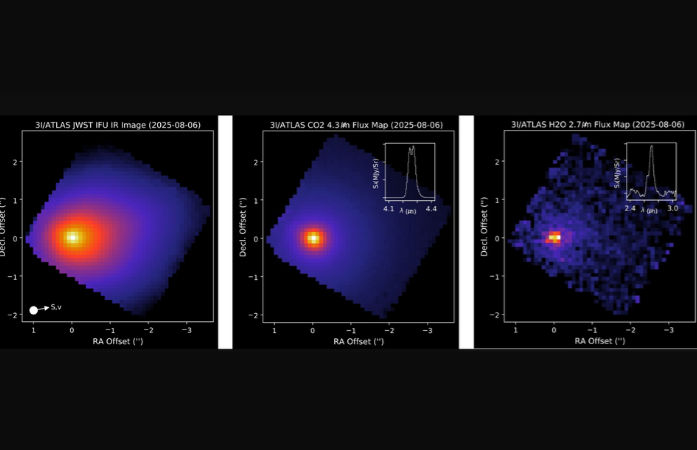 |
| Image source: NASA website |
NASA’s James Webb Space Telescope (JWST) observed the interstellar comet 3I/ATLAS on August 6 using its Near-Infrared Spectrograph (NIRSpec), according to the space agency’s website.
The research team is currently analysing Webb’s data, with a preprint already available online.
While interstellar comets pose no threat to Earth, the data will enhance NASA’s efforts to find, track, and study small bodies in and beyond our solar system.
Studying interstellar comets like 3I/ATLAS provides a rare window into the building blocks of other planetary systems. By comparing them with comets from our own solar system, scientists can test theories about how stars and planets form across the galaxy.
Webb is one of several NASA observatories tracking the comet, helping scientists better understand its size, composition, and physical properties. NASA confirmed that the Hubble Space Telescope and the recently launched SPHEREx mission are also contributing to the observations.
In a separate discovery, NASA scientists have identified a new ‘Super Earth’ exoplanet named TOI-1846 b, located about 154 light-years away. The planet is approximately twice the width of Earth and nearly four times its mass, according to reports.
The unusual exoplanet was first flagged earlier this year by NASA’s Transiting Exoplanet Survey Satellite (TESS), which detected a repeating flicker of light from a star in the Lyra constellation. The signal, which appears each March, was later traced to TOI-1846 b, raising questions about its atmosphere and orbital behavior.
Together, these discoveries underscore NASA’s growing ability to observe distant celestial bodies and deepen our understanding of the universe.