




MIT researchers develop new three-sided ‘Y-Zipper’
Updated: May 27th, 2026


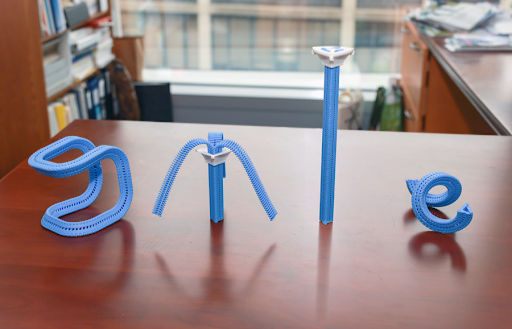 |
| Image: X (@MIT_CSAIL) |
Researchers at (Massachusetts Institute of Technology) MIT Computer Science and Artificial Intelligence Laboratory (CSAIL) have reportedly developed a new three-sided zipper called the ‘Y-zipper’, inspired by a design created nearly 40 years ago by MIT professor William Freeman.
The Y-zipper can change objects from soft and flexible to rigid and stable with a simple zip movement. Scientists say the technology could be useful in tents, medical devices, robots, and emergency shelters.
The original idea was reportedly designed by Freeman in 1985. He created a triangular zipper prototype that could help objects quickly change shape.
Now, researchers at MIT CSAIL have revived the project using modern 3D-printing technology. The team created software that allows users to design custom Y-zippers with different shapes such as straight, bent, coiled, or twisted forms.
According to lead researcher Jiaji Li, the new system can help create products that easily switch between flexible and rigid states while remaining practical for everyday use, as per reports. The researchers demonstrated several possible applications. The team also used motors with the zipper to create moving robotic structures and dynamic art installations. One robotic design could potentially adjust the size of its legs depending on terrain conditions.
To test durability, researchers repeatedly opened and closed the zipper. The device lasted about 18,000 cycles before breaking. Tests showed that the zipper’s elastic structure helps distribute pressure and improves strength.
The Y-zipper is made using common 3D-printing materials such as polylactic acid (PLA) and thermoplastic polyurethane (TPU). Researchers found that PLA could carry heavier loads, while TPU provided greater flexibility. These materials helped the zipper maintain both strength and movement during testing. The research team presented their findings at the ACM (Association for Computing Machinery) Conference on Human Factors in Computing Systems (CHI) in April.
