




ISRO warns of possible radio blackouts amid heightened solar activity
Updated: Feb 6th, 2026


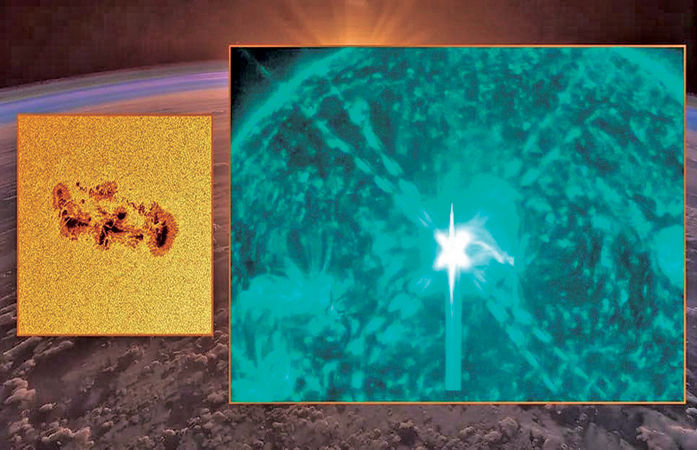
The Indian Space Research Organisation (ISRO) has cautioned that heightened activity on the Sun could trigger a storm of charged particles capable of disrupting communications and satellite operations on Earth.
Scientists have observed intense disturbances on the Sun’s surface, raising the possibility that powerful solar flares, solar winds and charged particle storms could reach Earth’s atmosphere. Such events, known in astronomy as ‘space weather’, can interfere with radio communications and other critical technologies.
ISRO said that if these solar emissions interact strongly with Earth’s magnetic field, they could lead to radio blackouts, affecting communications networks, power systems, television and radio broadcasts, radar operations and satellite services. There is also a risk that satellites orbiting the Earth could experience operational difficulties or be displaced from their designated orbits.
The space agency is closely monitoring solar activity while tracking the performance of more than 50 Indian satellites currently in orbit. Data and images from ISRO’s Aditya-L1 spacecraft, which is dedicated to studying the Sun, have indicated that intense solar emissions could have adverse effects on Earth’s magnetosphere, increasing the risk to satellite stability.
Anil Kumar, Director of ISRO’s Telemetry, Tracking and Command Network (ISTRAC), said there was a possibility of radio blackouts in several regions if solar conditions worsen. “We are keeping a close watch on all our satellites, and contingency measures are in place to respond swiftly to any disruption in communication services,” he said.
According to space weather experts, the Sun undergoes a cycle of heightened activity approximately every 11 years, during which powerful solar storms are more likely to occur. While astronomers have yet to fully understand the precise causes of this cycle, it is known to produce intense solar flares, high-speed solar winds and streams of charged particles.
Although such solar activity does not pose a direct threat to life on Earth, scientists warn that it can have a significant impact on modern technological systems. Space agencies and astronomers worldwide are therefore maintaining heightened vigilance as solar activity continues to intensify.
