




ISRO radar study detects possible subsurface ice in lunar south pole craters
Updated: May 28th, 2026


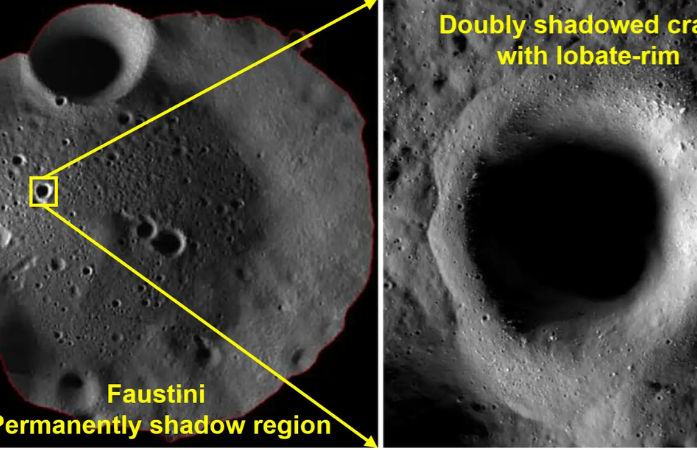
Scientists from Ahmedabad-based Physical Research Laboratory (PRL) have identified radar signatures indicating possible subsurface ice beneath craters in the Moon’s south polar region using observations from Chandrayaan-2’s Dual Frequency Synthetic Aperture Radar (DFSAR).
The study focused on ‘doubly shadowed craters’ located within permanently shadowed regions (PSRs), where temperatures remain around 25K due to the absence of sunlight and thermal radiation. These ultra-cold conditions are considered suitable for preserving water-ice over billions of years.
Using advanced radar polarimetric analysis, researchers proposed a new detection criterion where Circular Polarisation Ratio (CPR) values above 1 and Degree of Polarization (DOP) values below 0.13 indicate volumetric scattering potentially linked to subsurface ice deposits.
Out of four craters showing such signatures, a 1.1 km-wide crater inside Faustini crater displayed the strongest evidence. Scientists also observed a distinctive lobate-rim morphology, suggesting the impact may have struck ice-rich subsurface material.
DFSAR onboard Chandrayaan-2 is the first fully-polarimetric SAR instrument to study the Moon in both L- and S-band frequencies.
