




Indian space promotion centre IN-SPACe selects 3 space tech startups for funding
Updated: Jun 11th, 2026


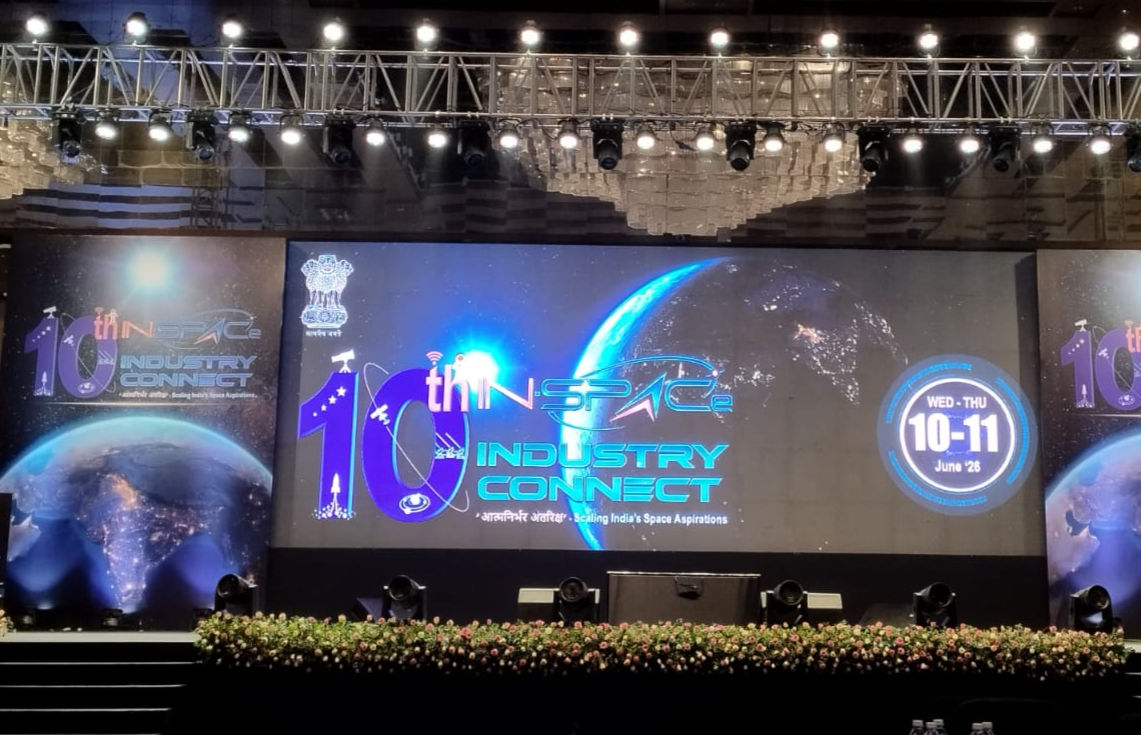
India’s private space sector continues to gain momentum, with the Indian National Space Promotion and Authorisation Centre (IN-SPACe) expanding funding support, infrastructure access and technical assistance for non-governmental space companies.
The latest initiatives, announced in Ahmedabad during IN-SPACe Industry Connect, include new financial schemes, support for launch providers, Earth observation projects and the selection of the first startups under the Technology Adoption Fund (TAF) Scheme.
IN-SPACe has launched several initiatives aimed at accelerating private participation in India's growing space sector.
Among the major support measures announced are a Venture Capital Fund worth ₹1,000 crore, a Technology Adoption Fund worth ₹500 crore and Common Technical Facilities worth ₹500 crore.
Additional initiatives include an Earth Observation constellation under a public-private partnership model, a Seed Fund Scheme, one ITU filing allocated to an NGE, and the release of an Expression of Interest (EoI) for PSLV Transfer of Technology.
The startups
On June 11, 2026, IN-SPACe announced the first set of Indian Non-Governmental Entities (NGEs) selected for funding under the Technology Adoption Fund Scheme.
Following a multi-stage evaluation process involving experts from ISRO, the Department for Promotion of Industry and Internal Trade (DPIIT), the Department of Science and Technology (DST), academia, industry and IN-SPACe, three startups were selected for financial support.
Bengaluru-based Astrobase Space Technologies will develop an 800 kN-class reusable closed-cycle LOX-LNG liquid rocket engine intended for medium and heavy-lift launch vehicles.
Another Bengaluru-based company, SatSure Analytics India, will develop "Dhaarini", a Large Earth Observation Model designed as an artificial intelligence foundation platform for remote sensing applications. The system is expected to support sectors including agriculture, infrastructure and disaster management.
Hyderabad-based TM2SPACE Technologies will develop indigenous AI-powered satellite star tracker systems, including StarSense Lite for CubeSats and StarSense Pro for larger satellites. The systems are intended to improve satellite navigation, attitude determination and pointing accuracy for imaging and communication missions.
Commenting on the selection process, Dr Pawan Goenka, Chairman of IN-SPACe, said the programme aims to bridge the gap between early-stage technology development and commercial deployment while supporting Indian companies working on advanced space technologies.
Rajeev Jyoti, Director – Technical Directorate, IN-SPACe, said the selected projects address critical technology gaps spanning reusable rocket propulsion, Earth Observation artificial intelligence platforms and indigenous high-accuracy star tracker systems.
IN-SPACe will provide technical guidance, milestone-linked funding support, and project monitoring during implementation.
Department of Space supporting private launch providers
The Department of Space is also extending technical support to private launch companies preparing for orbital missions.
Skyroot Orbital Launch
Skyroot’s orbital launch is targeted for July 2026.
Support provided by ISRO and the Department of Space includes propellant casting and static tests at SDSC-Sriharikota, fourth-stage liquid engine testing at LPSC and IPRC, flight trajectory validation by VSSC, pre-launch operations, launch pad integration, launch support, NOTAM issuance and range safety coordination.
Agnikul Orbital Launch
The Department of Space is also supporting Agnikul Cosmos in preparation for its orbital launch programme.
Support includes technical handholding for vehicle development and launch operations, while land has already been identified at SDSC-SHAR for a dedicated launch pad.
National Earth Observation Constellation
IN-SPACe has selected a consortium led by Pixxel to design, build and operate a national Earth Observation satellite constellation under a Public-Private Partnership framework.
The consortium includes Pixxel, Dhruva Space, PierSight and SatSure.
Together, the companies will develop and operate a 12-satellite Earth Observation constellation aimed at strengthening India's space-based monitoring and data capabilities.
Orbital slots opened for private industry
India has also begun facilitating access to orbital resources for private space companies.
One orbital slot at 89° East has been allocated to Ananth Technologies Ltd.
In addition, two more orbital slots at 55.8° East and 68° East have been identified for future allocation to non-governmental entities.
