




Future wars may begin in space as US, China and Russia prepare for new battleground: Report
Updated: Mar 31st, 2026


 |
The next major global conflict could begin in space, with the United States, China and Russia increasingly preparing for warfare beyond Earth’s atmosphere, according to experts and officials familiar with strategic planning, as per a report by Bloomberg.
While many countries reportedly lack comparable technological capabilities in the space domain, analysts in the report cited that the real concern lies in a potential confrontation involving the world’s leading powers — particularly Washington, Beijing and Moscow.
Discussions with defence and space experts in Washington, DC and Colorado Springs, home to the US military’s space operations, reportedly indicate a growing consensus that any future large-scale war could see its opening moves in space, alongside coordinated cyber attacks.
As per the report, during the discussion, it was alleged that the first shots of the next world war will almost certainly be fired in space. The controversy is about what form an attack would take and whether America in particular is vulnerable to a “space Pearl Harbour".
Modern militaries allegedly rely heavily on satellites for surveillance, navigation, communication and targeting, making them critical assets and prime targets in any conflict. As a result, nations are developing both offensive and defensive capabilities to disable adversaries’ satellites while protecting their own.
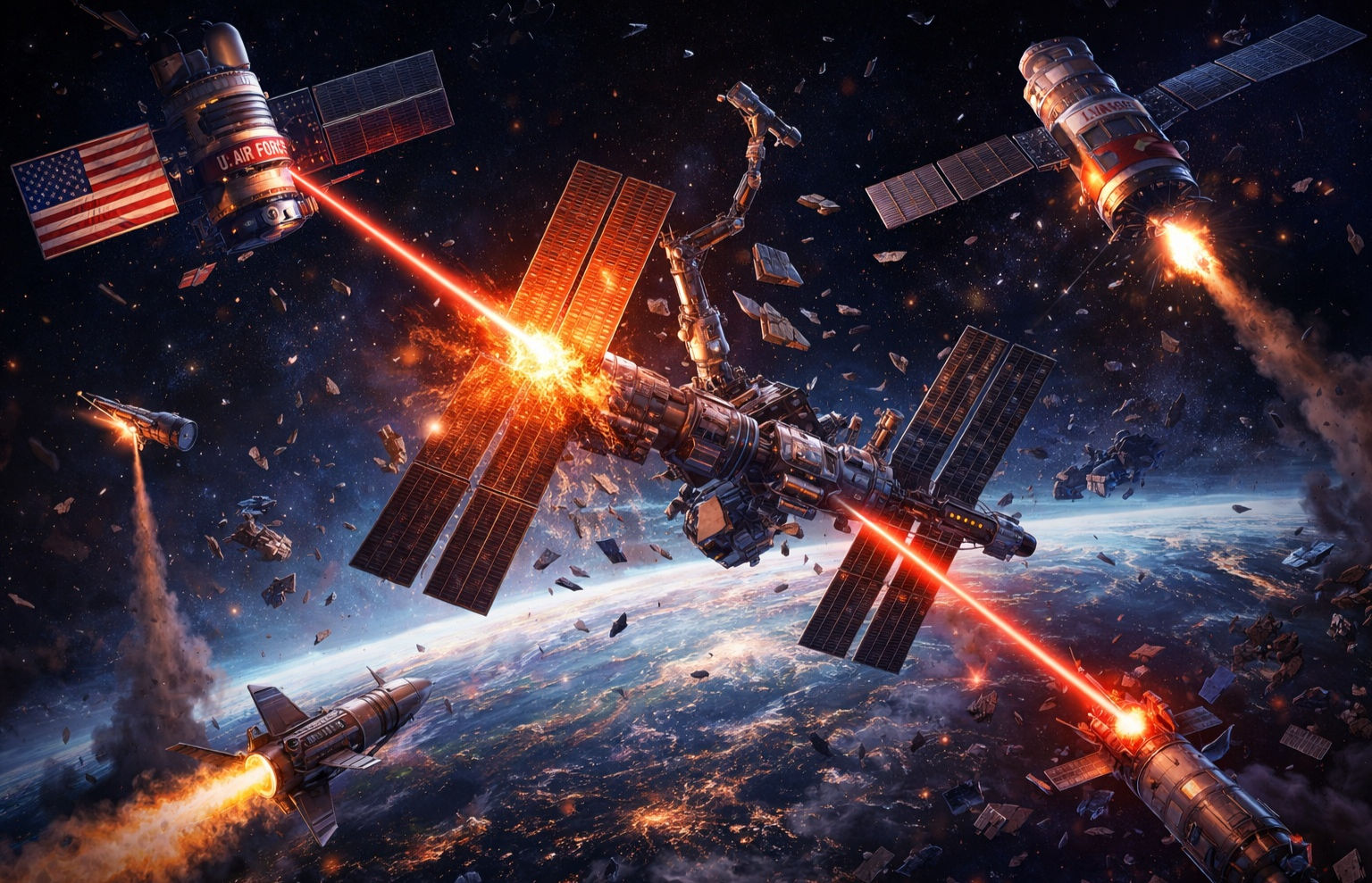
Experts say initial hostilities could involve electronic warfare such as signal jamming, which already occurs intermittently, though rarely attracts public attention. More aggressive measures could include laser-based systems, missile strikes or physical interference between satellites in orbit.
There are also concerns about increasingly sophisticated satellite technologies. Russian systems, for instance, have been described as capable of deploying smaller sub-satellites, potentially for repair missions or offensive use. Chinese satellites equipped with robotic arms could similarly serve dual purposes, ranging from debris removal to disabling rival spacecraft.
Such developments have contributed to what analysts describe as a growing arms race in low-Earth orbit, with rival nations testing manoeuvrability and engaging in prolonged “orbital manoeuvres” that resemble aerial dogfights.
At present, experts suggest the US may not have a decisive advantage in all aspects of such operations. Traditional American satellites, designed for durability and precision, are seen as less agile compared to emerging systems that prioritise speed and flexibility.
In response, the US is reportedly shifting towards a strategy of deploying large constellations of smaller, less expensive satellites to improve resilience. This “proliferation” model aims to reduce vulnerability by ensuring that the loss of individual satellites does not cripple overall capabilities.
However, officials warn that adversaries are adapting their strategies accordingly. Concerns have been raised over the possibility of space-based nuclear weapons, particularly following intelligence assessments that Russia may be exploring such capabilities, an allegation Moscow has denied.
Security analysts say a nuclear detonation in space would not directly harm people on Earth but could have devastating consequences for satellite networks. An electromagnetic pulse generated by such an explosion could disable satellites within range, while lingering radiation could render entire orbital zones unusable.
Such an act would violate the Outer Space Treaty, which prohibits the placement of nuclear weapons in space, and could trigger a severe global crisis.
Beyond deliberate attacks, experts also highlight the growing risk posed by space debris. Millions of fragments from defunct satellites and collisions already orbit the Earth, posing a threat to operational systems. A chain reaction of collisions, known as the Kessler Syndrome, could make certain orbital regions unusable.
Satellites underpin critical infrastructure worldwide, including navigation, communications, financial systems and agriculture. Disruption to these networks could have far-reaching economic and societal consequences.
Analysts note that dependence on space varies across countries, with the US and its allies being more reliant than others. This asymmetry could influence strategic decisions in a conflict scenario.
