





Ancient Chinese texts reveal new clues about earliest recorded solar eclipse, study finds
Updated: Dec 8th, 2025


 |
| Image: Phys.org |
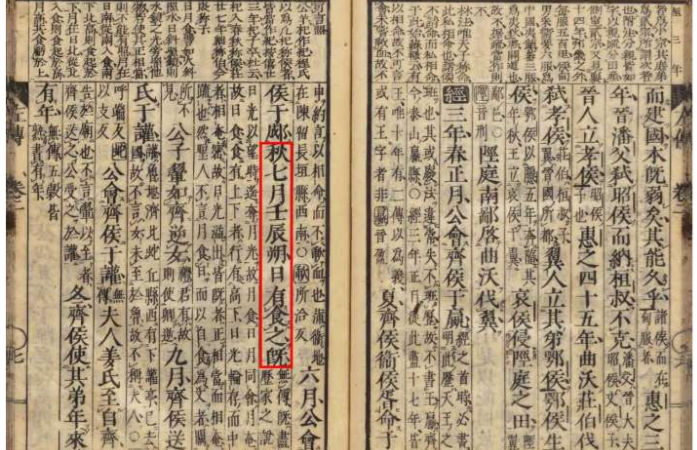
A reexamination of ancient Chinese records has helped scientists resolve a 2,700-year-old astronomical puzzle and produce new estimates of how fast Earth rotated in 709 BCE. The findings, published in The Astrophysical Journal Letters, combine historical geography with modern eclipse modelling to reinterpret what is considered the earliest datable total solar eclipse report.
An international team of researchers used detailed knowledge of the ancient Lu Duchy to calculate how the July 17, 709 BCE total eclipse would have appeared from Qufu, its capital. The original record preserved in the Spring and Autumn Annals, compiled centuries after the event, simply states that the sun was totally eclipsed. But a later annotation in the Hanshu (Book of Han), written roughly 700 years later, describes the darkened sun as completely yellow above and below, a phrase long believed to refer to the solar corona.
Lead author Hisashi Hayakawa of Nagoya University said this description may represent one of the earliest known written accounts of the corona, the sun’s faint outer atmosphere usually visible only during totality. By reconstructing how the eclipse would have looked from the correct historical location of Qufu, the researchers showed that the morphology described in the texts is consistent with modern reconstructions of solar activity cycles in the 8th century BCE.
The study also resolved a longstanding inconsistency. Earlier astronomical calculations suggested the eclipse should not have been visible as total from Qufu. The team discovered that previous analyses had used imprecise city coordinates, causing the mismatch. Correcting the ancient site’s location allowed researchers to align the historical account with celestial mechanics and Earth rotation models.