




Ancient asteroid impacts may have sparked life on earth, as per study
Updated: Jan 8th, 2026


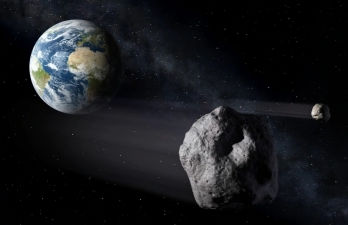 The same type of massive asteroid that famously wiped out dinosaurs 66 million years ago may have been responsible for creating life on earth billions of years earlier. Cosmic collisions could have provided the ‘natural laboratory’ needed to form the first building blocks of biology, as per a study published in PNAS (Proceedings of the National Academy of Sciences of the United States of America).
‘RNA First’ theory
Scientists focus on a molecule called RNA (Ribonucleic Acid). While DNA is famous for storing our genetic code, RNA is considered the ‘instruction molecule’ that tells cells how to work. Many researchers believe in the ‘RNA First’ hypothesis – the idea that RNA was the very first molecule capable of storing information and evolving before DNA even existed.
The study ‘Interstep compatibility of a model for the prebiotic synthesis of RNA consistent with Hadean natural history’ suggests that while large asteroids cause mass extinctions they played a very different role during earth’s infancy about 4.3 billion years ago. These massive impacts didn’t just leave craters, they transformed the planet’s environment by Cracking the Crust: Impacts fractured the earth's surface, allowing water and chemicals to mix, Creating Heat: The collisions generated long-lasting hydrothermal systems, Atmospheric Changes: The energy from the impacts temporarily changed the chemicals in the air.
This combination of heat, water, and minerals likely allowed short chains of RNA to assemble and eventually begin replicating. This process laid the foundation for evolution and, eventually, all living things.
This discovery also has big implications for the search for aliens. If asteroid impacts can jump-start life-friendly chemistry, similar processes might have happened on early Mars. This suggests that the same cosmic forces that end life can also be the ones to start it. Scientific research suggests that the same type of asteroid impacts responsible for wiping out the dinosaurs may have actually helped create life on Earth billions of years earlier. According to the ‘RNA First’ hypothesis, a molecule called Ribonucleic Acid (RNA) was likely the first to store information and evolve. While we often think of asteroids as agents of destruction, scientists believe that during earth’s infancy, these massive cosmic collisions provided the perfect conditions for RNA to form naturally.
About 4.3 billion years ago, Earth was frequently struck by massive space rocks. These impacts fractured the planet’s crust and created hydrothermal systems, which are essentially vents of hot, mineral-rich water. This environment acted like a natural laboratory, using heat and chemical mixing to help short chains of RNA assemble and eventually begin replicating. Over time, these replicating molecules laid the groundwork for Darwinian evolution and the complex biology we see today.
Crucially, researchers are not claiming that the specific asteroid that killed the dinosaurs created life; rather, they use it as an example of how much an impact can change a planet’s environment.
