

RMC SIT to Probe ₹70 Lakh Rajkot’s Jangleshwar Demolition Bill

Summarized by AI; it may make mistakes. Check important info
Summarized by AI; it may make mistakes. Check important info
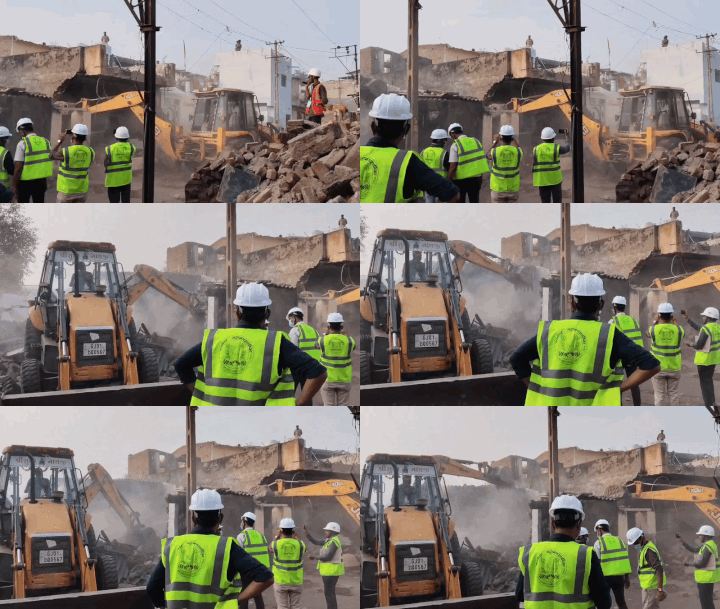
In a decisive move to crack down on administrative profligacy, the Rajkot Mayor has ordered a Special Investigation Team (SIT) to conduct an immediate forensic audit into the logistical bills submitted by the Rajkot Municipal Corporation (RMC) administration. The announcement, made today, follows intense public scrutiny over the eye-watering expenses run up by civic officials during an anti-encroachment drive earlier this year.
At the centre of the probe is a shocking ₹70.31 Lakh logistical expenditure accumulated over a brief 9-day operational window between February 21 and February 29. While hundreds of low-income families watched their dwellings being turned to rubble, the supervising bureaucracy managed to run up an average daily logistical bill of ₹7.81 Lakh per day.
The SIT has been tasked with breaking down the financial math, procedural rule-bending, and deep ethical lapses that define this unfolding saga.
The Core Investigation: Head-wise Expenditure Under Scrutiny
The total claimed amount of ₹70.31 Lakh submitted retrospectively for administrative clearance has been divided across four distinct heads. The SIT audit will scrutinise each of these figures line-by-line:
- ₹27.20 Lakh: Food and basic refreshments (including tea, traditional snacks, and full meals)
- ₹24.00 Lakh: Videography, camera crews, and drone surveillance
- ₹12.40 Lakh: Bottled mineral water
- ₹6.71 Lakh: Mandap (tents), air-cooling setups, and seating services
Inexplicable Math & Departmental Camouflage
The internal administrative logic behind these invoices collapses when subjected to basic mathematical scrutiny. The investigation team will focus on three key anomalies:
Improbable Water Consumption Metric
The RMC was billed ₹12.40 Lakh for small mineral water bottles at an inflated rate of ₹8 per bottle—substantially higher than the standard retail price of ₹5 and a wholesale procurement cost of under ₹3.
This means that over the 9-day period, an astonishing number of individual bottles were supposedly consumed on-site. For an on-site deployment averaging 4,800 personnel, the final bill implies that every single individual—from senior bureaucrats to manual labourers—was consuming 6 to 8 bottles of water every single day without fail. The audit team will look at whether these numbers were artificially inflated on paper.
Fractional Splitting to Evade Internal Flags
In an apparent bid to prevent a single massive financial figure from triggering automated accounting alerts, the administrative wing strategically fragmented the invoices across entirely unrelated departments. Food and heavy meals were routed through the Phool (Flower/Garden) department, while bottled water and tent rentals were pushed through the Cultural department. This deliberate structural separation points to a calculated effort to slip the bills past standard oversight mechanisms.
Exorbitant Unit Premium on Public Funds
Basic hospitality items w invoiced at luxury price points. Most notably, individual pieces of premium sweets like kaju katri and khajur rolls were billed at a staggering ₹231 per piece. Furthermore, a bill of ₹34,650 was submitted for just 150 standard snack plates. While the initial administrative defence claimed these high-end refreshments were reserved for a massive media briefing, the unit pricing remains entirely decoupled from commercial reality.
The Moral Crisis: Feasting Amid Ruin
Beyond the financial irregularities lies a profound ethical disconnect that has sparked widespread public anger across the city.
The Jangleshwar drive was a sensitive, heavy-handed enforcement operation that flattened 1,400 structures along the Aji riverbed, leaving hundreds of local families displaced and out in the open. The stark contrast has created terrible public optics: while marginalised citizens were watching their livelihoods and belongings turned to dust, the supervising bureaucracy was operating out of air-cooled tents just metres away, feasting on luxury sweet, hot snacks, and lemon-ginger sherbet on the public dime.
The excessive hospitality tab creates a distinct impression that a sombre, highly sensitive law-and-order enforcement action was treated by civic officials as an expensive outdoor corporate retreat.
The Road Ahead for the SIT
Because the demolition drive was executed under rapid state directives, the RMC bypassed standard tendering protocols and competitive market discovery, opening the door for arbitrary retroactive billing.
The newly appointed SIT faces a clear mandate: verify the physical delivery logs of the catering trucks, demand a legal justification for the 150% markup on bottled water despite existing municipal contracts, and determine if "emergency clauses" were intentionally weaponised to abuse taxpayer money without accountability. Until the forensic audit is complete, the city's Standing Committee has frozen all pending payments.


