




NSE IPO guide for NRIs: How to invest in India’s biggest ₹30,000-crore public issue
Updated: Jun 19th, 2026


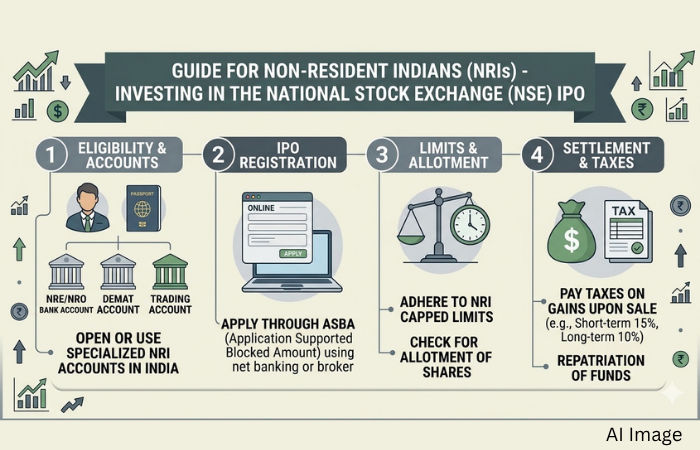
The long-awaited initial public offering (IPO) of the National Stock Exchange of India (NSE) is officially a reality. After a decade-long regulatory standoff over the co-location controversy, the world’s largest derivatives exchange, NSE, has filed its Draft Red Herring Prospectus (DRHP) with the Securities and Exchange Board of India (SEBI).
Estimated at a whopping ₹30,000 crore, this mega-issue is slated to become the largest IPO in the history of Indian capital markets.
Key Details of the NSE Public Issue
Type of Issue: 100% Offer for Sale (OFS) of 14.89 crore equity shares.
Selling Stakeholders: Existing institutional investors—including the State Bank of India (SBI), Canada Pension Plan Investment Board (CPPIB), Morgan Stanley, and Temasek—will be divesting around a 6% stake.
Listing Platform: Because an exchange cannot list on its own platform under SEBI regulations, the NSE will list on its rival exchange, the BSE.
Given the global buzz surrounding India’s economic growth, Non-Resident Indians (NRIs) are showing unprecedented interest in securing a piece of this premier financial institution. If you are an NRI looking to subscribe to this historic issue, here is your comprehensive playbook on the process, unique investment limits, and distinct tax implications.
NSE Market Value & Dominance
Based on unlisted market indicators, the listing is poised to value the NSE at over ₹5 lakh crore, placing it squarely within India's top 10 most-valued companies. The bourse handles nearly 93% of the country’s cash market turnover and an astounding 99.8% of equity futures.
How NRIs Can Apply for the NSE IPO
The application path for an NRI differs fundamentally based on whether you choose to invest on a repatriable basis (funds can be moved back abroad) or a non-repatriable basis (funds must remain in India).
Step 1: Align Your NRI-Specific Accounts
To bid for the IPO, you need a triad of interconnected accounts linked explicitly to your NRI status:
Bank Account: A Non-Resident External (NRE) account for repatriable investments, or a Non-Resident Ordinary (NRO) account for non-repatriable investments.
NRE/NRO Demat Account: Opened with a SEBI-registered Depository Participant (DP) in India. Ensure your demat account type matches your bank account type (NRE linked to NRE, NRO linked to NRO).
Trading Account: Established with an Indian brokerage firm.
Step 2: Use the ASBA Route
SEBI makes it mandatory to apply for IPOs via ASBA (Application Supported by Blocked Amount).
Log into your NRI NetBanking portal or your Indian broker’s platform.
Select the NSE IPO from the ongoing listings.
Enter your NRI Demat DP ID, Client ID, and bid details.
The bank will block the application amount in your NRE/NRO account. The funds will only leave your account if you receive an allotment; otherwise, they will be unblocked automatically.
NRI Investment Limits and Critical Regulatory Caps
When applying for the IPO, NRIs can opt for different bidding categories depending on their capital size. However, the overarching regulatory caps are strictly monitored:
NRI Retail Category: Applications up to ₹2,00,000 can be made under the individual retail bucket, using either NRE or NRO funds via ASBA.
NRI High Net-Worth Category: Applications above ₹2,00,000 must be filed under the Non-Institutional Investor (NII) bucket.
Important Regulatory Cap: It must be noted that no single foreign individual or NRI can hold more than 5% of the exchange's equity capital. Merchant bankers will closely monitor these thresholds during the allotment phase to ensure compliance.
Special Tax Regime and TDS for NRIs
The tax landscape for NRIs investing in Indian equities is distinct from domestic residents. For an NRI, tax liability triggers only upon the subsequent sale of the allotted shares, but it is enforced via immediate Tax Deducted at Source (TDS).
1. Short-Term Capital Gains (STCG)
If you sell your allotted NSE shares within 12 months of their listing date:
NRI Tax Rate: Profits are taxed at 20% (plus applicable surcharge and a 4% health and education cess).
TDS Mechanism: Your institutional broker is legally mandated to deduct this tax automatically at the time of the sale before releasing the net proceeds into your NRE/NRO account.
2. Long-Term Capital Gains (LTCG)
If you hold the NSE shares for more than 12 months before executing a sale:
NRI Tax Rate: Profits are taxed at 12.5% on gains exceeding an annual threshold of ₹1.25 lakh, without the benefit of indexation.
TDS Mechanism: The broker will deduct TDS on the long-term gains calculated from that specific transaction.
Mitigating Double Taxation
Since taxes are chopped off at source in India, NRIs should review the Double Taxation Avoidance Agreement (DTAA) between India and their current country of residence (such as the US, UK, or UAE). This allows you to claim a Foreign Tax Credit against your local home country tax returns, preventing you from paying tax twice on your NSE investment profits.
