

‘Why Fund Foreign Students?’: Tanzanian Student’s Stipend Revelation On Samay Raina's Latent Show Sparks Outrage

Summarized by AI; it may make mistakes. Check important info
Summarized by AI; it may make mistakes. Check important info

A clip from Samay Raina’s India’s Got Latent Season 2 has triggered a debate over India’s scholarships for foreign students, with social media users questioning whether taxpayer-funded support should prioritise Indian students or also serve wider diplomatic interests.
Tanzanian Student’s Stipend Sparks Debate
The discussion began after X user Neha Patel shared a post about a Tanzanian student who appeared on the comedy show. According to Patel’s account, the student said he receives financial support from the Indian government while studying in India and sends part of the money to his mother in Tanzania.
Patel questioned why Indian taxpayers should fund stipends for foreign students when many Indians struggle with access to seats, hostels and educational resources.
She argued that India should first expand its own higher education infrastructure before spending public money on international scholarship programmes.
Social Media Users Point To Education Crunch
Patel’s post quickly drew attention to the wider pressure on India’s higher education system.
She referred to the intense competition for IIT seats and shortages of hostel accommodation at institutions such as Delhi University, arguing that more colleges and hostels should be prioritised for Indian students.
The argument resonated with some users who questioned whether public funds should be used to support students from other countries when domestic students continue to face financial and infrastructure challenges.
Others Defend Foreign Scholarship Programmes
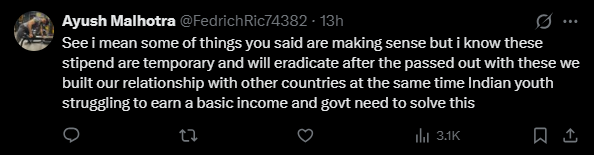
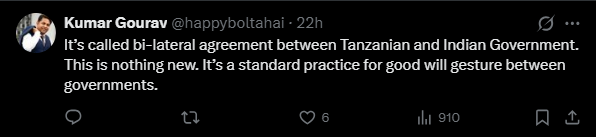
Several users, however, pushed back against the criticism, arguing that government-funded scholarships for foreign students can form part of bilateral agreements and international education initiatives.
One user described such arrangements as part of bilateral cooperation between India and Tanzania. Others pointed to international student-exchange programmes and questioned whether similar criticism should be directed at Indian students who receive scholarships or financial assistance while studying abroad.
The Erasmus Mundus scholarship was also cited as an example of an international programme through which Indian students have benefited.
ICCR Scholarships Enter The Discussion
The debate also turned to how foreign students studying in India are funded.
Some users pointed to the Indian Council for Cultural Relations (ICCR), which facilitates scholarship programmes for international students. Commenters claimed that students can receive stipends to cover living expenses, although the amount and benefits can vary depending on the specific scholarship programme.
The discussion highlighted that such programmes are not necessarily limited to providing financial assistance. International scholarships can also be used to deepen educational, cultural and diplomatic links between countries.
Are Foreign Scholarships An Investment In Diplomacy?
Supporters of the programmes argue that students who study in India may return to their home countries with professional networks, familiarity with Indian institutions and a stronger understanding of Indian society.
Over time, such connections can contribute to goodwill and broader diplomatic, cultural and economic relationships.
Critics, meanwhile, believe the government should first address gaps in India's own higher education system before allocating taxpayer-funded resources to international students.
A Bigger Question About Public Spending
What began with a student discussing his stipend on India’s Got Latent has now evolved into a broader debate over international scholarships, taxpayer money and India’s diplomatic interests.
At the centre of the argument is a larger question: Should India’s foreign-student scholarship programmes be viewed primarily as education spending or as an investment in long-term international relations?
The debate also raises questions about how these programmes are structured, how much they cost the government and what measurable benefits India gains from them.


