‘When will luxury brands stop colonising Indian crafts?’: Harsh Goenka, Kiran Mazumdar-Shaw Slam Fendi over ₹9.5 Lakh ‘Navratri’ Bag

Summarized by AI; it may make mistakes. Check important info
Summarized by AI; it may make mistakes. Check important info

Italian luxury fashion house Fendi has found itself at the centre of an intense online storm after launching an embroidered handbag priced at ₹9.5 lakh that closely resembles traditional Gujarati street craft, prompting sharp reactions from top corporate leaders in India.
RPG Group Chairman Harsh Goenka and Biocon Chairperson Kiran Mazumdar-Shaw publicly called out the brand over cultural appropriation and the absence of credit to Indian artisans for a design routinely sold across local bazaars during festive seasons for roughly ₹500.
Corporate India Calls Out Cultural Erasure
The controversy erupted after Harsh Goenka shared an image of the heavily decorated piece on social media platform X, drawing direct parallels to previous instances where Western fashion houses commodified regional Indian attire without attribution.
"After the Prada Kolhapuri chappal scandal, here comes the Fendi 'Navratri' bag," Goenka wrote. "Charging ₹8.3 Lakhs for a design that looks exactly like a ₹500 bag available in the streets of Gujarat. And zero credit to Indian artisans. When will luxury brands stop colonising our crafts?"
Echoing these concerns, Biocon founder Kiran Mazumdar-Shaw emphasised that repackaging heritage techniques as proprietary European luxury undermines local craftspeople.
"This is a case of cultural appropriation and not in good taste," Mazumdar-Shaw posted in response. "Repackaging India's traditional craft as luxury, without credit to the artisans who created and preserved it, undermines our authentic talent and heritage. Indian craftsmanship deserves recognition, not imitation."
The Detail Behind the ₹9.5 Lakh Price Tag
Listed on Fendi's international portal as the 'Baguette 26424: Multicolour Re Edition bag', the item forms part of the label's Fall/Winter 2026-27 showcase. The luxury house describes it as a re-creation of an archival 1997 silhouette, highlighting the following product details:
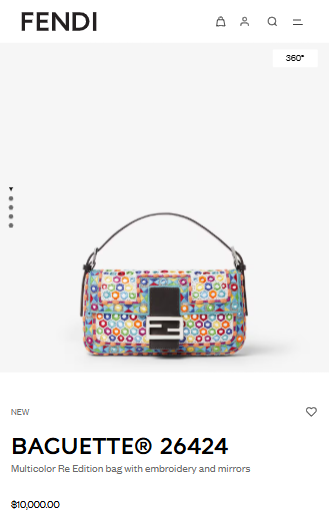
- Embellishment: The exterior incorporates 39,500 individual beads alongside 475 tiny reflective mirrors set into hand-embroidered silk.
- Labour Requirement: Official specifications claim the piece requires upwards of 138 hours of artisan handiwork.
- Assembly: While listed on the brand portal as "Made in Italy", industry reports indicate that physical production was handled through Chanakya, a specialized embroidery atelier based in Mumbai.
- Hardware: Features dark brown calfskin straps, an adjustable handle, and palladium-finish signature FF buckles.
Despite relying on techniques distinct to Indian mirror-work (shisha embroidery) and beadwork, the digital listing makes no explicit reference to Indian heritage or traditional design origins.
Pattern of High-Fashion Exploitation
The fallout over Fendi follows a string of similar disputes involving European luxury labels adopting traditional Indian garments and footwear without contextual acknowledgement.
Prada previously faced severe public pushback for showcasing footwear virtually identical to Maharashtra's traditional Kolhapuri chappals without citing their geographical heritage, a backlash that later forced the Italian brand to update its official documentation with historical context.
Similarly, Christian Dior and Ralph Lauren have drawn criticism for using Lucknowi mukaish and zardozi threadwork while branding the finished products under European origin labels.
Social media users expressed outrage at the retail markup, with many noting that without the metal logo buckle, the underlying handicraft remains readily accessible in domestic markets across Ahmedabad and Surat at a fraction of the price.
The incident has renewed calls among industry leaders for strict intellectual property protection and formal attribution standards for traditional Indian crafts on the global stage.