




Waqf (Amendment) Bill in Lok Sabha Live: Shah alleges UPA for ‘turning Waqf into a land-grabbing machine’
Updated: Apr 2nd, 2025


Amit Shah counterpunches
Union Home Minister Amit Shah, during the debate on the Waqf (Amendment) Bill in the Lok Sabha on Wednesday, presented a lengthy list of properties he claimed were donated to Waqf. This list included land belonging to temples, other religions, the government, and others.
The Home Minister asserted, “You cannot donate someone else’s property. You donate something which is yours.”
He also noted: “Properties in (Delhi’s) Lutyens zone went to Waqf, and they started taking over government land... In Tamil Nadu, a 400-year-old temple property was declared as Waqf property. Land for a five-star establishment was given to Waqf for Rs 12,000 a month... Several properties belonging to different religions were declared as Waqf property, including Chandra Shekhar Azad Park in Prayagraj.”
“This bill will protect property. Like ASI property, Tribal land, private property, and for Waqf, you can only donate private, personal property and not the land of the community (village). This bill will bring transparency,” he stated.
Amit Shah slammed the UPA government for changing Waqf rules just before the 2014 general election. He described it as another instance of “politics of appeasement” and stated, “In 2013, they (the Congress-led government) wiped out the provision to take land-grabbing complaints to court. They sinned. The new bill will not come in retrospective effect but they are trying to scare the people.”
“We got over 1 crore suggestions from people... Our principle is clear, we won’t bring any law for vote bank, it’s for justice,” he said.
Opposition argues
Gaurav Gogoi, Congress MP and Deputy leader of opposition in Lok Sabha, said the bill is to dilute, defame, divide and disenfranchise.
Read all the arguments presented by Gogoi here: Gaurav Gogoi calls Waqf Amendment an ‘attack’ on Constitution
Celebrations in Bhopal
A large number of Muslims in Madhya Pradesh's capital, Bhopal, burst firecrackers on Wednesday to express their support for the Waqf (Amendment) Bill, which was presented in the Lok Sabha earlier in the day.
People from various organizations and groups, including women and children, gathered at a central location in the city to welcome the central government's decision to introduce the Bill. Many were seen holding posters, placards, and banners supporting the Waqf (Amendment) Bill and Prime Minister Narendra Modi.
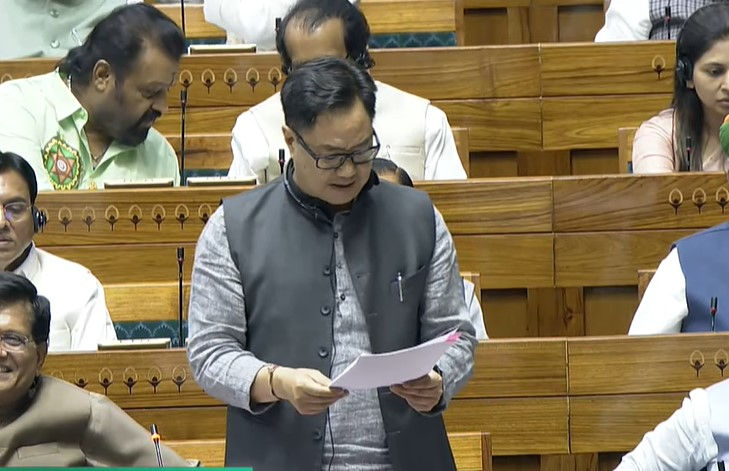
Rijiju slams UPA for making provisions 'overriding' other laws
Minister Kiren Rijiju on Wednesday bashed the previous UPA government for de-notifying 123 properties and handing them over to the Delhi Waqf Board. Defending the necessity of the Waqf (Amendment) Bill, he said that without this legislation, even the Parliament premises could have been claimed as Waqf property.
He proposed to repeal Section 40 of the 1995 Act, as it gives the boards power to decide on a property.
Calling the section the most draconian law, Rijiju said this has now been done away with.
“It gave the power to Waqf Boards to declare any property as its own. Now, it will no longer be the case,” he pointed out.
Section 40 allowed the Waqf Board to declare any property as Waqf. Once a property was designated as Waqf, ownership was transferred from the individual to the board, rendering it almost irrevocable. The irrevocability has led to various disputes, including the Bengaluru Eidgah ground, claimed as Waqf property, and the Surat Municipal Corporation building, which is claimed due to its historical use as a 'sarai' during the Mughal era.
As Section 40 led to disputes, one could challenge them before a Waqf Tribunal, whose decision was final, and courts could do nothing. This grave anomaly will be removed in the new Act after the amendments get ratified by Parliament.
The new amendments in the Bill facilitate appeal in higher courts if the concerned party is not satisfied with the Waqf Tribunal decision. Appeals can be filed in the high court within 90 days, and the district collector will verify the genuineness of registration applications.
An eight-hour discussion on the bill, subject to an increase, is scheduled.
The Opposition claimed that the Centre is “bulldozing the legislation” as it alleged to not be given the time for amendments since the bill was brought to the notice of the House.
Earlier in the day, Rijiju called Wednesday a “historic day” as the Waqf Amendment Bill 2025 was set to be introduced in the Lok Sabha.
Rijiju emphasised that the Bill, which aims to amend the Waqf Act of 1995, is in the national interest and will benefit the entire country, especially Muslims, women, and children.
Speaking to the media ahead of the parliamentary proceedings, Rijiju stated, “Today is a historic day, as the Waqf Amendment Bill 2025 will be presented in the Lok Sabha. I want to make it very clear that this bill, introduced in the national interest, will be supported not only by millions of Muslims but by the entire country. We are committed to any initiative that benefits the nation, especially for the welfare of poor Muslims, women, and children. Those opposing the bill are doing so for political reasons. I will present the rest of my arguments in the House.”
The Waqf Amendment Bill is designed to amend the Waqf Act of 1995 to address existing challenges and improve the management of Waqf properties in India.
The Bill aims to streamline the Waqf Board’s functions, ensuring the efficient administration of these properties.
The Union government first announced the introduction of the Waqf (Amendment) Bill 2025 on Tuesday, revealing that the Bill would be tabled in the Lok Sabha shortly after the Question Hour. The Bill will be followed by a detailed debate lasting up to eight hours.
This Bill builds on the 2024 Waqf (Amendment) Bill and the Mussalman Waqf (Repeal) Bill, which were introduced with similar objectives to improve the functioning of the Waqf Board and address ongoing management issues.
The government is hopeful that the amendments in legislation will pass with wide support across the political spectrum.
(With inputs from Syndicated feed)
