

THE INVISIBLE 'FOREIGN HAND': How The Ruling Party Uses Geopolitical Trash-Talk To Fizzle Out Dissent on Election Commission, SIR and Gyanesh Kumar

Summarized by AI; it may make mistakes. Check important info
Summarized by AI; it may make mistakes. Check important info

Ahmedabad: When a government faces uncomfortable domestic accountability, nothing works quite as efficiently as pulling out the old "Foreign Hand" playbook. Facing a mounting opposition wave demanding the resignation of Chief Election Commissioner Gyanesh Kumar over alleged electoral roll discrepancies, the ruling establishment and its ideological apparatus have hit the panic button—and their go-to narrative pivot is as predictable as it is disingenuous.
Rather than answering substantive questions about voter list management, ministers and mouthpiece publications like Organiser have launched a coordinated deflection campaign: branding critics "anti-national" and spinning a conspiracy theory that protests against the Election Commission of India (ECI) are a CIA-backed deep-state plot.
It is a masterclass in political distraction—one that relies on confusing unrelated international news to manufacture a national security crisis out of routine democratic opposition.
The Reality Behind Donald Trump's "Praise"
The cornerstone of the ruling party's attempt to paint ECI critics as foreign agents relies on a conflated sequence of events.
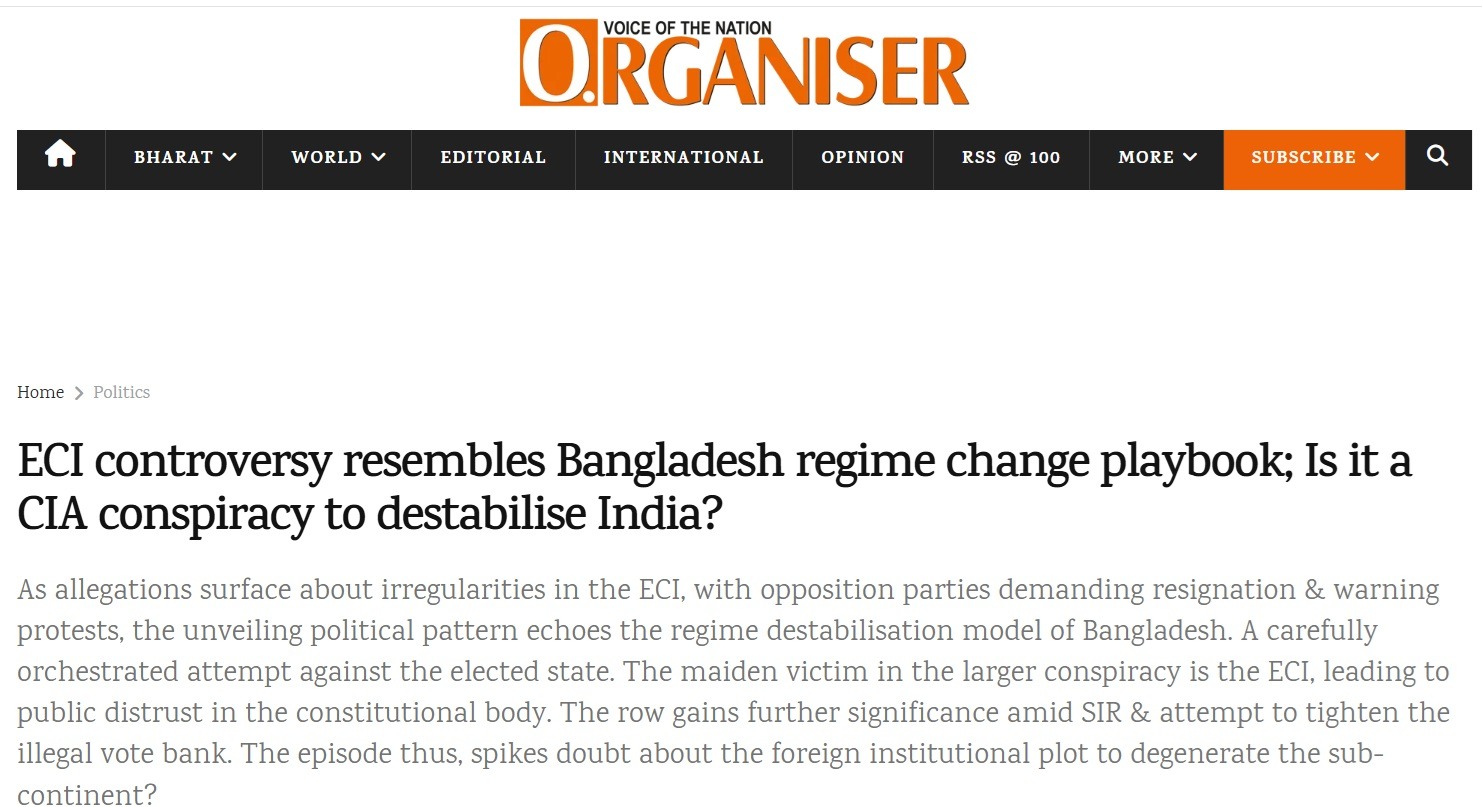
When Donald Trump took to social media to praise India's voter identification model and cite CEC Gyanesh Kumar, he was not launching an endorsement of the ruling party, nor was he interfering in Indian domestic politics. Trump was pursuing purely transactional U.S. domestic interests. He weaponized India's strict voter-ID rules and low reliance on mail-in ballots as a convenient talking point to push his own domestic legislation—the "SAVE America Act"—in the U.S. Congress.
Washington is indifferent to the administrative fate of Gyanesh Kumar or the internal squabbles over Indian polling machinery. The idea that the CIA is secretly orchestrating street protests against the ECI on one hand, while the U.S. President is simultaneously praising the same ECI on the other, is an ideological fantasy that collapses under the mildest logical scrutiny.
The Mechanics of Deflection: Terming Dissent as "Anti-National"
When political parties run out of procedural arguments to defend public officials, the quickest exit ramp is delegitimization.
By labelling demands for Gyanesh Kumar's resignation as an "attack on the nation" orchestrated by external intelligence agencies, the ruling party achieves three immediate tactical goals:
1. Shifting the Burden of Proof: The conversation instantly moves away from voter roll auditing, administrative transparency, or constitutional duties to high-strung debates on patriotism and national defense.
2. Vilifying the Opposition: Opposition leaders exercising their constitutional right to question state authorities are conveniently framed not as political rivals, but as witting or unwitting instruments of foreign destabilization.
3. Insulating Public Officials from Scrutiny: It places the Election Commission—a body meant to serve the citizens, not the executive—behind a shield of national security paranoia, treating legitimate public questioning as treason.
Democracy Demands Accountability, Not Paranoia
Democracy does not weaken when citizens or political parties question state institutions; it weakens when those institutions are declared above critique.
Attempting to weaponize random foreign social media posts by leaders like Trump, while fabricating tales of CIA conspiracies to shield the Chief Election Commissioner, is an insult to the intelligence of the electorate.
The ruling party's minister and its ideological media would do well to remember that questioning an administrator's conduct is standard democratic practice—not a foreign plot. Crying "anti-national" every time a constitutional authority is called to account doesn't protect Indian democracy; it simply exposes a government running scared of straightforward questions.


