




PM Modi dedicates 'Operation Sindoor' to women of India in his first speech after India's strike
Updated: May 12th, 2025


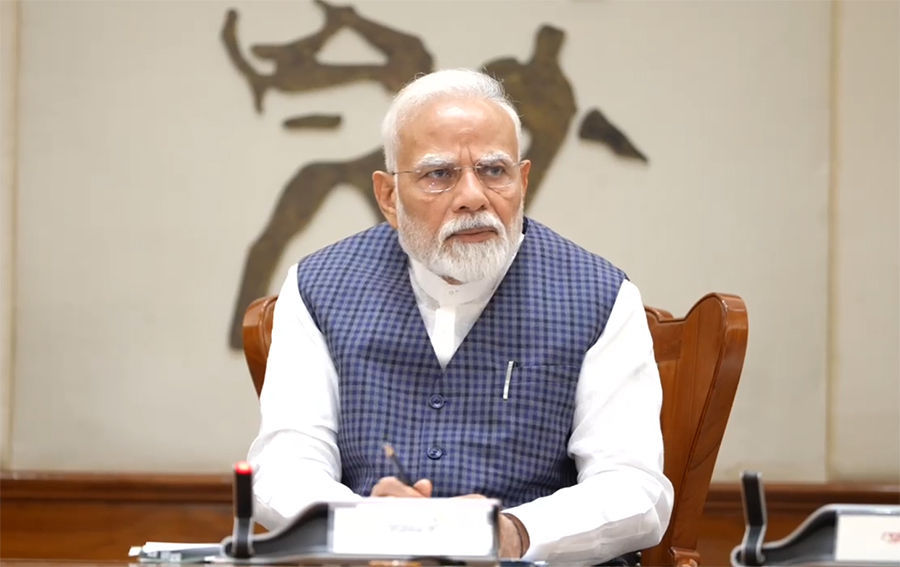
Calling the Pahalgam terror attack a personal tragedy, Prime Minister Narendra Modi on Monday dedicated the bravery and courage of the armed forces involved in Operation Sindoor to every mother, sister and daughter of the nation.
Addressing the nation, PM Modi said: “Now every terror group knows the cost of targeting sindoor (vermilion) of Indian women.”
He said the attack was a personal tragedy which saddened him a lot.
“I salute the grit of the armed forces, intelligence agencies and scientists for their grit that helped Operation Sindoor achieve its objective,” he said.
Indicating to suspended Indus Water Treaty with Pakistan, he said, ”Terror and Talks can’t go together, Terror and Trade cannot work together, Water and Blood can't flow together...”
Calling Pakistan a living example of state-sponsored terrorism, Prime Minister Narendra Modi on Monday outlined the new normal in the country’s tough anti-terror policy that is committed to strong response irrespective of 'nuclear blackmail', reminding that is not an ‘era of terror’ just as it is not an ‘era of war’.
In a special video address to the nation, PM Modi sent a strong warning to Pakistan, saying: “Terror and talk, terror and trade and water and blood cannot flow together. Talks with Pakistan will only be held on terror.”
Referring to Buddha Purnima being observed on Monday, he said the day signifies peace, but India will not hesitate from using its strength to establish peace.
He saluted the armed forces and said the government could take strong decisions because of its policy of “Nation First”.
Warning that Pakistan will be destroyed by its own terror infrastructure, the Prime Minister said that "we struck terror hubs in the heart of that country and also destroyed its defence facilities when it attacked us instead of joining our war against terror that eliminated 100 terrorists".
Earlier in the day, PM Modi chaired a high-level meeting with top government functionaries, including Defence Minister Rajnath Singh, External Affairs Minister S. Jaishankar, and NSA Ajit Doval.
India also reiterated that 'Operation Sindoor' was a targeted response against terrorism and its support infrastructure, lamenting that Pakistan chose to stand with terrorists rather than remain neutral, prompting a necessary military retaliation.
"We have also reiterated that our fight was against terrorism and their support infrastructure and not with the Pakistan military. However, it is a pity that the Pakistani military chose to intervene and that, too, for terrorists, which compelled us to respond," said Air Marshal A.K. Bharti, Director General Air Operations, during a joint DGMO Press briefing.
He clarified that India's strikes on May 7 targeted only terrorist hideouts, but Pakistan's direct military support to the terrorists turned the situation into an unavoidable confrontation.
Earlier, the meeting that took place at the Prime Minister’s residence in the national Capital was attended by Defence Minister Rajnath Singh, Chief of Defence Staff General Anil Chauhan and all three service chiefs - General Upendra Dwivedi, Admiral Dinesh K. Tripathi and Air Chief Marshal Amar Preet Singh.
Foreign Secretary Vikram Misri, Intelligence Bureau (IB) Director Tapan Deka, and Research and Analysis Wing (R&AW) chief Ravi Sinha were also in the meeting.
The high-level meeting came two days after India and Pakistan arrived at an understanding for a ceasefire. The ceasefire was sought by Pakistan after facing massive airstrikes by the Indian Air Force that destroyed 11 of its airbases.
On Sunday, PM Modi gave clear directions to the Armed Forces to respond to cross-border firing and shelling with full force during a similar high-level meeting.
The tensions rose after Pakistan-supported terrorists killed 26 people in Jammu and Kashmir’s Pahalgam on April 22. India avenged the deaths by carrying out airstrikes on nine terror bases in Pakistan on May 7, in which more than 100 terrorists were killed.
In retaliation, the Pakistani Army launched drones and missiles at western parts of India, which were successfully intercepted by the Indian armed forces. Following the drone raid, the IAF carried out a massive 90-minute operation in which 11 airbases were struck. Most of these airbases are vital for Pakistan.
A rattled Pakistan then sought de-escalation. On the advice of the US, India reached an understanding with Pakistan on a ceasefire on Saturday afternoon. The understanding was to halt military actions with immediate effect, which came after four days of intense cross-border drone and missile strikes.
Following the de-escalation, no adverse incident was reported during the Sunday-Monday night in Jammu and Kashmir and the rest of the western border. The authorities have also decided to reopen 32 airports that were shut for civil flight operations following the tension.
(with inputs from syndicated feed)
