




Pilots’ body flags electrical cause in Air India crash, seeks fresh technical probe
Updated: May 6th, 2026


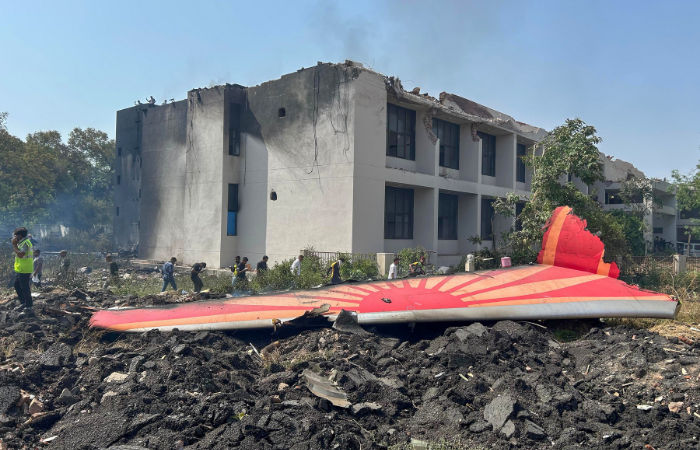
The Federation of Indian Pilots (FIP) has written to the Civil Aviation Ministry, proposing a new technical hypothesis in the investigation of the Air India AI171 accident of June 12, 2025, in Ahmedabad, suggesting that an electrical failure, not pilot action, may have led to the dual engine fuel cut-off.
In a detailed technical note dated May 1, 2026, addressed to the Ministry of Civil Aviation, the pilots’ body urged authorities to examine what it calls a ‘credible cause’ involving an electrical reverse voltage pathway triggered by a battery short circuit.
RAT deployment points to pre-lift-off issue
FIP said that security camera images from Ahmedabad airport show that the Ram Air Turbine (RAT) was deployed during the take-off roll, indicating a technical malfunction even before the aircraft became airborne.
The letter argues that manual RAT deployment is unlikely, as the system is automatic and protected by guarded controls. It also questioned media reports suggesting pilot action, stating that under ICAO Annex 13 norms, all technical causes must be ruled out before attributing human error.
Electrical disturbance could affect both engines
According to the technical explanation provided, aircraft DC systems rely on stable positive supply and ground return. Any disturbance in this balance can trigger abnormal system behaviour.
Citing OEM documentation from Hamilton Sundstrand for the Boeing 787, FIP noted that RAT deployment occurs following loss of power to critical systems such as:
- Captain and first officer instrument buses
- C1 or C2 transformer rectifier units (TRUs)
Once deployed, the RAT connects both instrument buses through transfer contactors, effectively creating a common electrical return path.
Battery failure and reverse voltage theory
The pilots’ body highlighted past investigations into Boeing 787 battery failures by agencies such as the Japan Transport Safety Board and the US National Transportation Safety Board, which documented electrical arcing, high current flow (44–45 amperes), and resistive heating.
FIP explained that in such a scenario:
- High current through a resistive path can raise ground voltage
- A battery short circuit could lead to reverse voltage across relay coils
- The aircraft’s dual-coil latching relays, which control fuel shutoff systems, may switch position under reverse voltage
Quoting aerospace relay manufacturer Leach International, the note states that relays may transfer position even under reverse voltage conditions.
Possible trigger for dual engine fuel cut-off
FIP argues that with a shared return path after RAT deployment, such reverse voltage could energise the cut-off mechanism, shutting the spar valves and leading to near-simultaneous switching of both engines from RUN to CUTOFF without pilot input.
Timeline raises further questions
The technical note also points to a 4-second gap between the reported fuel cut-off at approximately 08:08:43 UTC and RAT hydraulic power at 08:08:47 UTC, as per the preliminary report by the Aircraft Accident Investigation Bureau (AAIB).
Since RAT deployment typically takes around 6 seconds to supply hydraulic power, FIP argues that it must have deployed earlier, consistent with the take-off roll images.
Call for independent technical examination
FIP has requested that the hypothesis be treated as a testable technical scenario and examined through detailed electrical analysis by institutions such as:
- IIT Bombay
- Aeronautical Development Agency (ADA)
- Hindustan Aeronautics Limited (HAL)
The body has also reiterated its earlier demand for verification of timing data through a Boeing 787 simulator session, stating that technical causes cannot be ruled out without thorough analysis.
“Do not rule out technical causes yet”
Concluding the note, FIP President Capt C S Randhawa said that based on lithium-ion battery behaviour, relay response under abnormal voltage, and Boeing 787 system design, a pre-lift-off electrical disturbance remains a plausible explanation for the accident.
