

Pannun Lawsuit: US Judge Clears Delhi Route to Serve NSA Ajit Doval And ex-RAW Chief Samant Goel

Summarized by AI; it may make mistakes. Check important info
Summarized by AI; it may make mistakes. Check important info

A federal court in New York has given Khalistani separatist Gurpatwant Singh Pannun a new way to reach National Security Adviser Ajit Doval and former Research and Analysis Wing (RAW) chief Samant Goel. It has allowed him to serve his civil lawsuit on them through courts in India. Pannun has been trying to deliver the papers for more than two years.
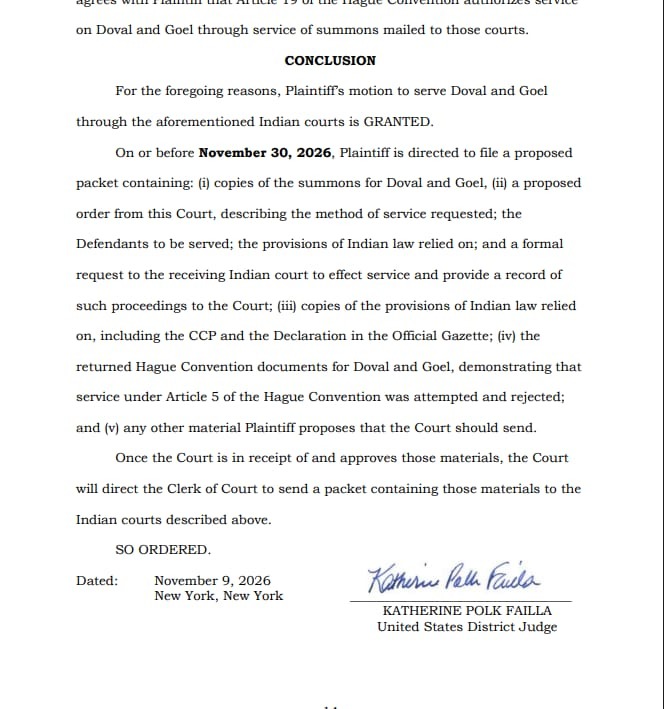
US District Judge Katherine Polk Failla of the Southern District of New York signed the order on 9 November. "Plaintiff's motion to serve Doval and Goel through the aforementioned Indian courts is GRANTED," she wrote.
The judge accepted Pannun's argument that Article 19 of the Hague Service Convention allows the summons to be sent to Indian courts for service. The order records that Pannun first tried the Convention's usual channel, service through India's designated Central Authority under Article 5, and that this attempt was rejected.
A 30 November deadline
The summons will not go out straight away. Pannun has until 30 November to file a packet for the court's approval. It must contain:
- the summons for Doval and Goel
- a proposed order setting out the method of service, the defendants and the Indian law relied on
- a formal request asking the Indian court to carry out service and report back
- copies of the relevant Indian law, including the Code of Civil Procedure (CPC) and a declaration published in the Official Gazette
- the returned Hague Convention papers showing that the earlier attempt failed
Once Judge Failla approves the packet, the Clerk of Court will send it to the courts in India.
The order refers to the CPC and a Gazette declaration. That points to Section 29 of the CPC, which lets Indian courts serve summonses issued by notified foreign courts as if they were their own. A 2009 Law Ministry notification extended this to civil courts in every country that is party to the Hague Service Convention, including the United States.
What the order means for Doval
The ruling deals only with procedure. It says nothing about whether Pannun's allegations are true, and it does not require Doval to appear in court. Doval faces no criminal charge in the United States, and American prosecutors have not accused him of wrongdoing.
What the order does change is how the case can move. Pannun no longer has to wait for the NSA to land on American soil. Much now depends on whether the courts in Delhi act on the request. If the papers are served, Doval and Goel will have to answer the New York suit or risk a default judgment for damages.
If they do answer, the officials and the Indian government could argue that they are immune from suit because the claims concern acts carried out in an official capacity. The New York court has yet to rule on that question.
The Blair House episode
Pannun's last attempt ended outside a Starbucks. In February 2025, Doval was in Washington with Prime Minister Narendra Modi and staying at Blair House, the US President's guest house. Pannun hired process servers to hand him the papers there. According to Pannun's court filings, Secret Service agents stopped them at a checkpoint and refused to accept anything. One server finally left the envelope at a nearby coffee shop and asked the agents to pass it on.
Judge Failla was not convinced. In a ruling on 3 March 2025, she held that service had not been completed because the papers never reached hotel staff or the security officers named in her earlier order.
How the case began
Pannun holds US and Canadian citizenship and is general counsel of Sikhs for Justice (SFJ). He filed the civil suit in September 2024. It names the Government of India, Doval, Goel, former RAW officer Vikash Yadav (listed in the suit as "Vikram Yadav") and Indian national Nikhil Gupta. It alleges that Doval and Goel approved a plot to kill him on American soil and seeks compensation from all five.
The lawsuit draws on a US criminal case. In November 2023, American prosecutors announced that they had foiled a plot to assassinate Pannun in New York. Gupta was arrested in Prague on 30 June 2023 at Washington's request and extradited to the US in June 2024. Prosecutors say he agreed to pay $100,000 for the killing and passed on surveillance photographs of the target. The "hitman" he hired was an undercover officer of the US Drug Enforcement Administration.
In October 2024, the US Justice Department named Yadav as "CC-1", the government employee who allegedly directed the plot. The Ministry of External Affairs said the person named in the indictment no longer worked for the Government of India. The FBI lists Yadav as wanted.
Gupta pleaded guilty in February 2026 to murder-for-hire, conspiracy to commit murder-for-hire and conspiracy to commit money laundering. His sentencing has been postponed several times and is now set for 20 November before Judge Victor Marrero. The last delay came after prosecutors told the court that Pannun wanted to take part in the hearing.
New Delhi's stand
India has rejected the suit from the start. When the summons was first issued in September 2024, Foreign Secretary Vikram Misri called the claims "completely unwarranted and unsubstantiated imputations". He said SFJ had been banned for "anti-national and subversive activities aimed at disrupting the sovereignty and territorial integrity of India". The Centre designated Pannun a terrorist under the Unlawful Activities (Prevention) Act in 2020.


