





Odd-even scheme works as an effective emergency measure: Delhi govt to SC
Today, the issue of worsening air quality of Delhi and adjoining areas will be taken up for hearing by the Supreme Court
Updated: Nov 10th, 2023


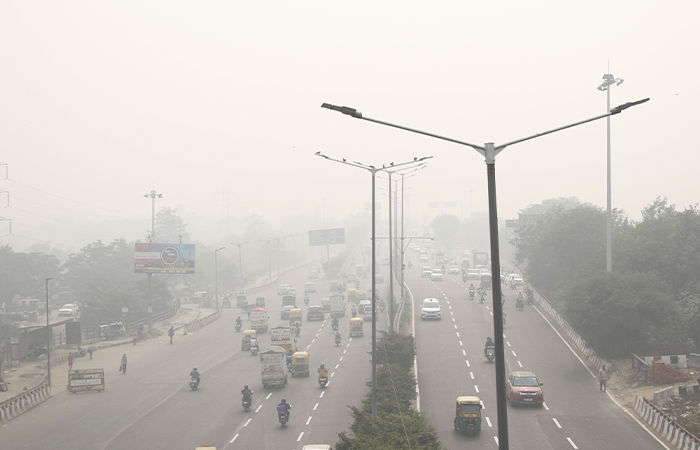 |
| Delhi Air Quality (img: IANS) |
The Delhi government has told the Supreme Court that the national capital’s odd-even scheme works as an “effective emergency measure” to control air pollution.
It said that the Delhi Integrated Multi-Modal Transit System (DIMTS) conducted a Traffic Impact Assessment of odd-even scheme during November 4 -15, 2019 and found that 30% personal car traffic was reduced on road.
“However, there was an increase of 6.5% in two-wheeler traffic, 19.5% in taxi, 7.5% in auto and 4.7% in buses,” it added.
The national capital’s government told the apex court that due to reduction in traffic, average speed on roads increased between 2% to 15% on various major roads in Delhi.
“36% of people shifted from car to metro, bus, two-wheelers, taxi and auto modes during odd-even scheme,” it said, placing reliance upon opinion surveys conducted as a part of study.
The overall analysis suggests that nearly half (46%) of the users want the scheme to be implemented permanently followed by 32% people suggesting implantation of the scheme during high pollution days only, it added.
Further, the Supreme Court was apprised that there was about an estimated 15% decrease in fuel consumption on average day during the odd-even scheme implementation.
The odd-even drive scheme broadly indicated a positive impact in reduction of the air pollution contributed by the vehicles, besides reduction of congestion on Delhi roads as well as increase in share of public transport, added the Delhi government.
It has also relied upon findings of two independent and scientific evaluations carried by globally reputed institutions in the first two implementations of odd-even scheme during Jan 1-15, 2016 and Apr 15-30, 2016.
One of the analyses conducted by researchers affiliated with -- Energy Policy Institute at the University of Chicago, Centre for Policy Research and Harvard Kennedy School -- found that PM 2.5 levels were lower by 13% on average during 8 a.m. - 8 p.m. during the odd-even scheme in Jan 2016.
Another impact evaluation conducted by researchers of IIT-Delhi and Kanpur amongst others concluded that the traffic restriction between January 1-15 in 2016 reduced PM 2.5 by 4-6% with a maximum of up to 10%, primarily at three local hotspots in Delhi.
The issue of worsening air quality of Delhi and adjoining areas will be taken up for hearing by the Supreme Court today.
(Source: IANS)
- Edited for style