





Moving around moon, India’s moon rover leaving its imprint on lunar soil
The rover’s and lander’s solar panels have been deployed
Updated: Aug 24th, 2023


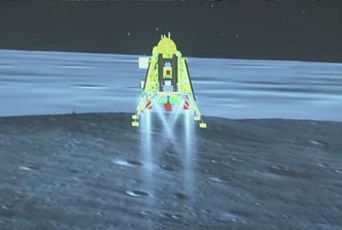
India’s moon rover is now also on the moon, moving around and leaving its imprint on the soil, said a senior official of the Indian space agency.
“The rover rolled down onto the moon surface from the lander sometime around 12.30 a.m. today. It is moving around. It is leaving its imprint on the moon’s surface,” said Dr S Unnikrishnan Nair, director, Vikram Sarabhai Space Centre (VSSC).
The logo of the Indian Space Research Organisation (ISRO) and the national emblem have been engraved on the wheels of the rover to leave the imprint when it moves around.
According to Unnikrishnan, the rover’s and lander’s solar panels have been deployed.
He said the rover will collect samples of the moon, do the experiments and send the data to the lander.
India’s moon lander that safely landed on the lunar surface on the evening of Aug 23 will pass on the message to the Mission Operations Complex at ISRO Telemetry, Tracking and Command Network (ISTRAC), Bengaluru.
Queried whether the lander has landed at the planned site or was there any variation Unnikrishnan said as per the current data available, everything has gone as per plans.“We have to do a post-flight assessment to know further,” Unnikrishnan said.
The moon lander and the rover are part of the ₹600 cr Chandrayaan-3 mission.
The Chandrayaan-3 spacecraft comprises a propulsion module (weighing 2,148 kg), a lander (1,723.89 kg) and a rover (26 kg).
According to the ISRO, the moon rover has Alpha Particle X-ray Spectrometer (APXS) and Laser Induced Breakdown Spectroscope (LIBS) for deriving the elemental composition in the vicinity of the landing site.
On its part, the lander too will carry out the tasks assigned to it with its payloads: Chandra’s Surface Thermophysical Experiment (ChaSTE) to measure the thermal conductivity and temperature; Instrument for Lunar Seismic Activity (ILSA) for measuring the seismicity around the landing site; Langmuir Probe (LP) to estimate the plasma density and its variations. A passive Laser Retroreflector Array from NASA is accommodated for lunar laser ranging studies.
The mission life of the lander and the rover is 1 Lunar day or 14 Earth days, ISRO said.
The propulsion module has a Spectro-polarimetry of Habitable Planet Earth (SHAPE) payload to study the spectral and Polari metric measurements of Earth from the lunar orbit.
The life of the payload carried by the propulsion module post-ejection of the lander is between three and six months.
Meanwhile, ISRO took to X and said: “Chandrayaan-3 ROVER: Made in India Made for the MOON! The Ch-3 Rover ramped down from the Lander and India took a walk on the moon!”
Source: IANS
-Edited for style
For more such updates and news on the go, follow us on