




Bills to remove ministers in custody spark chaos in Parliament, referred to joint parliamentary committee
Updated: Aug 20th, 2025


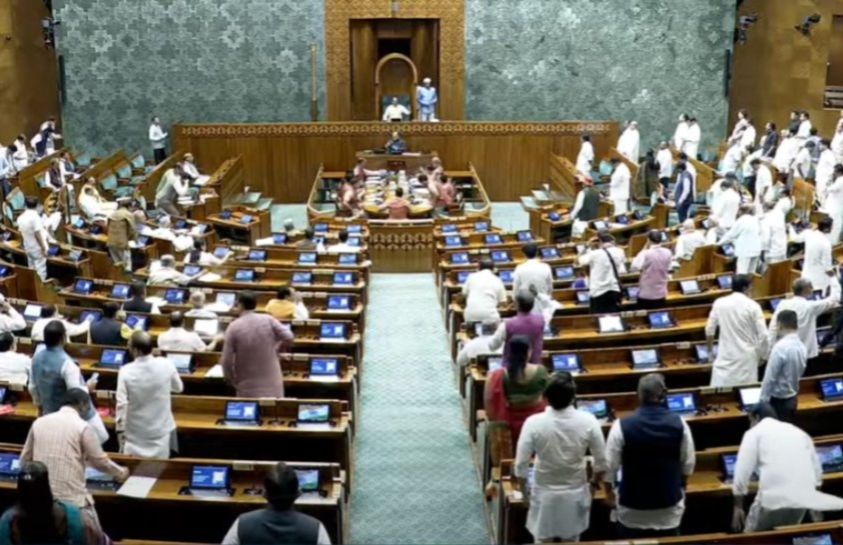
Union Home Minister Amit Shah introduced three significant and contentious bills in the Lok Sabha on Wednesday, triggering a storm of debate and opposition across party lines.
The bill, along with the Government of Union Territories (Amendment) Bill, 2025 and the Jammu and Kashmir Reorganisation (Amendment) Bill, 2025, was referred to a Joint Parliamentary Committee following a voice vote.
The committee is expected to submit its report by the first week of the next session.
The bills propose amendments to Articles 75, 164, and 239AA of the Constitution, as well as changes to the Government of Union Territories Act, 1963, and the Jammu and Kashmir Reorganisation Act, 2019.
They aim to uphold constitutional morality and public trust by mandating the automatic removal of ministers held in custody for serious offences punishable by five years or more.
However, the introduction was met with fierce resistance. AIMIM MP Asaduddin Owaisi called the bills “destructive to the basic structure of the Constitution”, arguing that they undermine the principle of presumption of innocence and distort parliamentary democracy.
“This bill makes the investigating officer more powerful than the Prime Minister,” he said, warning of potential political misuse and erosion of constitutional safeguards.
Manish Tewari of Congress opposed the bills, stating that they violate the basic structure of the Constitution and open the door for political misuse.
M L Premchandran of the Revolutionary Socialist Party questioned the urgency of introducing such sensitive legislation, while Congress member K.C. Venugopal raised concerns about federal overreach and the implications for state autonomy.
In response, Amit Shah defended the bills as necessary reforms to ensure accountability and integrity in public office.
He reiterated that members have the right to oppose the bills at the time of introduction and assured that the Joint Parliamentary Committee would thoroughly examine all aspects before final passage.
Meanwhile, little could be heard of the exchanges between the Opposition members, Speaker Birla, and Home Minister Shah, as other Opposition MPs continued shouting slogans and holding placards.
The Speaker adjourned the House till 3 p.m. The bills have ignited a broader debate on the balance between anti-corruption measures and constitutional protections, setting the stage for a politically charged review in the coming weeks.
(This story was taken from syndicated feed and was only edited for style by Gujarat Samachar Digital team)
