





Chandrayaan-3's moon-landing on Aug 27 if not on Aug 23: ISRO
Updated: Aug 21st, 2023


|
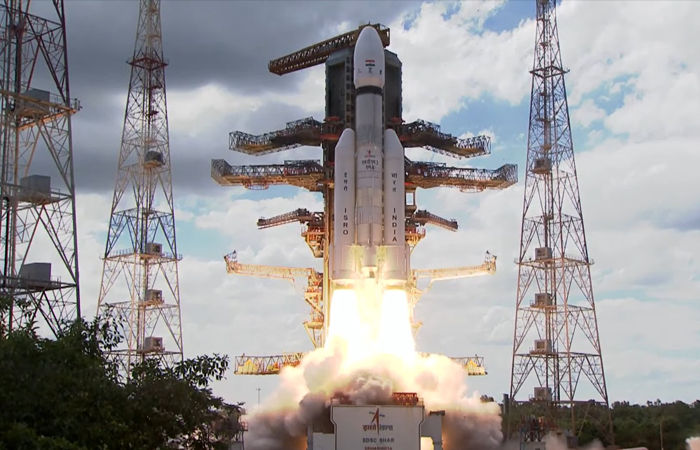
The three-stage LVM3 rocket blasted off Chandrayaan-3 on July 14 from the second launch pad at Satish Dhawan Space Centre at Sriharikota rocket port Andhra Pradesh. Now the lander carried by the spacecraft is expected to make a soft landing on the moon on Aug 23.
Updated on Aug 21, 8.45 p.m.
Moon Landing on Aug 27 if conditions seem unfit on Aug 23
ISRO-Ahmedabad's director of the space applications centre, Nilesh M Desai, stated that ISRO will take stock of the condition of the landing site on the moon and the lander as well, two hours before landing Chandrayaan-3.
He further added that ISRO will then decide according to the conditions. If the lander or moon conditions are deemed unfit on Aug 23, ISRO will extend the landing date to Aug 27. However, their priority would be to achieve the moon landing on Aug 23.
Updated on Aug 20, 1.50 p.m.
Chandrayaan-3 completes final deboosting op; all set for moon-landing on Aug 23
India’s moon lander is all set to make a landing on the lunar soil on August 23, 2023 evening as the final deboosting operation got over in today's wee hours, informed Indian Space Research Organisation (ISRO).
The orbit of 25 x 134 km was achieved at 1.50 a.m. today.
Updated on Aug 17, 3.15 p.m.
India's Vikram moon lander separates from Chandrayaan-3 spacecraft
The Indian space agency today afternoon successfully detached the moon lander from the main spacecraft Chandrayaan-3.
The Chandrayaan-3 spacecraft comprises a propulsion module (weighing 2,148 kg), a lander (1,723.89 kg) and a rover (26 kg).
“Thanks for the ride, mate!” Tweeted ISRO, impersonating the Lander Module (LM). The LM is successfully separated from the Propulsion Module (PM) and is set to descend to a slightly lower orbit upon a deboosting planned for Aug 18 around 4 p.m.
The lander will now travel alone to the moon and will attempt a soft landing on the south pole of the moon on Aug 23.
Updated on Aug 16, 1.35 p.m.
Chandrayaan-3 modules prepare for separation; to stride further towards their respective assigned paths
Moving India’s Chandrayaan-3 spacecraft closer to the moon today, the Indian Space Research Organisation (ISRO) said the lander module is slated for separation from the propulsion module on Aug 17.
“Today’s successful firing, needed for a short duration, has put Chandrayaan-3 into an orbit of 153 x 163 km, as intended", tweeted ISRO.
"With this, the lunar bound maneuvres are completed. It’s time for preparations as the propulsion module and the lander module gear up for their separate journeys. Separation of the lander module from the propulsion module is planned for August 17, 2023,” the space agency added in the tweet.
Update at 2.55 p.m.
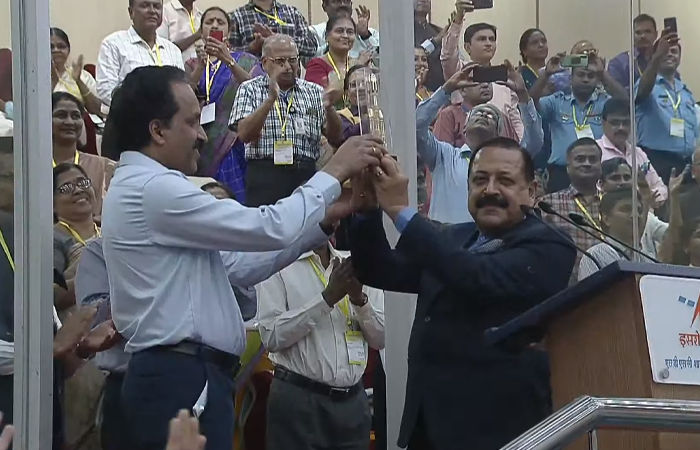 |
| Dr Jitendra Singh and ISRO chief S Somanath |
Dr Jitendra Singh, Minister of State for Science and Technology felicitated with a momento by ISRO chief S Somanath
Update at 2.35 p.m.
The three-stage LVM3 rocket blasted off Chandrayaan-3 from the second launch pad at Satish Dhawan Space Centre at Sriharikota rocket port in Andhra Pradesh. Now the lander carried by the spacecraft is expected to make a soft landing on the moon on Aug 23 or 24.
Update at 2.20 p.m.
The moon lander Vikram will be perched on a GSLV Mark 3 heavy, the 'Bahubali rocket' lift launch vehicle.
Update at 2.15 p.m.
ISRO prepares for third space mission to the moon; to demonstrate end-to-end capability in safe landing and roving on the lunar surface.
India’s tryst with space prominence
The Chandrayaan-3 mission sets off with the ambition to soft land on the moon’s surface and manoeuvre a robotic rover there. The moon landing also aims to explore and study elements present on the moon.
Counting down India’s hopes in Chandrayaan-3
As regards the changes made in the lander this time as compared to the one that crash landed on the moon during the Chandrayaan-2 mission, a senior ISRO official stated that the lander has four motors instead of five. The space agency has also made some changes to the software. Interestingly, ISRO is silent on naming the lander and rover this time around. During the Chandrayaan-2 mission, the lander was named ‘Vikram’ and the rover was named ‘Pragyan’.
Chandrayaan-3's trajectory: from Earth to Moon and beyond
• Chandrayaan-3 spacecraft will take off from earth at 2.35 p.m. The LVM-3 rocket will carry the spacecraft into satellite transit orbit.
• After this process five Earth fires will occur so that the Lander Module (LM) and Propulsion Module (PM) can escape from the earth's gravitational pull. Then it will exit the orbit of the earth and will lead towards entering the orbit of the moon.
• After this phase, both LM and PM will be in transit orbit period between Earth and Moon.
• This phase will be followed by four moon burns to enter the lunar orbit.
• On Aug 17, both LM and PM will separate and the Vikram ladder will move towards the lunar surface.
• On Aug 23, the lander module will move into a 100 by 30 k.m. orbit and accelerate towards the landing.
• It will descend from a height of 30 k.m. to 7.4 k.m. at a speed of 1.98 k.m. per hour in 690 seconds.
• The Vikram lander will move at a distance of 7.4 km to the moon and will stabilise itself, it will then begin its descent to 6.8 km.
• The lander will descend to 800m from 6.8 km in 170 s and will stay in its position for 12 s, rotating continuously.
• After that, it will move downward to 150 m in 75 s. The lander will keep rotating at this altitude for 22s.
• From 150 m height, the lander will look for one of the two landing sites that are pre-decided for it to land.
• If there are no further warnings, the lander will descend to the site without stopping from 150 m.
(Source: IANS)
Edited for style
For more such updates and news on the go, follow us on