




Indore High Court declares 11th-century Bhojshala as hindu temple, suggests separate land for mosque
Updated: May 15th, 2026


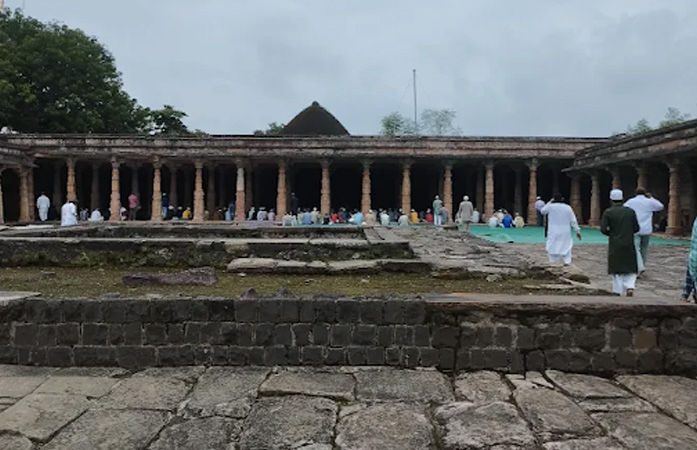
In a landmark judgement, the Indore High Court has ruled in favour of the Hindu side in the long-standing Bhojshala dispute declaring the historical complex in Dhar district of Madhya Pradesh a hindu temple.
The court accepted the scientific survey report submitted by the Archaeological Survey of India (ASI) as the primary legal basis in the case, bringing years of legal and religious dispute to an end.
While hearing the petition filed by the Hindu side, the High Court observed that the entire premises was basically a temple dedicated to Goddess Saraswati, and was originally functioned as a Sankrit educational centre
In its order, the court stated that archaeology is a recognised science and that the findings of the ASI survey carry legal validity. It further emphasised that preserving historically and archaeologically significant structures is the constitutional responsibility of the government.
Historical verdict and the right to worship
Advocate Vishnu Shankar Jain reportedly described the verdict as historic, noting that the court had modified the 2003 arrangement and granted the Hindu side exclusive rights to worship at the site. The court also acknowledged that the complex was associated with Raja Bhoj, the Parmar dynasty king credited with establishing Bhojshala in 1034 AD.
The High Court additionally directed the government to consider the demand for the return of the idol of Goddess Vagdevi (Saraswati), currently housed in a museum in London. The Muslim side will be allowed to present its views before the government during the process.
Provision of alternative land for the Muslim side
In a significant development, the court asked the government to consider allotting alternative land to the Muslim side for offering namaz. The earlier arrangement allowing Friday prayers at the site has now been revoked, and henceforth only Hindu worship will be permitted within the complex.
The court also placed the administration and management of Bhojshala entirely under the control of the ASI. Directions were issued to the central government and the ASI to ensure proper management of the premises, promote Sanskrit education at the site, provide necessary facilities for devotees, and maintain peace and law and order in the region.
History of Bhojshala
Historically, Dhar was ruled by Raja Bhoj between 1000 and 1055 AD. A devoted follower of Goddess Saraswati, he established a grand educational institution at the site, which later came to be known as Bhojshala.
Historical accounts state that the structure suffered damage during the invasion of Alauddin Khilji in 1305, following which parts of the complex were converted into a mosque. Excavations conducted in 1875 reportedly led to the discovery of an idol of Vagdevi at the site.
Until now, the ASI-regulated arrangement allowed Hindus to worship on Tuesdays and Muslims to offer Friday prayers. However, the latest court verdict significantly changes the religious status and usage rights of the 11th-century monument.
