





India slams Pakistan at UN, says terrorists cannot hide behind claim that they are ‘civilians’
India lost 20,000 Indian lives in four decades in terror attacks
Updated: May 24th, 2025


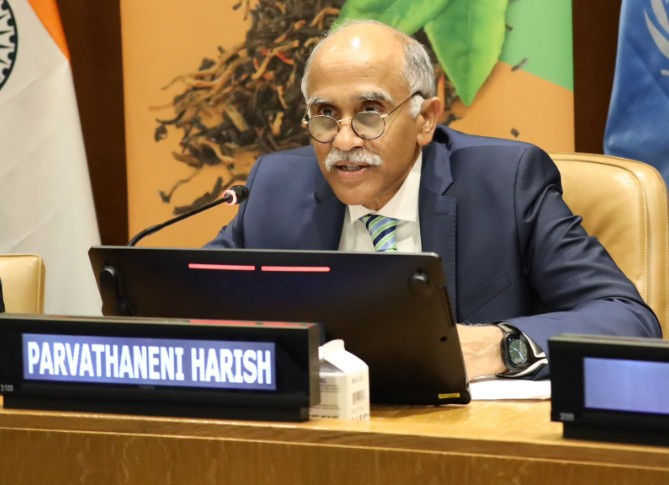
India has declared that Pakistan-based terrorists cannot claim immunity from anti-terrorism action by asserting that they are civilians.
“Let us be clear: Protection of civilians should not serve as an argument for protection of UN-designated terrorists,” India’s Permanent Representative to the UN, P Harish, told the UN Security Council on Friday.
“Pakistan has repeatedly used the ‘civilian’ cover to advance the cause of terrorism,” he said.
Speaking at a Security Council debate on emerging threats to civilians and protecting them, Ambassador Harish dismissed Pakistan’s claims that civilians were targeted during Operation Sindoor by drawing attention to the open nexus between terrorists and the Pakistani government and military.
“A nation that makes no distinction between terrorists and civilians has no credentials to speak about protecting civilians,” Harish said.
“We just recently saw senior government, police, and military officials pay respects at the funeral of noted terrorists targeted by Operation Sindoor,” he added.
Pakistan military’s top brass, including Lieutenant General Fayyaz Hussain Shah and Major General Rao Imran, and Punjab Police Inspector General Usman Anwar were among those who attended the funerals of terrorists killed in the Operation Sindoor strikes, including Hafiz Abdur Rauf, a senior leader of the Lashkar-e-Taiba (LeT) who is designated a terrorist by the US government.
“Pakistan retaliated to the strikes on terrorists by deliberately shelling India’s border areas, killing more than 20 civilians,” Ambassador Harish said.
“There was intentional targeting of places of worship, including gurudwaras, temples, and convents, as well as medical facilities,” he added.
“To preach at this body after such behaviour is grossly hypocritical,” he said.
“Regrettably, during armed conflict civilians, including women and children, are used as human shields for military operations and terrorist activities. Therefore, it is paramount that the international community resolves to take concrete actions towards the implementation of relevant Security Council resolutions that have been previously adopted,” he added.
India underscored that any attack on civilians and humanitarian workers is a grave violation of International Law, in particular International Humanitarian Law.
The existing legal framework concerning the protection of civilians cannot be overlooked.
“Respect for principles of the UN Charter, including sovereignty and territorial integrity of Member States, should remain the basis for all actions taken by the Council for the protection of civilians.”
Pak violated spirit of Indus Water Treaty through terror
“Despite this, India has shown extraordinary patience and magnanimity,” said India’s Permanent Representative P Harish, responding to what he said were Pakistan’s campaign of disinformation about New Delhi suspending the treaty.
“India has finally announced that the Treaty will be in abeyance until Pakistan, which is a global epicentre of terror, credibly and irrevocably ends its support for cross-border terrorism. It is clear that it is Pakistan which remains in violation of the Indus Water Treaty and not India,” he said.
After the massacre of 26 people by Pakistan-based terrorists last month, India said it was suspending the treaty reached in 1960 under the aegis of the World Bank to provide Pakistan a consistent share of the water from the Indus and its allied water resources.
“Far-reaching fundamental changes have taken place not only in terms of escalating security concerns through cross-border terror attacks, but also growing requirements for producing clean energy, climate change, and demographic change”, he said.
While the technology for dam infrastructure improved to ensure safety and more efficient water use, “some of the old dams are facing serious safety concerns”.
He said that New Delhi formally asked Islamabad on several occasions in the last two years to discuss modifications of the treaty to no avail.
“Pakistan has continued to consistently block any changes to this infrastructure, and any modifications of the provisions, which are permissible under the treaty,” Harish said.
Harish emphasised that while the fundamental basis of the treaty laid out in its preamble is a spirit of goodwill and friendship, Pakistan has inflicted on India three wars and thousands of terror attacks.
He added that these cynical acts continue to endanger the safety of our projects and the lives of civilians.
“In the last four decades, more than 20,000 Indian lives have been lost in terror attacks, the most recent of which was the dastardly targeted terror attack on tourists in Pahalgam last month. In fact, in 2012, terrorists even attacked the Tulbul Navigation Project in Jammu and Kashmir,” he said.
(Compiled from syndicated feed)