




India, EU sign landmark free trade pact, seal ‘mother of all trade deals’
Updated: Jan 27th, 2026


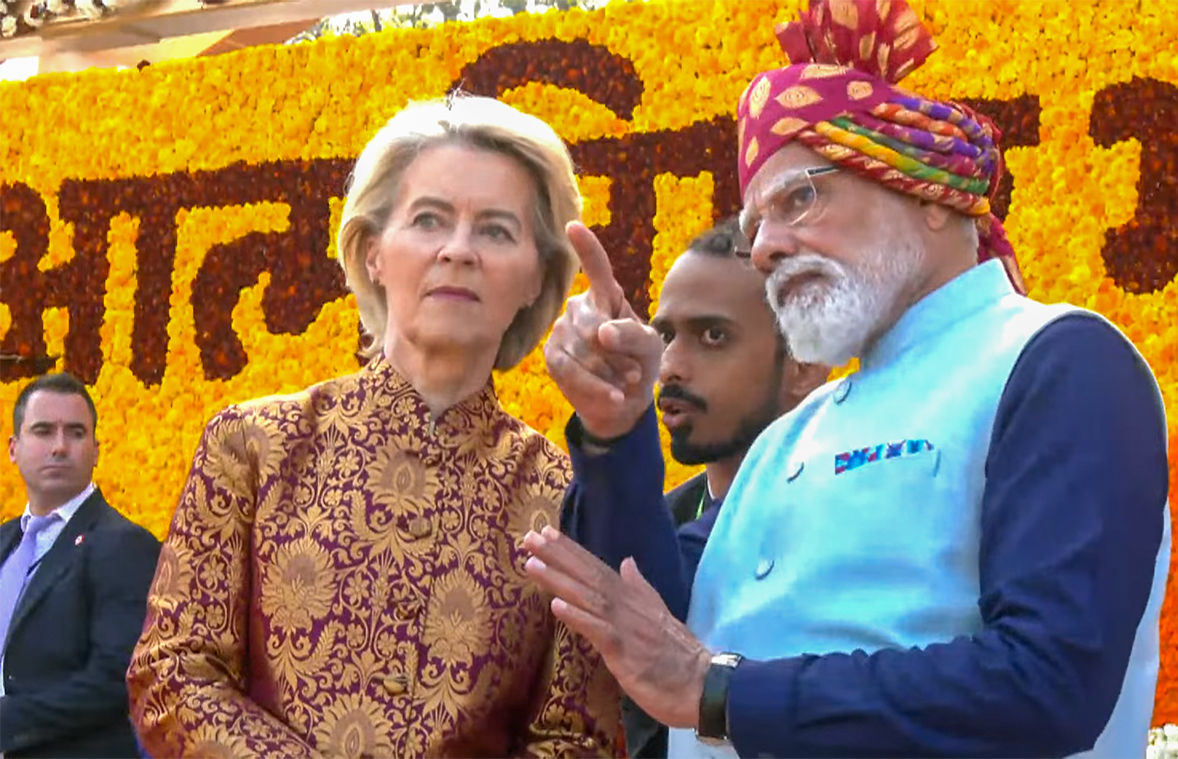
India and the European Union on Tuesday signed the long-awaited Free Trade Agreement (FTA) at the 16th India–EU Summit in the national capital, marking a watershed moment in bilateral economic relations.
The agreement was signed in the presence European Commission President Ursula von der Leyen, formally concluding years of negotiations aimed at deepening the India–EU strategic partnership.
The signing comes amid strong positive momentum in India–EU ties and is expected to provide a major push to cooperation across trade, investment, clean energy, security and defence, and people-to-people exchanges.
The India–EU FTA is being viewed as a key step in expanding India’s global trade footprint and reducing dependence on a limited set of markets. It is also expected to help cushion the impact of high US tariffs by opening wider access to the European market for Indian exporters, particularly in labour-intensive sectors.
One of the most notable aspects of the agreement is the gradual opening of India’s automobile sector to European manufacturers, which is expected to reshape the premium car market in the country.
The European Union is already India’s largest trading partner in goods. In FY 2024–25, bilateral trade in goods stood at $136.53 billion, with India’s exports valued at $75.85 billion and imports at $60.68 billion. Trade in services between the two sides touched $83.10 billion in 2024.
Key highlights of the India–EU Free Trade Agreement:
- Import duties on European cars to be reduced sharply from around 110% to nearly 40% in a phased manner
- Enhanced market access for Indian exports such as textiles, garments, jewellery, leather goods and pharmaceuticals
- Improved access for EU companies to India’s manufacturing and services sectors
- Stronger provisions on investment protection and regulatory transparency
- Cooperation on clean energy, climate action and sustainable supply chains
- Boost to trade in services, including IT, professional services and mobility of skilled workers
- Measures to facilitate easier customs procedures and reduce non-tariff barriers
At present, European carmakers account for about 4% of India’s annual car market of 4.4 million units, a figure expected to rise following the implementation of the agreement.
Officials on both sides said the FTA reflects growing strategic trust between India and the EU and positions the partnership as a key pillar of the evolving global trade architecture.
(with inputs from syndicated feed)
