

‘If Any Hindu Thinks There Should Be No Muslim In Bharat, He Will Not Remain Hindu’: Mohan Bhagwat

Summarized by AI; it may make mistakes. Check important info
Summarized by AI; it may make mistakes. Check important info

Rashtriya Swayamsevak Sangh chief Mohan Bhagwat has said that a person cannot claim to be a Hindu while believing that Muslims should have no place in India, stressing that Hindu thought recognises the dignity of every human being and that different religious paths can lead to the same goal.
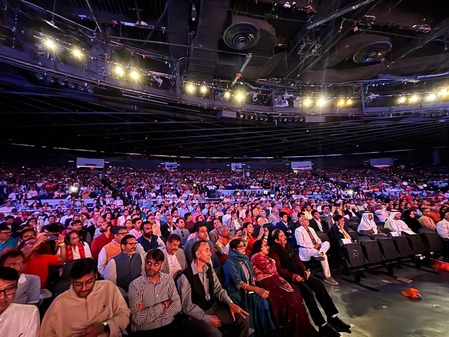
Speaking at a ‘One World One Humanity’ event in New York on Saturday, Bhagwat said, “If any Hindu thinks that there should be no Muslim in Bharat, he will not remain Hindu.”
“If you want to call yourself Hindu, you must believe that all paths are leading to the same goal and that every human has dignity. There is no difference between human beings,” he said.
‘Religions May Be Different, Humanity Is One’
Bhagwat said the traditional Indian view was centred on the “unity of humanity”, arguing that religious differences should not obscure the common humanity of people.
He said truth is one but can be described in different ways depending on how people perceive it.
“There are many religions, and in today's world, religions are largely defined by rituals,” Bhagwat said, adding that religious practices were meant to guide people towards the ultimate goal of realising truth.
Using the analogy of a finger pointing towards a light, he said people could become so focused on religious rituals that they lose sight of the larger purpose of faith.
He also compared different religious paths to rivers flowing towards the same ocean, saying they may be longer, shorter, straight or crooked but ultimately seek the same divine truth.
‘We And Ours Are The Solution’
The RSS chief also criticised what he described as the growing role of self-interest in politics and called for social change through selfless service and public participation.
“Politics has now become a game of self-interest,” he said, arguing that lasting change could not be achieved through politics alone.
Bhagwat said society needed to be educated and mobilised locally, with people working towards creating an atmosphere of unity and selfless service.
“If there is public opinion, then no politician will dare to go against it,” he said.
He called for the creation of communities centred on selfless service and dialogue, saying such efforts should begin locally before expanding more widely.
Recalls RSS Volunteers’ Relief Work
Bhagwat also recalled the role of RSS volunteers following the 1996 Charkhi Dadri mid-air collision in Haryana, in which two aircraft collided, killing all but one of the people aboard.
He said most of those killed were Muslims and claimed RSS volunteers helped treat the injured, recover bodies, identify victims and arrange funeral rites.
“We never thought at that time that these are Muslims,” he said, describing the work as an example of service without expectations of reward or recognition.
‘Unity Of Humanity’ As India’s Traditional Thought
Bhagwat said India’s traditional philosophy was based on the idea that humanity is one and referred to the country's long-standing emphasis on unity despite differences in religious practices.
He said the Constitution also embodies principles of equality and unity, but argued that such values cannot be sustained through political action alone.
“If we do not keep educating the society, then the deflections creep in,” he said, referring to historical changes and the impact of foreign invasions on Indian society and culture.
Bhagwat is on a three-nation outreach tour covering the United States, Canada and the United Kingdom as part of the RSS centenary-year activities. His New York visit has drawn attention amid debate over the organisation's ideology and its approach to India's religious and cultural identity.


