





How India’s strategic attack at Nur Khan may have prompted US to push for Indo-Pak ceasefire
Updated: May 12th, 2025


The ceasefire between India and Pakistan on May 10 went beyond India and Pakistan, as Donald Trump, announced on X, “After a long night of talks mediated by the United States, I am pleased to announce that India and Pakistan have agreed to full and immediate ceasefire.”
The involvement of the US as a mediator, despite J D Vance calling the India-Pakistan situation “none of US’s business”, came about at a time when the conflict might have quickly spiralled into a nuclear one after India hitting one of Pakistan’s most important air bases..
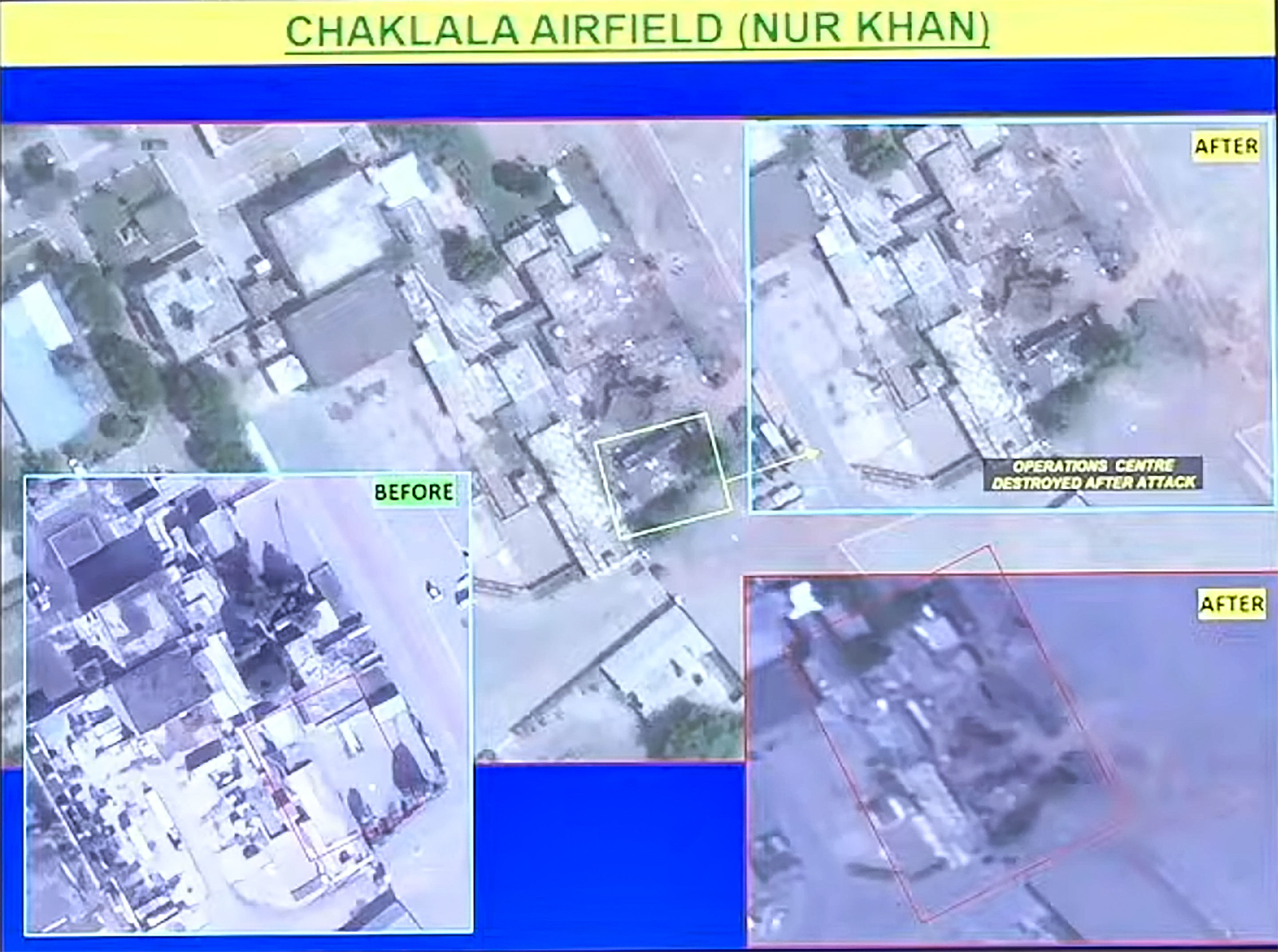
In retaliation to Pakistan sending 300-400 drones to attack India’s Western front, Indian strikes extended hundreds of kilometres inside Pakistan, not just PoK. India struck strategic targets, including the Nur Khan air base in Rawalpindi (Chaklala airfield), considered a strategic stronghold of Pakistan’s military.
According to the New York Times, the Nur Khan base is one of the central transport hubs for Pakistan’s military and air refuelling centre for its fighters.
However, what is striking is the base is a short distance from the headquarters of Pakistan’s Strategic Plans Division, which oversees and protects the country’s nuclear arsenal, according to the NYT.
India’s counter military action on the night of May 9-10 also became the first instance of a country damaging air force camps of a nuclear country. Within three hours, 11 bases were attacked including Nur Khan, Rafiqi, Murid, Sukkur, Sialkot, Pasrur, Chunian, Sargodha, Skaru, Bholari and Jacobabad. This led to destruction of 20% infrastructure of Pakistan’s Air Force, as per estimates.
The NYT goes on to add that a former American official long familiar with Pakistan’s nuclear program noted that Pakistan’s deepest fear was of its nuclear command authority being decapitated. The missile strike on Nur Khan could possibly be interpreted, the former official said, as a warning from India.
Reports in their local media also suggest that Pak PM Shehbaz Sharif had also called for a National Command Authority meeting, a committee that makes the final call on using the nuclear weapons of Pakistan. The reports, however, were later denied by Pakistan.
After these developments, US Secretary of State Marco Rubio is said to have reached out to Pakistan’s Army chief Asim Munir after talks with Prime Minister Shehbaz Sharif to de-escalate tensions with India failed.
“The US President wants to see the confrontation de-escalate as quickly as possible,” Donald Trump’s spokesperson Karoline Levitt had said.
“This is something that the secretary of state and, of course, now, as our national security advisor as well, Marco Rubio, has been very much involved in,” she said.
Bruce said that Rubio offered Munir “US assistance in starting constructive talks in order to avoid future conflicts”.
She added, “He continued to urge both parties to find ways to de-escalate”.
Rubio spoke to Sharif on Thursday, and “emphasised the need for immediate de-escalation”, Bruce said in a readout of that call.
After India launched ‘Operation Sindoor’, India’s National Security Advisor (NSA) Ajit Doval had made the first international call to Rubio. Rubio is also the national security advisor after Mike Waltz stepped down from the job.
India launched the operation in retaliation for an attack by a front organisation of the Pakistan-based Lashkar-e-Taiba in which 26 people were killed in Pahalgam last month.
(with inputs from syndicated feed)