

Exclusive: Govt Freezes Sugar Ethanol: 250+ Crore Litre Deficit Threatens India’s Green Fuel Targets, May Spur Maize, Rice Prices

Summarized by AI; it may make mistakes. Check important info
Summarized by AI; it may make mistakes. Check important info

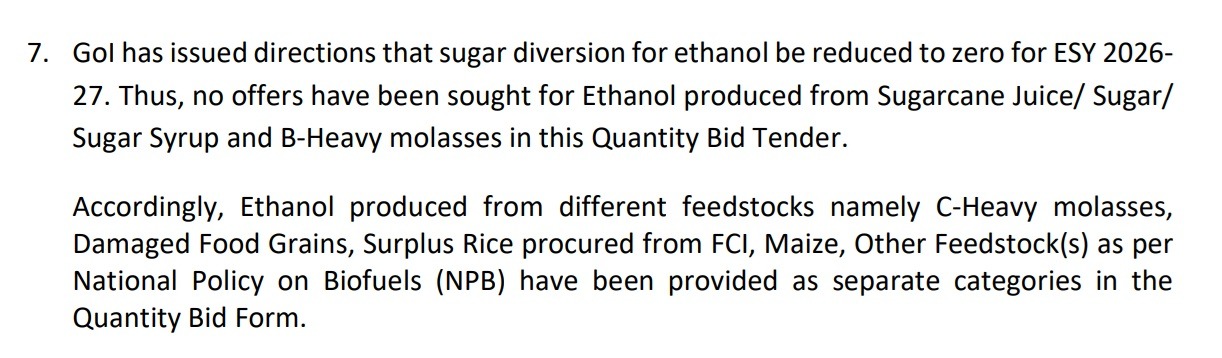
The Central Government has completely frozen sugar diversion for ethanol production for the 2026–27 Ethanol Supply Year, wiping over 250 crore litres of supply off the national grid overnight.
State-run Oil Marketing Companies—including Indian Oil Corporation, Bharat Petroleum, and Hindustan Petroleum—issued the latest quantity-bid procurement tender on Friday, mandating zero sugar diversion. These companies have floated tender to procure 1,100 crore litres of ethanol for the year 2026-27 – beginning on November 1, 2026 to October 31, 2027. The order explicitly excludes sugarcane juice, sugar syrup, and B-heavy molasses, effectively shutting off the primary feedstocks that drove India’s biofuel expansion over the past five years.
Quarter of National Ethanol Grid Wiped Out Overnight
The policy shift removes a massive portion of the nation's ethanol supply pool. In the 2025–26 supply cycle, sugar-based feedstocks supplied approximately 266 crore litres of ethanol to the grid, with sugarcane juice delivering 151 crore litres and B-heavy molasses contributing 115 crore litres.
ESY 2026–27 Ethanol Tender & Supply Gap | Details |
Total OMC Tender Procurement Target | 1,100 Crore Litres |
Erased Sugar Ethanol Supply | ~266 Crore Litres (24.1% Loss) |
Mandated Sugar Diversion | ZERO (0 Lakh Tonnes) |
Allowed Feedstocks | C-Heavy Molasses, Maize, Damaged Grains, FCI Surplus Rice |
With OMCs floating a cumulative procurement requirement of 1,100 crore litres for the upcoming cycle, removing 266 crore litres eliminates% of the country's operational supply base in a single move.
Stranded Investments and Squeezed Margins Hit Distilleries
The sudden freeze inflicts severe damage on integrated sugar refiners and distillery operators. Sugar companies poured thousands of crores into expanding multi-feed plants and specialized dual-feed distillation units over the last four years. These facilities now face capacity underutilization and idle production lines.
While processors can still utilise C-heavy molasses, its ethanol yield per tonne of sugarcane is drastically lower than that of B-heavy molasses or direct juice. This shift severely crimps operating margins across the sector. In sugar processing, B-heavy molasses is an intermediate byproduct retaining high sugar content used for maximum ethanol yields, whereas C-heavy molasses is the final residual byproduct after all crystallisable sugar has been extracted.
To cover the supply deficit, the government is forcing a rapid pivot towards grain-based ethanol. However, the same OMC tender reduced the price incentive for corn-based ethanol by ₹3.00 per litre, cutting procurement prices from ₹71.86 to ₹68.86 per litre and squeezing grain distillers further.
Grain Markets Prepare for Severe Price Inflation
Redirecting the entire shortfall onto grain feedstocks threatens domestic agricultural markets. Offtaking massive volumes of maize to supply the 1,100 crore litre demand forces distilleries into direct procurement competition with the poultry feed and starch industries, threatening sharp price spikes in open-market corn.
Without sustained releases of subsidized rice from the Food Corporation of India, grain processors face soaring raw material expenses alongside lower government procurement returns.


