




Union Budget 2026-27 important updates: What gets costlier and what gets cheaper?
Updated: Feb 1st, 2026


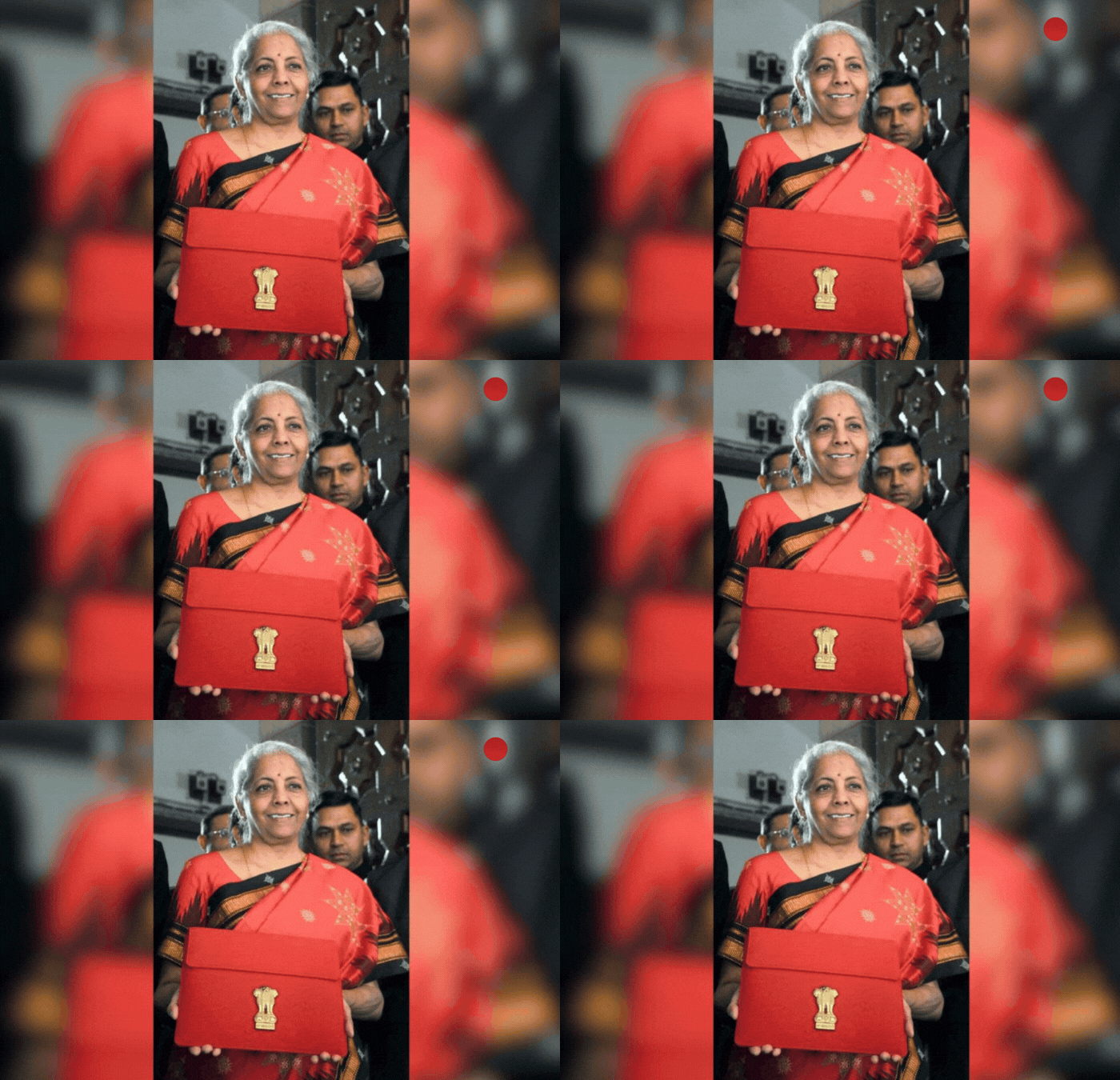
Finance Minister Nirmala Sitharaman is presenting the Union Budget for 2026–27, marking a historic moment as it is being delivered on a Sunday for the first time in independent India’s history.
This will be her ninth consecutive Budget, making her the first woman finance minister to achieve this feat, and the 15th Budget of the Narendra Modi-led government. It is also the second full Budget since the National Democratic Alliance (NDA) returned to power for a third straight term in 2024.
FM Nirmala Sitharaman begins presenting the budget, watch it live:
Budget 2026-27 live updates
What gets costlier and what gets cheaper?
According to the Budget announcements, several everyday and essential items are expected to become cheaper. These include microwave ovens, CNG and biogas, 17 cancer-related medicines, diabetes medicines, drugs used for seven serious diseases, footwear, solar energy products, leather goods, mobile phone batteries, textiles, and aircraft spare parts.
On the other hand, some items are likely to become more expensive following the Budget proposals. These include liquor, scrap materials, and minerals.
Sensex and Nifty takes a dive
During budget representation, the Indian indices Sensex and Nifty took a dive, with Sensex losing 2,500 points and Nifty going down by 700 points. However, minutes after the adjournment of the house, both indices recovered.
Sensex stood at -1,400 points in red at 81,159 while Nifty 50 was at -440 points at 24,984 points on 12.40 pm.
Important proposals
FM proposes a Biopharma Shakti worth ₹10,000 cr.
ISM 2.0 for semiconductor to develop technology worth ₹40,000 cr.
Mineral rich Odisha, Kerala, Andhra Pradesh, Tamil Nadu to establish dedicated rare earth corridors.
Scheme for container manufacturing with allocation of ₹10,000 cr.
Integrated program for natural and manmade fibres, 'Mahatma Gandhi Handloom Scheme' to promote Khadi and other textile industries.
Allocation for high quality affordable sports goods.
Rejuvenation of legacy industrial clusters.
Three pronged approach to help grow MSMEs. Allocation of ₹10000 cr for SME growth fund.
Infrastructure Investment Trust and Real Estate Investment Trust in Tier 2 and Tier 3 cities.
Public sector expenditure to increase to ₹12.2 lakh crores
Establish new dedicated freight corridors from Dankuni to Surat, with new waterways
Proposal for National Waterways 5 in Odisha, ship repair ecosystem in Varanasi and Patna.
Total Return Swaps on corporate bonds.
Municipal bonds, with incentive of ₹1,000 cr for single bond issuance of more than ₹1,000 cr.
Portfolio investment scheme for Person Resident Outside India (PROI) to invest in public listed equities.
Developing infrastructure for medical tourism: 5 regional medical hubs in partnership with public sector.
Two new All India Ayurveda Institutions.
Upgrade the WHO global traditional medicine centre in Jamnagar.
Two NIDs in eastern regions of India.
One girls' hostel in every district of India for women in education.
Pilot scheme for upscaling guides in iconic tourist sites in collaboration with IIM.
Digital documentation of cultural, spiritual, and heritage locations of importance.
Development of 15 archaeological sites including Lothal in Dholavira.
World class trekking and hiking with mountain trails in multiple states.
Turtle trails in Odisha, Karnataka, Kerala.
Global Big Cat Summit to be hosted in India this year.
'Khelo India Mission' to transform sports sector.
Targeted efforts: Increased farmer income, empowering Divyangs with employment and equipments, Focus on mental health care, development of eastern and north-eastern states.
4,000 e-buses to be allocated to North-eastern states.
Coconut Promotion Scheme in major coconut growing states
Indian cashew and cocoa project to make India self-reliant and enter premium global market.
Bharat VISTAAR: AI-powered portal for farmers with agricultural supports.
SHE mart: self-help entrepreneurship for women owning businesses.
Divyang Sahara Yojna: supportive equipments for eligible divyangs. AI-integration and technology at Divy-Asha centres to see, try, and purchase assisting equipment.
Mental healthcare: National Mental Health Institutions to be developed.
TDS, income tax not applied on accidental death claim.
TCS rates deducted for education from 5% to 2%
New Income Tax norms to be applied from April 1, 2026, with simplified forms.
Scheme for small tax payers: Obtain lower or 0 tax certificate with simpler assessment.
Extension of review of filing tax return can be shifted to Mar 31 from Dec 31 with nominal fees.
ITR can be filed till July 31
Companies (including offshore) providing cloud services will be exempted from taxes till 2047 if they offer their services to Indian consumers through Indian resellers
NRIs would not require TAN to sell properties, undisclosed foreign properties will only attract fines.
Promotion of marine, leather and textile products, seafood exports.
Customs duty exemptions on aircraft maintenance, and aircraft raw materials for defence sector.
17 drugs or medicines for cancer, 7 more rare disease medications exempted from duty.
No changes in Income Tax slabs.
Cabinet approves the budget
The Cabinet on Sunday approved the Union Budget 2026-27 during a meeting in Parliament chaired by Prime Minister Narendra Modi.
A meeting of the Union Cabinet was held at Sansad Bhawan at 10 am, and after the Cabinet’s approval, Finance Minister Nirmala Sitharaman proceeded to Parliament to present the Budget.
FM meets president, presents 'digital bahi-khata'
FM Sitharaman once again highlighted the government’s move towards tradition and technology on Sunday by carrying the Union Budget documents on a digital tablet placed inside a red ‘bahi-khata’ style pouch.
This continues the paperless Budget format introduced by the Prime Minister Narendra Modi government.
FM Sitharaman first replaced the old leather briefcase, a symbol inherited from British times, with the traditional bahi-khata in 2019.
Two years later, in 2021, she switched to using a digital tablet to carry the Budget papers, further promoting a modern and eco-friendly approach.
The upcoming Budget presentation will be her ninth in a row as Finance Minister.
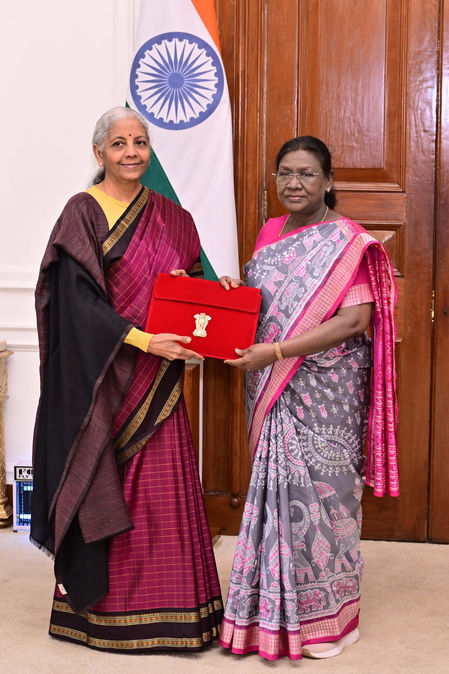
The bahi-khata is a red pouch that holds the digital tablet containing the Budget documents.
FM Sitharaman also mentioned that the bahi-khata was easier and more convenient to carry.
The FY27 Budget comes at a time of heightened complexity for the Indian economy. While domestic demand has remained resilient and inflation has moderated from recent peaks, the global environment remains deeply uncertain.
Geopolitical tensions, volatile commodity prices, uneven monetary easing by major central banks and rising trade fragmentation continue to weigh on the outlook. Adding to the challenge are punitive 50% tariffs imposed by US President Donald Trump on Indian goods, which have unsettled financial markets and contributed to sustained foreign investor outflows and a record low rupee.
So far, sweeping income tax and GST cuts, higher infrastructure spending and interest rate reductions by the Reserve Bank of India have helped cushion the economy against these external shocks. However, those tax cuts have also dented government revenues, narrowing the fiscal space available to support growth in the new Budget.
The government has steadily reduced the fiscal deficit from the Covid-induced peak of 9.2% to an estimated 4.4% in FY26, and experts believe this path of “fiscal rectitude” will largely be maintained, with no major deviation expected.
Unlike the FY26 Budget, which was more explicitly geared towards stimulating middle-class consumption through tax relief, the FY27 Budget’s consumption push is expected to be more targeted.
(with inputs from syndicated feed)
