




El Niño alert: India, South Asia face higher drought risk as FAO warns of monsoon and crop stress
Updated: Jun 23rd, 2026


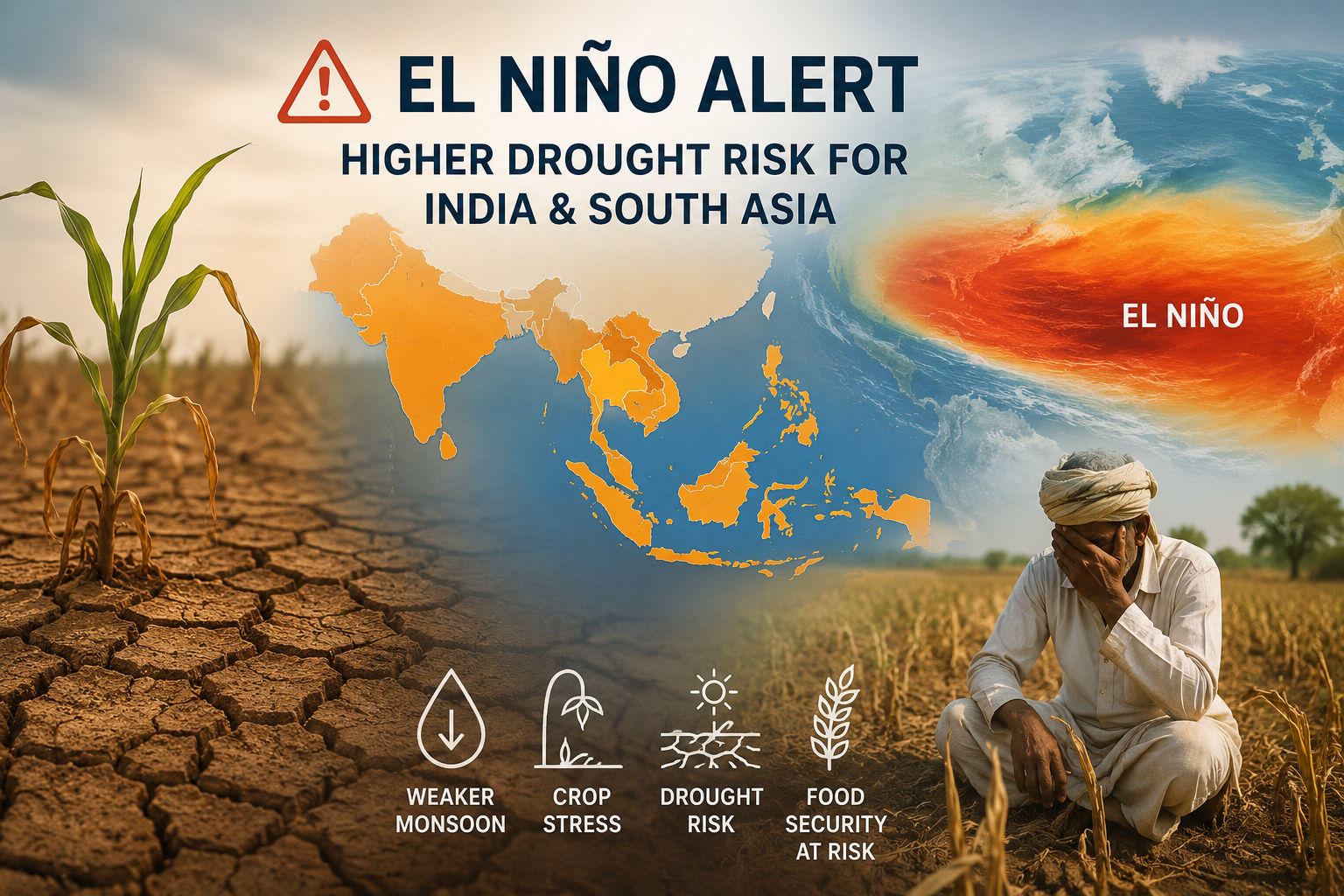
A new El Niño phase is expected to develop within weeks, raising concerns for agriculture across India and Asia as global weather agencies warn of increased drought risks and potential disruptions to food production.
According to new analysis by the Food and Agriculture Organization (FAO), several parts of South and Southeast Asia face a heightened risk of El Niño-linked drought in the coming months.
The assessment, based on 41 years of satellite data, identifies India, Pakistan, Myanmar, Thailand, Cambodia, Vietnam, the Philippines, Indonesia and Timor-Leste among the regions most vulnerable to agricultural stress.
The warning comes as the World Meteorological Organization (WMO) forecasts a stronger-than-usual El Niño cycle. Experts caution that the weather pattern could weaken India’s summer monsoon, placing rain-fed crops such as rice and maize under pressure during the critical growing season.
Notably, El Niño weakens India’s Southwest Monsoon, which accounts for 70% of the country's annual rainfall.
FAO noted that previous strong El Niño events have disrupted agricultural output across Asia.
During the 2015 episode, rice and maize production declined in several major producing countries, contributing to higher food prices and supply pressures.
The agency’s analysis suggests that drought risk stretches across much of South and Southeast Asia, threatening crop yields, livestock grazing areas and water availability. The risk is particularly significant for regions dependent on seasonal rainfall and monsoon-driven agriculture.
Early identification of drought-prone areas allows governments and farmers to take preventive measures, including delaying sowing, switching to drought-resistant crops, storing livestock feed and securing additional water resources before shortages emerge, said FAO.
The warning also comes amid growing concerns over food security. FAO and the World Food Programme (WFP) have identified multiple countries facing acute food insecurity due to a combination of climate shocks, conflict and economic pressures.
Experts say timely intervention and targeted support will be critical if El Niño conditions intensify in the months ahead.
With the monsoon season underway, the development of El Niño will be closely watched across India and Asia, where millions of farmers depend on consistent rainfall for agricultural production and rural livelihoods.
El Niño is a natural climate phenomenon that occurs when sea surface temperatures in the central and eastern Pacific Ocean become warmer than normal.
This warming changes global weather patterns, often affecting rainfall, temperatures, storms and agriculture across different parts of the world.
