

Delhi's Diwali Pollution Spike: Missing Data Reveals PM2.5 Levels Surging Past 3,700

Summarized by AI; it may make mistakes. Check important info
Summarized by AI; it may make mistakes. Check important info
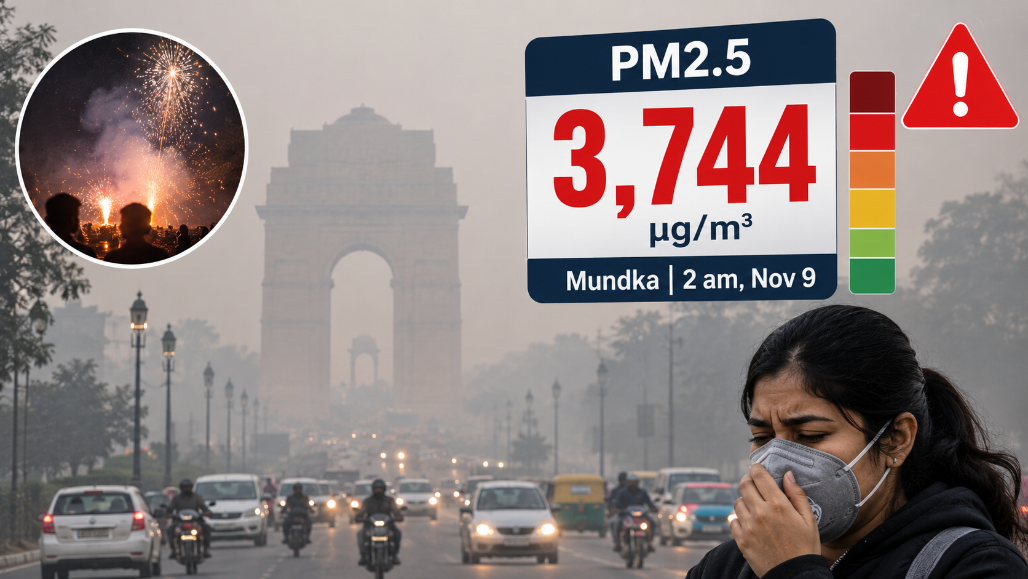
Delhi's Diwali-night pollution was far worse than the official hourly records initially suggested. Data released by the Delhi Pollution Control Committee (DPCC) on Monday evening revealed that PM2.5 concentrations at several monitoring stations crossed 2,000 micrograms per cubic metre, with Mundka recording a staggering 3,744 µg/m³ at 2 am on November 9 — more than 60 times the national 24-hour standard of 60 µg/m³.
The readings, released around 8 pm, filled gaps in the Central Pollution Control Board's (CPCB) records for the night of November 8. They show that pollution levels peaked in the early hours of November 9, when firecracker emissions added to the city's already deteriorating air quality.
Mundka Records Highest PM2.5 Level At 3,744 µg/m³
The highest concentration was recorded at Mundka at 2 am, followed by JNU, where PM2.5 levels reached 3,023 µg/m³ at 4 am. NSUT's West Campus recorded 3,008 µg/m³ at 5 am.
Other monitoring stations also reported extremely high concentrations. Mandir Marg recorded 2,908 µg/m³ at 3 am, Nehru Nagar registered 2,808 µg/m³ at the same time, while Wazirpur reached 2,721 µg/m³ at 1 am.
In total, 11 DPCC monitoring stations recorded PM2.5 concentrations exceeding 2,000 µg/m³.
All 125 Missing Station-Hour Readings Crossed 1,000
The data released by DPCC covered all 125 station-hour entries missing from CPCB's records. Every one of these readings was above 1,000 µg/m³.
Where both agencies had recorded data, the figures matched. However, the highest PM2.5 concentration appearing in CPCB's records for Diwali night was capped at 1,000 µg/m³.
Earlier, Hindustan Times had reported that PM2.5 readings from several Delhi monitoring stations had disappeared from CPCB's records as air quality deteriorated on the night of November 8. At 1 am, 36 of the city's 59 monitoring stations had no PM2.5 reading listed.
Delhi's AQI Estimates Rise After Missing Data Is Included
The newly released readings also affect estimates of Delhi's air quality index (AQI).
Using CPCB's own calculation method, HT report estimated that the city's AQI for the 24 hours up to 9 am on November 9 would have been around 384, compared with the officially published figure of 370.
Similarly, the 4 pm bulletin figure would have been approximately 360 instead of 344.
However, the AQI calculation has an upper limit of 500 for hourly PM2.5 concentrations above approximately 420 µg/m³. As a result, readings running into the thousands have a limited additional impact on the final index, despite indicating extremely high pollution levels.
DPCC Cites Technical Glitches, Says All 43 Stations Are Reporting
A government official, who requested anonymity, said the air-quality monitoring stations were generating hourly data despite technical problems.
"The air quality monitors are giving hourly data. There were some technical glitches, but all our 43 stations are giving data," the official said.
The figures remain provisional. As of 7.58 pm on Monday, the readings released by DPCC had still not appeared in CPCB's records.


