




Congress slams alleged move to lift that ban on Chinese companies amid Beijing’s Shaksgam Valley claims
Updated: Jan 13th, 2026


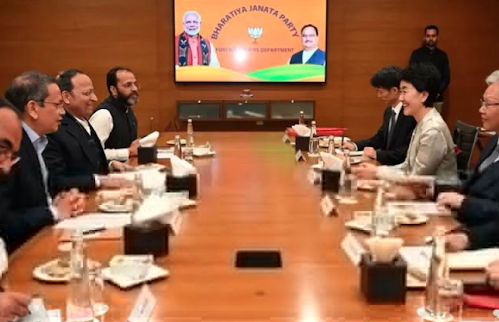
After the BJP posted the photos of their party leaders meeting with Chinese communist party leaders [CCP] , Congress has slammed the BJP and PM Modi over meeting with The Chinese Communist Party leaders amid high tension after China claims the Shaksgam valley.
Congress leader Supriya Shrinate has strongly criticised the Modi government over reports of easing restrictions on Chinese companies participating in government contracts. She alleged that the move ignores China’s role in backing Pakistan, the Galwan clash, and continued tensions in Ladakh, while accusing the government of weakening India’s strategic and economic interests.
Shrinate claimed the government speaks tough on China politically but enables Chinese economic influence, calling it a betrayal of national security and public trust.
Calling it “the true face of Narendra Modi,” Supriya Shrinate said the government “whimpers before America, grovels before China, and then projects itself as a vishwa guru,” warning that reopening doors for Chinese firms amounts to fresh “infiltration” of India’s strategic sectors.
Earlier this month, the Ministry of External Affairs (MEA) rejected the Chinese infrastructure build-up in the Shaksgam Valley in Pakistan occupied Kashmir (PoK) through the China-Pakistan Boundary Agreement of 1963, reiterating that it reserves the right to take necessary measures to safeguard its interests in the region.
Addressing reporters during a regular media briefing in New Delhi, MEA spokesperson Randhir Jaiswal highlighted that India has never accepted the so-called China-Pakistan Boundary Agreement of 1963, through which Pakistan unlawfully attempted to cede the area to China.
"Regarding Chinese infrastructure buildup via CPEC as also in the Shaksgam Valley, which is Indian territory. We have never recognised the so-called China-Pakistan boundary agreement of 1963. We have consistently maintained that the agreement is illegal and invalid. We do not recognise the so-called China-Pakistan Economic Corridor (CPEC) either, which passes through Indian territory that is under forcible and illegal occupation of Pakistan," said Jaiswal.
"The entire Union Territories of Jammu and Kashmir and Ladakh are an integral and inalienable part of India. This has been clearly conveyed to Pakistani and Chinese authorities several times. We have consistently protested with the Chinese side against attempts to alter the ground reality in the Shaksgam Valley. We further reserve the right to take necessary measures to safeguard our interests," he added.
Reframing the two-front narrative, EAM Jaishankar said in July 2025 that by recalling a pattern of military, economic, and diplomatic alignment between Islamabad and Beijing over six decades, he sought to reframe the "two-front threat" as not a product of contemporary escalation but a structural reality that Indian diplomacy and defence must now reckon with decisively.
"The person who said (two front threat) it, must have missed the history lesson from school," EAM Jaishankar quipped, before tracing the arc from Pakistan's cession of the Shaksgam Valley to China in 1963, to Bhutto's initiation of nuclear cooperation in 1976, and landmark developments including Gwadar’s transfer in 2013 and the formal launch of the China-Pakistan Economic Corridor (CPEC) thereafter.
“We are getting warnings now,” he noted pointedly, “but this collaboration has been going on for 60 years.”
