

File Judicial Petition, Not Administrative Memorandum: What Chief Justice Write In Reply to Rahul Gandhi’s Meeting Request

Summarized by AI; it may make mistakes. Check important info
Summarized by AI; it may make mistakes. Check important info

Chief Justice of India Surya Kant has declined an administrative meeting with opposition leaders Mallikarjun Kharge and Rahul Gandhi, advising them instead to invoke the Supreme Court's judicial powers under Article 32 to address their grievances.
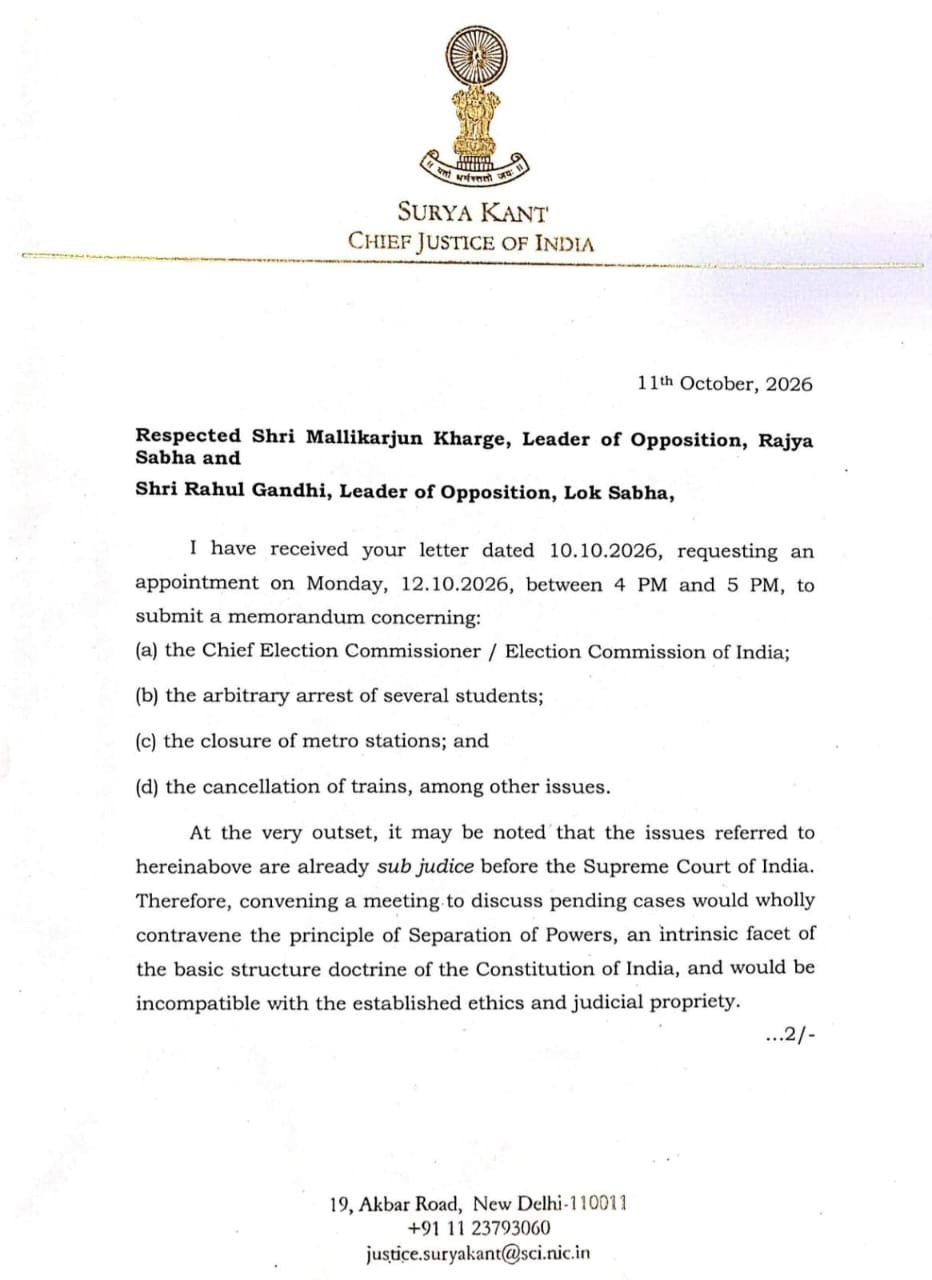
In an official communication dated 11 October 2026, CJI Surya Kant addressed the opposition leaders' joint request for an appointment on 12 October to submit a memorandum regarding the Election Commission, student arrests, metro closures, and train cancellations. The Chief Justice stated that convening an administrative meeting on issues currently sub judice would violate the constitutional principle of separation of powers.
Separation of Powers and Judicial Propriety
Refusing the administrative appointment, CJI Surya Kant noted that discussing pending cases in a private meeting contravenes judicial ethics. "Convening a meeting to discuss pending cases would wholly contravene the principle of Separation of Powers, an intrinsic facet of the basic structure doctrine of the Constitution of India, and would be incompatible with the established ethics and judicial propriety," the CJI wrote.
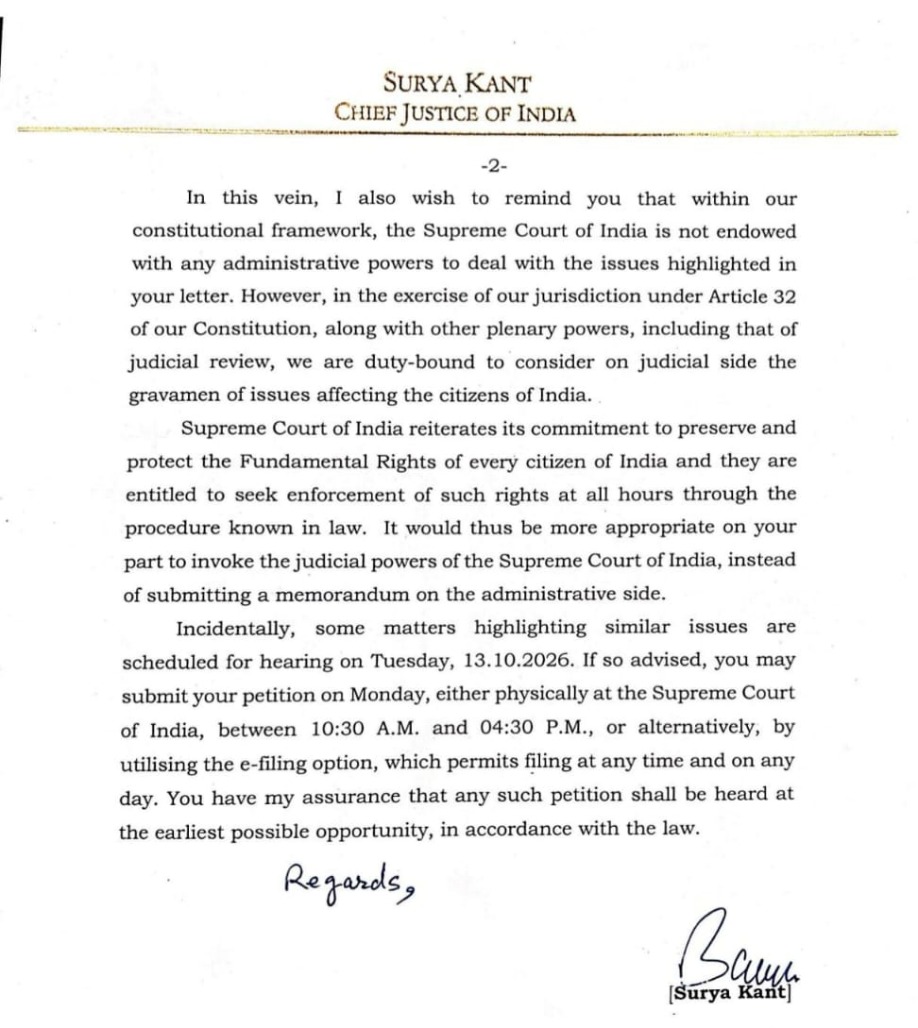
The letter emphasized that the Supreme Court possesses no administrative authority to resolve the political and logistical issues raised in the memorandum. However, the CJI highlighted that the court remains duty-bound under Article 32 to examine fundamental rights violations on the judicial side.
Window Provided for Formal Judicial Filing
Redirecting the opposition's approach, CJI Surya Kant urged the leaders to seek legal recourse through formal petitions rather than administrative representations. "It would thus be more appropriate on your part to invoke the judicial powers of the Supreme Court of India, instead of submitting a memorandum on the administrative side," the letter stated.
Pointing out that related matters are listed for hearing on Tuesday, 13 October 2026, the CJI advised the leaders to file a formal petition on Monday between 10:30 AM and 04:30 PM physically or through e-filing. Assuring swift consideration, CJI Surya Kant confirmed that any petition submitted through proper judicial channels will be listed for hearing at the earliest opportunity in accordance with law.


