





SC refuses to grant any legal sanction to same-sex marriage
The right to choose a life partner lies at the root of Article 21, said CJI DY Chandrachud
Updated: Oct 17th, 2023


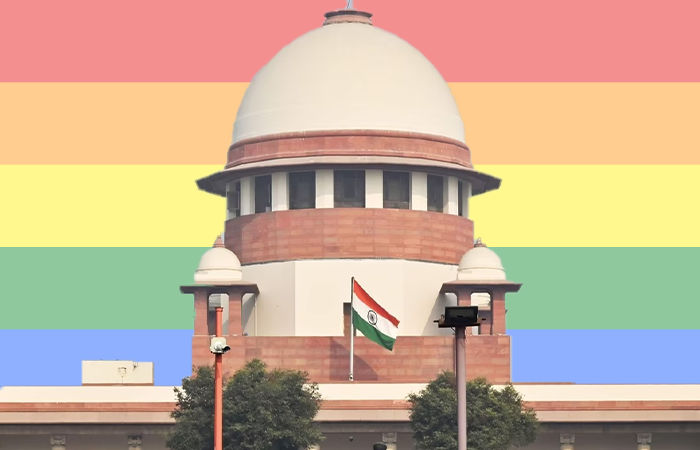 |
| Image: IANS |
A five-judge Constitution Bench headed by chief justice of India DY Chandrachud today refused to grant any legal sanction to same-sex marriage.
The Constitution Bench, also comprising Justices SK Kaul, SR Bhat, Hima Kohli, and P.S. Narasimha, held that queer couples do not have an unqualified right to marriage.
The Supreme Court said that courts cannot make law and can only interpret it. It refused to accept the petitioners’ contention that in the Special Marriage Act (SMA), wherever ‘husband’ and ‘wife’ is used, it can be made gender neutral by using ‘spouse’, and ‘man’ and ‘woman’ should be substituted by ‘person’.
The Constitution Bench was hearing a batch of petitions that challenged certain provisions of the Hindu Marriage Act, Foreign Marriage Act, Special Marriage Act and other marriage laws as unconstitutional on the ground that they deny same-sex couples the right to marry, or alternatively, to read these provisions broadly so as to include same-sex marriage.
Delivering the verdict on pleas seeking legal sanction for same-sex marriage, chief justice of India (CJI) DY Chandrachud today said that queerness is not an urban or elite concept and the right to choose a life partner lies at the root of Article 21 of the Constitution.
He said that Article 15 of the Constitution prohibiting discrimination on the basis of ‘sex’ must be read to prohibit all forms of discrimination based on ‘sexual orientation’.
CJI Chandrachud said that the doctrine of separation of power does not take away power of judicial review and any directions or orders issued for enforcement of fundamental rights cannot be termed as violation of doctrine of separation of power.
A committee to be set up by the union government
He directed that the committee set up by the Union government will take steps to decide the rights and social entitlements of same-sex couples.
During the hearing, the top court had asked the Centre to find a way to give same-sex couples basic social benefits, like joint bank accounts or nominating a partner in insurance policies, even without legal recognition of their marital status.
Articles 15 and 21 of Indian constitution
Article 15
The State shall not discriminate against any citizen on grounds only of religion, race, caste, sex or any of them. In particular, no citizen shall, on grounds only of religion, race, caste, sex or any of them, be subject to any disability, liability, restriction or condition with regard to
Access to shops, public restaurants, hotels and places of public entertainment, or
The use of wells, tanks, roads and places of public resort maintained wholly or partly out of the revenues of the State or dedicated to the use of the general public.
Article 21
No person shall be deprived of his life or personal liberty except according to procedure established by law
The pleas and Centre’s response
In May, the Constitution Bench, also comprising justices SK Kaul, SR Bhat, Hima Kohli, and PS Narasimha, reserved its judgment on the issue as to whether same-sex marriage be given legal recognition.
The batch of petitions challenged certain provisions of the Hindu Marriage Act, Foreign Marriage Act, Special Marriage Act and other marriage laws as unconstitutional on the ground that they deny same-sex couples the right to marry, or alternatively, to read these provisions broadly so as to include same-sex marriage.
The Centre, in its written submissions, had told the Supreme Court that demand for same-sex marriage is a ‘mere urban elitist views for the purpose of social acceptance’, and recognising the right of same sex marriage would mean a virtual judicial rewriting of an entire branch of law.
The central government had stressed that petitions which ‘merely reflect urban elitist views’ cannot be compared with the appropriate legislature which reflects the views and voices of a far wider spectrum and expands across the country.
It contended that legal validation of same-sex marriage will cause ‘complete havoc’ with the delicate balance of personal laws in the country and in accepted societal values.
(Source: IANS)
-Edited for style
For more such updates and news on the go, follow us on