




Indian Armed Forces brief on Operation Sindoor, gives detailed chronology of developments
Updated: May 11th, 2025


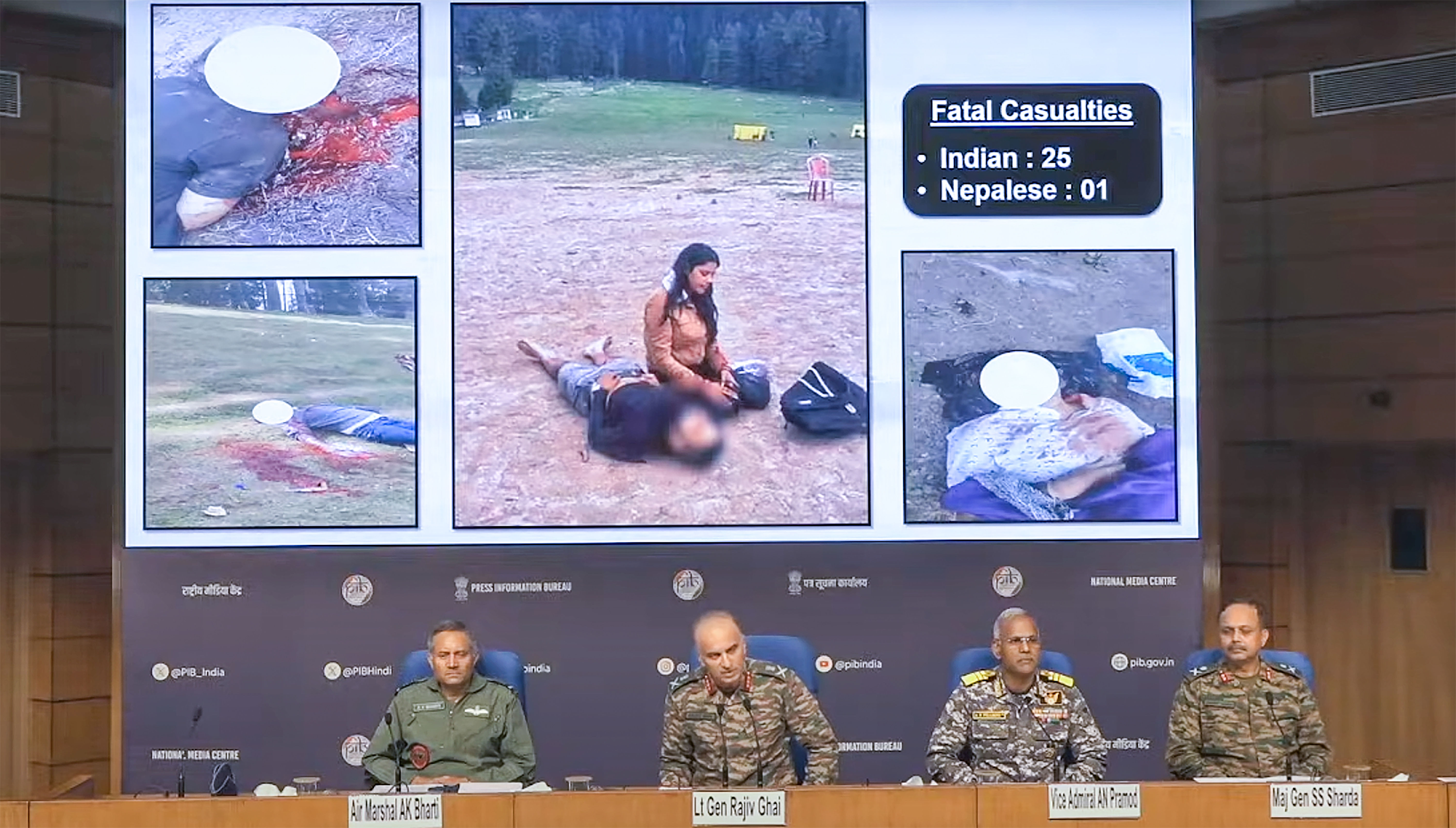
In a press conference held by the Government of India, the officials of three wings of Indian Armed Forces briefed about Operation Sindoor — India's response to the Pahalgam terror attack in Baisaran valley of Kashmir which took 25 Indian and one Nepalese life.
Opening up the briefing Lt General Rajiv Ghai offered insights into Operation Sindoor on May 7 where nine terrorist sites were targeted and struck by India in PoK and Punjab in Pakistan.
"Operation Sindoor was conceptualized with a clear military aim to punish the perpetrators and planners of terror and to destroy their terror infrastructure. What I do not state here is the often-stated determination of India and its intolerance to terror. It set into motion a very diligent and microscopic scarring of the terror landscape across the borders and the identification of terror camps and training sites. The locations that emerged were numerous, but as we deliberated more, we realized that some of these terror hubs were now bereft of presence and had preemptively been vacated, fearing retribution from us. There was also a term of reference and our own binding self-imposed restriction to target only terrorists and thus prevent collateral damage," said DGMO Lieutenant General Rajiv Ghai.
Taking over from him, Air Marshal AK Bharti explained in detail the methodology of the attack by the Indian Air Force in Operation Sindoor on May 7.
Afterwards, Lt Gen Ghai, Air Marhal Bharti, and Vice Admiral A N Pramod, along with Major General SS Sharda explained the attacks and combatting intrusions by Pakistan from May 8 to 10 in tandem.
"On the night of 8th and 9th May, starting as early as 22:30 hours, our cities had a mass raid of drones, unmanned aerial vehicles, starting right from Srinagar and going right up to Naliya. It was a mass raid in waves and it was relentless. We were prepared and our air defence preparedness ensured that there was no damage on the ground or to any of the intended targets that the enemy might have planned for. In a measured and calibrated response, we once again targeted the military installations and surveillance radar sites at Lahore and close to Gujranwala, " said Air Marshal AK Bharti.
"A decision was taken to strike where it would hurt and towards that in a swift, coordinated, calibrated attack, we stuck air bases, command centers, military infrastructure, air defence systems across the entire Western Front. The bases we stuck include Chaklala, Rafiqui, Rahim Yar Khan, and Sukkur sending a clear message that aggression will not be tolerated. This was followed by strikes at Sargodha, Bholari, and Jacobabad," he added.
Lt Gen Rajiv Ghai informed that the Chief of Army Staff (COAS) General Upendra Dwivedi reviewed the security situation with Army Commanders of the Western Borders following ceasefire and airspace violations under Operation Sindoor in New Delhi, and said that COAS has authorised the commanders to ‘deal with violations in a manner they deem fit’.
"The response will be fierce and punitive," he stressed.
In conclusion, Lt Gen Rajiv Ghai remembered fallen heroes of Operation Sindoor, saying, "Their sacrifices shall always be remembered in glowing terms by a grateful nation.”
He added, “We have exercised immense restraint in our actions, have been focused, measured, and non-escalatory. However, any threat to India's soveringnity, territorial integrity, and safety of our citizens will be met with decisive force.”
Notably, India and Pakistan entered a ceasefire agreement on Saturday (May 10), which was breached by Pakistan hours after, according to Indian Foreign Secretary Vikram Misri.
