





Air pollution protest turns controversial as demonstrators display Hidma posters
Updated: Nov 24th, 2025


 |
| Image: X Screengrab ANI |
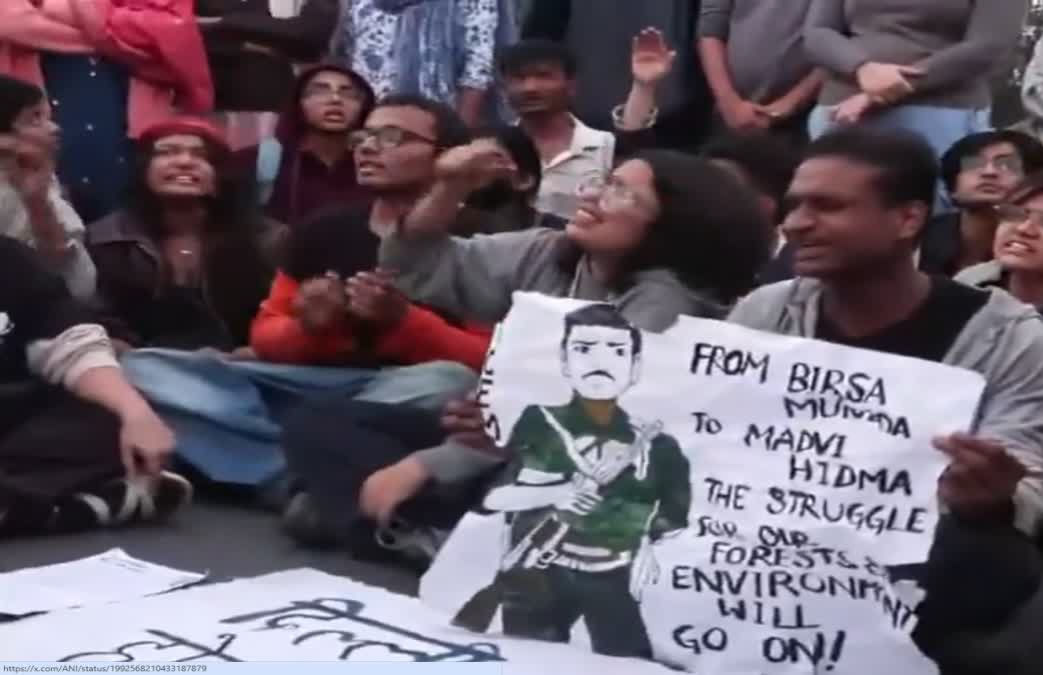
A demonstration at India Gate over Delhi’s worsening air pollution drew sharp attention after participants displayed posters of Maoist commander Madvi Hidma, who was recently killed in an encounter with security forces in Andhra Pradesh.
The protest turned tense on Sunday evening when some demonstrators reportedly attempted to block traffic. Police personnel trying to disperse the crowd were said to have been pepper-sprayed by a few participants, prompting the filing of an FIR and a wider investigation into how the posters were introduced at the gathering.
Reports indicated that visuals praising Madvi Hidma and calls in his support were observed shortly before the situation escalated. One sign referenced a broader struggle for forests and the environment, mentioning both Birsa Munda and Hidma.
Officials said they would identify individuals responsible for raising such slogans at the heritage site and that legal action would follow.
The controversy emerged days after where Hidma, considered one of India’s most influential and wanted Maoist commanders, was killed in an operation near the Andhra-Odisha border. His wife and four armed cadres were also killed during the encounter in the Maredumilli forest region.
According to reports, senior state officials said the exchange of fire took place early in the morning and that security agencies had been maintaining close surveillance after receiving information that Maoist units were attempting to move into Andhra Pradesh to regroup. Intelligence inputs suggested the presence of top leaders, which led to increased combing operations in the region.
Authorities confirmed that bodies from the encounter were being processed as per official procedures, while search efforts continued for Maoists who fled. Security personnel recovered multiple weapons, including AK-47 rifles and handguns, along with operational material.
Madvi Hidma, believed to be in his early fifties, was known as the commander of the PLGA’s Battalion No. 1 considered among the most lethal Maoist strike units. Originating from Sukma district in Chhattisgarh, he rose through the ranks over nearly three decades and was named in several major attacks, including the 2010 Dantewada massacre of 76 CRPF personnel and the 2013 Jhiram Ghati incident involving top Congress leaders. States had collectively announced rewards amounting to several crores for information leading to his capture.
His death is being described in reports as a significant setback to Maoist operations in the region, particularly at a time when the group was believed to be attempting a revival along the Andhra-Odisha border, once a stronghold for its activities.