




3,000 km of unbroken flight: How India is tracking migratory falcons that took off from Manipur
Updated: Nov 17th, 2025


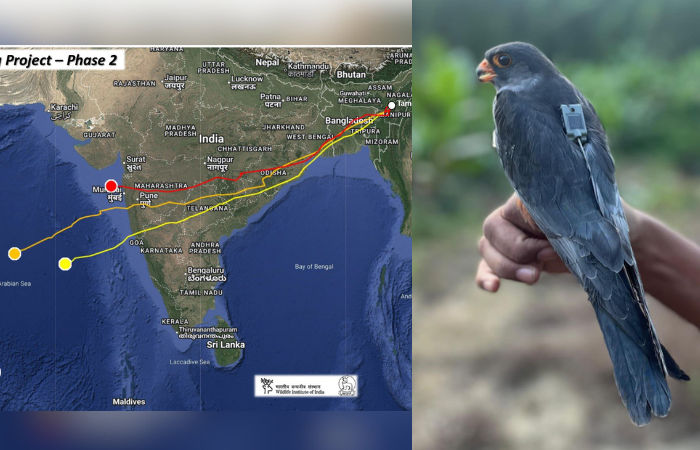 |
| Image: X (@supriyasahuias) |
In one of the most ambitious migratory journeys known in the bird world, three Amur Falcons –Apapang, Ahu, and Alang– are currently undertaking an unbroken 3,000-km flight over the Arabian Sea after taking off from Manipur and heading to Somalia.
The project began on November 10, when the Tamenglong Forest Division of the Manipur Forest Department, in collaboration with the Wildlife Institute of India (WII), Dehradun, tagged the three falcons with lightweight satellite transmitters at the Chiuluan roosting site.
Leap into the sky
According to IAS Supriya Sahu, Additional Chief Secretary Environment Climate Change & Forests, Tamil Nadu, within days, the tagged birds launched into their annual migration, quickly demonstrating why Amur Falcons are considered among the world’s most remarkable long-distance flyers.
Apapang, the adult male, was the first to surge ahead, cutting across central India in a relentless nonstop flight before skimming the Arabian Sea.
Alang (a young female) and Ahu (an adult female) followed in similar fashion, staying consistent with the migratory routes etched into their evolutionary biology.
The feat is astonishing not just for the distance but for the conditions. These birds, weighing barely 150 grams, make the oceanic crossing without any possibility of rest, food or water. Once they leave the Indian coastline, there is no turning back — the next landmass lies thousands of kilometres away.
3,100 km in 76 hours without stops
A detailed update shared by Sahu revealed the scale of Apapang’s performance on Sunday.
Riding strong easterly tailwinds, he has already completed a nonstop, 76-hour flight covering roughly 3,100 km at a rate of nearly 1,000 km per day. All three tagged birds are now deep into the Arabian Sea section of their route, with Somalia as their next destination.
These birds cannot land on water as they are territorial species, meaning the whole journey over Arabian Sea is non-stop.
Why do these birds migrate?
With interest in the journey surging, Dr Suresh from WII who leads the Manipur Amur Falcon Tracking Project explained to IAS Sahu why and how India is mapping this extraordinary migration.
The conversation, shared by Sahu on X, noted that migration helps birds escape harsh weather, find richer feeding grounds and locate suitable breeding sites.
Over time, individuals that migrated had higher survival and reproductive success, embedding this behaviour within the species.
How do they survive such long flights?
According to the X post, before takeoff, the birds spend time in Manipur and Nagaland where their arrival coincides with termite emergence.
These rich protein sources allow the falcons to undergo intense pre-migratory fattening (hyperphagia), building reserves that sustain them during their nonstop oceanic passage.
Such tagging and tracking helps scientists understand flight routes for these birds, environmental influences, and critical stopover sites.
The tracking also provides the scientists with data to determine if these birds are facing habitat loss due to climate change.
