

₹3,826 crore flow through Electoral Trusts in 2024–25, BJP gets ₹3,150 cr: ADR

Summarized by AI; it may make mistakes. Check important info
Summarized by AI; it may make mistakes. Check important info

Political funding has long remained a subject of debate in India’s democracy. The latest report released by the Association for Democratic Reforms (ADR) for the financial year 2024–25 has once again brought corporate donations routed through electoral trusts into sharp focus.
The findings reveal massive financial flows from the corporate sector to political parties, highlighting how electoral trusts continue to play a crucial role in shaping party finances. From the ruling party to opposition outfits, the scale and distribution of funds present striking insights into India’s political funding ecosystem.
Corporate and Gujarat’s strong presence in political donations
According to the ADR report, a total of over ₹3,826 crore was donated to electoral trusts during 2024–25, with manufacturing and real estate sectors emerging as the dominant contributors. On a state-wise basis, Gujarat featured among the top five donor states, underlining its significant corporate footprint in political funding. Contributions from major corporate houses such as Torrent Power and ArcelorMittal further underscore the growing influence of large industrial groups in the electoral funding process.
Key financial highlights
Total donations received: During FY 2024–25, 10 electoral trusts received a total of ₹3,826.3417 crore from corporate and individual donors.
Total donations distributed: Electoral trusts distributed ₹3,826.3522 crore to various political parties.
Reporting trusts: Out of 20 registered electoral trusts, 15 submitted their reports, of which only 10 declared receiving donations during the year.
Party-wise distribution of funds
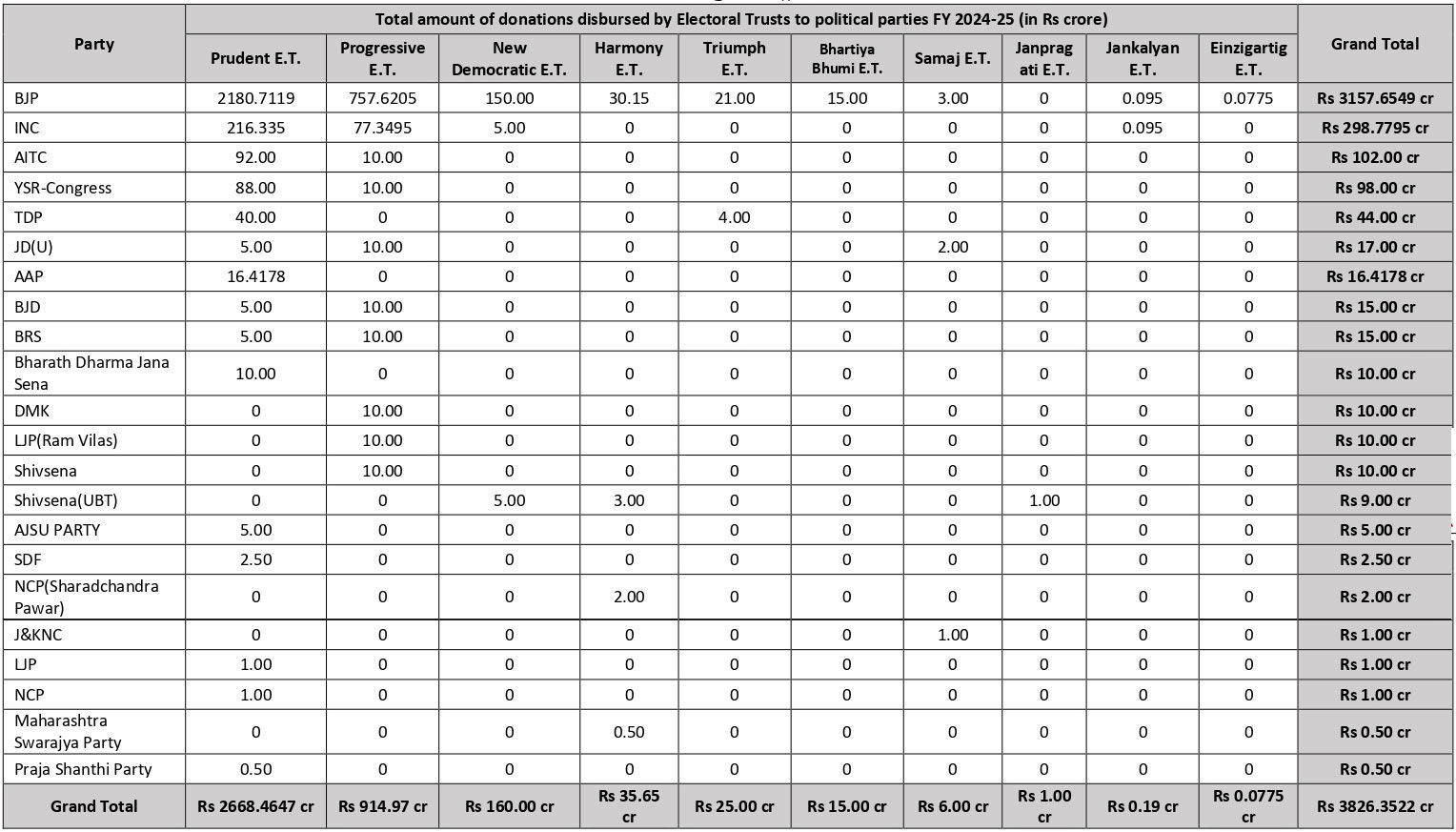
The Bharatiya Janata Party (BJP) emerged as the biggest beneficiary of electoral trust donations:
BJP: Received 82.52% of the total donations, amounting to ₹3,142.6549 crore.
Indian National Congress (INC): Secured 7.81% of the donations, totalling ₹298.7795 crore.
All India Trinamool Congress (AITC): Received ₹102 crore, accounting for 2.67%.
Other parties: A total of ₹267.9178 crore was distributed among 19 other political parties.
Sector-wise contribution pattern
The report details the sectors that contributed the most to electoral trusts:
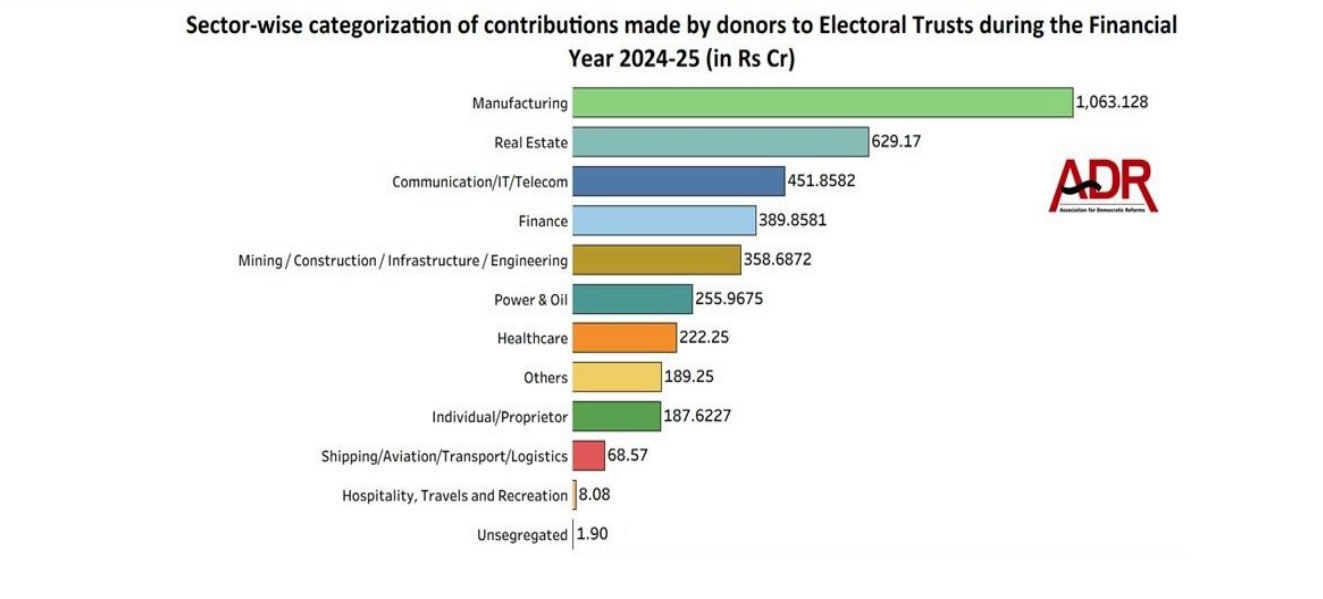
Manufacturing: ₹1,063.128 crore (27.78%).
Real estate: ₹629.17 crore (16.44%).
Communication/IT/Telecom: ₹451.8582 crore (11.81%).
Finance: ₹389.8581 crore (10.19%).
Mining/Construction/Infrastructure: ₹358.6872 crore (9.37%).
Power and oil: ₹255.9675 crore (6.69%).
State-wise donations: Gujarat in top five
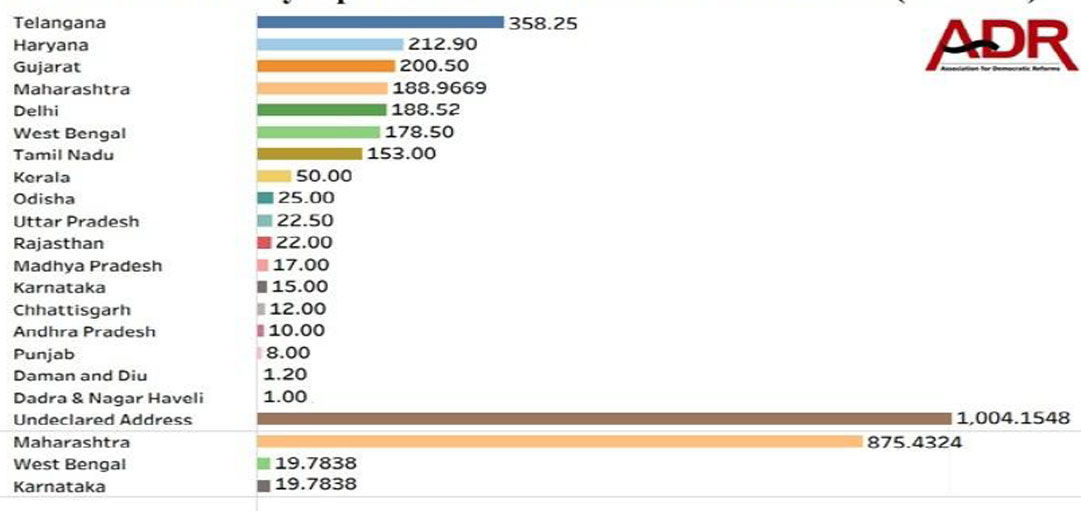
Maharashtra led the list of donor states, while Gujarat secured the fifth position:
Maharashtra: ₹1,225.4293 crore.
Telangana: ₹358.25 crore.
Haryana: ₹212.90 crore.
West Bengal: ₹203.8538 crore.
Gujarat: ₹200.50 crore.
Major donor companies (all-India)
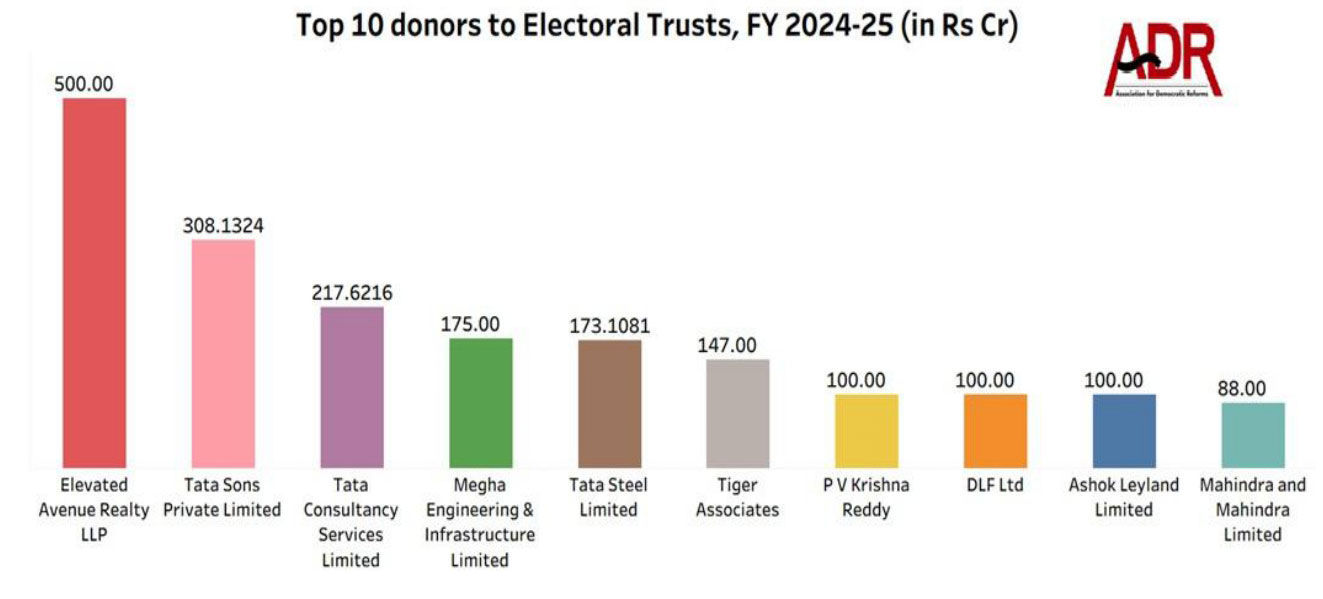
Some of the largest contributors across the country included:
Elevated Avenue Realty LLP: ₹500 crore.
Tata Sons Private Limited: ₹308.1324 crore.
Tata Consultancy Services (TCS): ₹217.6216 crore.
Megha Engineering and Infrastructure Limited: ₹175 crore.
Performance of electoral trusts
Among all electoral trusts, the Prudent Electoral Trust emerged as the largest recipient, receiving ₹2,668.4917 crore during the year. As per government norms, electoral trusts are required to distribute at least 95% of the donations they receive to political parties within the same financial year.
The ADR report provides a detailed snapshot of the evolving dynamics of political funding in India, raising important questions about transparency, corporate influence and the role of electoral trusts in the democratic process.


