





2023 Wrapped: Supreme Court of India finds voice
A look back at some of the decisive or debatable verdicts and issues handled by the Supreme Court in 2023
Updated: Dec 30th, 2023


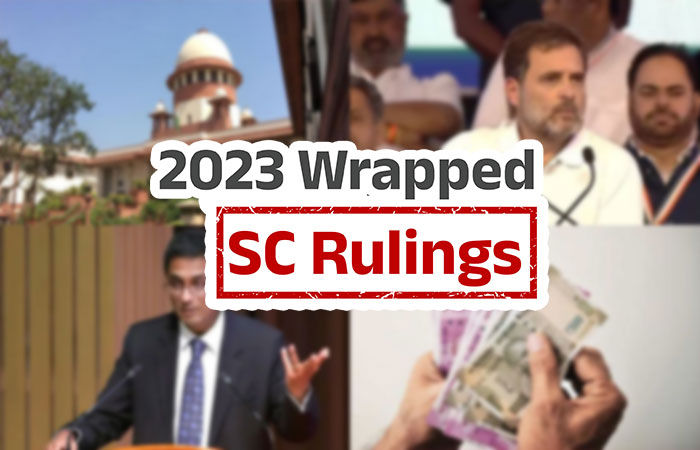
With the amount of times the apex court of India, the Supreme Court, was a point of discussion this year, exhibited the signs of healthy involvement of the law in the country’s proceedings.
From the LGBTQ marriage rights to the abrogation of Article 370 in Jammu & Kashmir, SC had something to say. Issues concerning the general population were touched upon more, leading to an active participation of the court in the day-to-day lives of everyone.
Here is a look back at some of the decisive or debatable verdicts and issues handled by the Supreme Court of India in 2023.
Demonetisation stays
SC in January upheld the Centre’s decision in 2016 to demonetise the denominations of ₹500 and ₹1,000.
It upheld the decision with a 4:1 majority in a bench of five judges, with a sole woman judge disagreeing with the bench’s conclusions.
The court delivered this verdict in its hearing to multiple petitions challenging the Centre’s decision of demonetisation.
Passive euthanasia in selective cases
SC has given its legal nod to passive euthanasia, supporting the use of a ‘living will’ for patients to stop medical support in irreversible coma or in cases where a patient with a terminal illness has reached a ‘point of no return.’
The court stressed that its established directions and guidelines, along with its directive, will remain in effect until legislation is passed on the matter by the Centre.
During the judgment, the Chief Justice of India DY Chandrachud highlighted that despite four different opinions from the bench, all judges unanimously agreed that allowing a ‘living will’ is crucial.
An individual should not be forced to endure prolonged suffering in a comatose state if they have clearly expressed a desire to stop living, stated the court.
CEC and EC chief election without monopoly
In a landmark judgment in March on the appointment of the chief election commissioner (CEC) and election commissioners (ECs), the court ruled that the government cannot have exclusive control and monopoly over these posts.
As per the SC, a committee of the prime minister, the leader of the opposition, the leader of the single largest opposition party, and the chief justice of India, led by the president of India, will appoint CEC and ECs in the election commission.
Irretrievable breakdown of marriage
A couple who were separated from each other for the last 25 years in Delhi were burdening each other with multiple litigations.
While hearing about the case, the court ruled that it would amount to cruelty if two people were made to stay in a marriage that has reached a point of irretrievable breakdown of marriage.
The court also waived the six-month waiting period mandated by the Marriage Act for the couple in question.
Thackeray loses CM seat
In May, the Supreme Court criticised former Maharashtra Governor Bhagat Singh Koshyari for demanding that Maha Vikas Aghadi government leader Uddhav Thackeray prove his majority in the Assembly.
However, the court stopped short of declaring the current regime led by rebel Shiv Sena leader Eknath Shinde as illegal, as Thackeray’s predecessor had resigned without undergoing a trust vote.
A Constitution bench of five judges, headed by CJI, determined that the Governor lacked substantial evidence to conclude that Thackeray, leading the coalition of Congress, NCP, and Shiv Sena, losing to the majority.
Removal of ban on Jallikattu
With support for changes made by Tamil Nadu, Maharashtra, and Karnataka to the Prevention of Cruelty to Animals Act, the court in May allowed Jallikattu (bull-taming sport) and Kambala (bullock-cart racing) in these states.
The court observed that the new amendments made by the states were in accordance with the Constitution and did not violate the apex court’s decision to ban these sports in 2014.
The amendments received the president’s approval and therefore were considered valid by the court.
Rahul Gandhi’s return as MP
In a verdict that allowed Rahul Gandhi’s return to the Parliament, the court put a stay on Rahul Gandhi’s punishment by the Gujarat sessions and high court in the ‘Modi Surname’ defamation case.
The court, while acknowledging that the remarks were not in ‘good taste’, said that the lower courts did not cite enough reasons to affect the maximum sentence for Rahul Gandhi.
Same-sex marriages
The five-judge bench in October held the hearing on providing marriage rights to homosexual couples. The two judges on the bench, CJI DY Chandrachud and Justice Sanjay Kaul stated that marriage cannot be restricted on sexual orientation, and the discrimination violates Article 15 of the constitution.
The three other judges, the majority, held that the approval of the legal stature of same-sex marriages is on the legislature and not on the court.
The court unanimously ruled that the Special Marriage Act of 1954 was not unconstitutional for the exclusion of same-sex marriages.
The bench decided that non-heterosexual (LGBTQ) couples cannot claim a right to marry unless a framework is made by the legislature.
Eradication of manual scavenging
The court in October ruled that the country and the states are ‘duty-bound to the pledge to completely eradicate manual scavenging through the stringent implementation’, citing the Prohibition of Employment as Manual Scavengers and their Rehabilitation Act, 2013.
The court, in its judgment, was strictly against the idea that a ‘sizeable section of society is forced to enter sewers for a living and die trapped in them’.
Abrogation of Article 370
In December, an SC panel unanimously supported the president’s authority to revoke Article 370 in August 2019. This decision led to the restructuring of the State of Jammu and Kashmir into two Union Territories, removing its special privileges.
The panel, led by the CJI affirmed that the president could independently declare that Article 370 no longer exists.
The court explained that the removal of Article 370 was an effort to integrate Jammu and Kashmir with India.
He noted that the Constitution of India is a comprehensive guide to constitutional governance, and the Jammu and Kashmir constitution was ‘obsolete’ and ‘non-operative’.
Two contradictory abortion verdicts
The apex court of India in May did not allow a married Delhi woman to terminate her 26-week-old pregnancy after the medical reports revealed that there was no imminent danger to her life due to pregnancy, and the foetus was healthy.
On the other hand, the court allowed the termination of a 27-week-old pregnancy for a rape survivor from Gujarat in August.