




11,000-carat ruby discovered in Myanmar’s famed Mogok region
Updated: May 10th, 2026


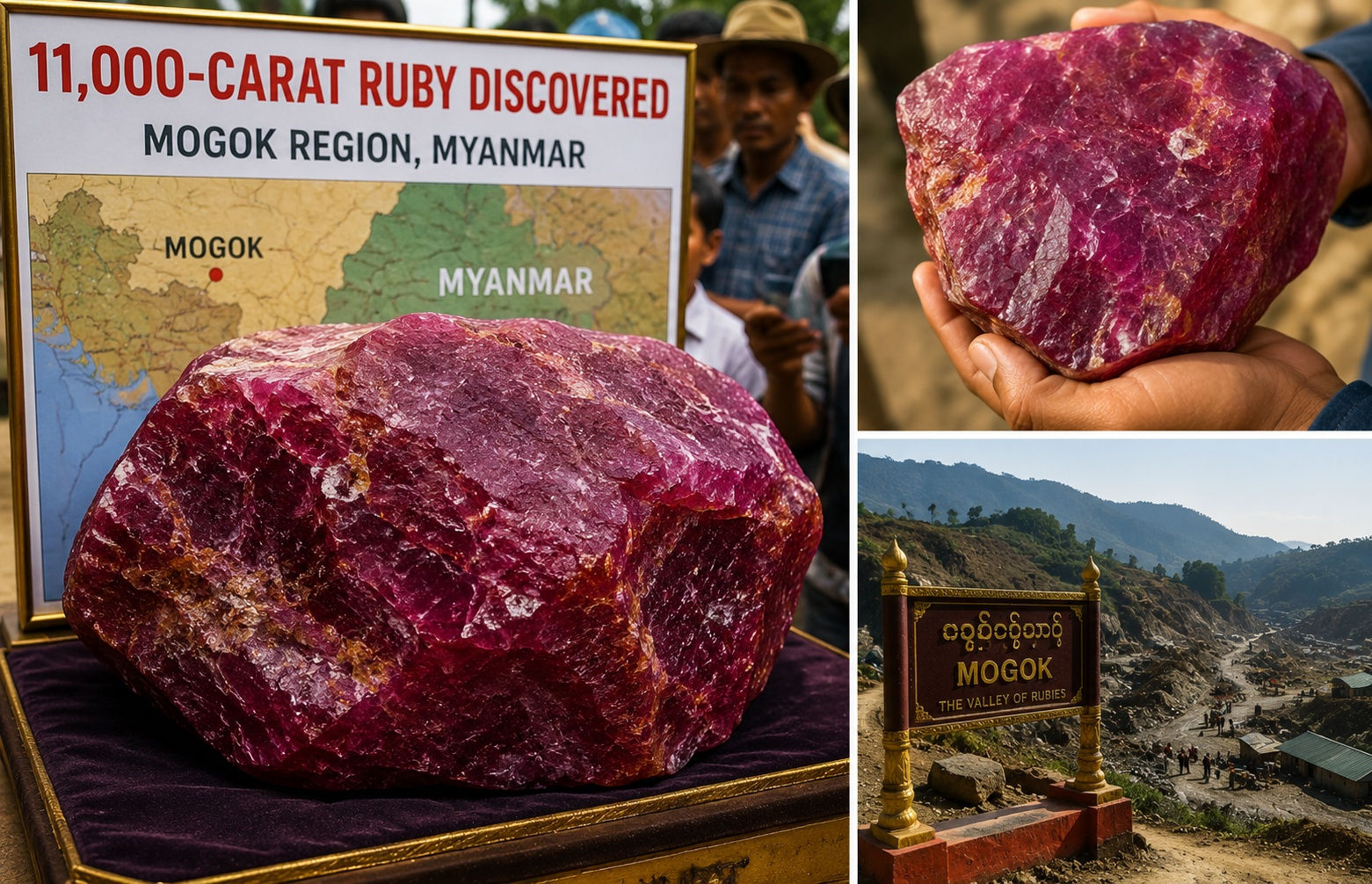 |
An 11,000-carat ruby has been discovered by miners in Myanmar, making it one of the largest rubies ever found in the country, as per local reports.
The gemstone, reportedly weighing around 4.8 pounds, was reportedly unearthed in mid-April shortly after Myanmar’s traditional New Year celebrations.
The ruby was found in the Mogok region, widely known as the ‘Valley of Rubies’ for its centuries-old reputation for producing some of the world’s finest gemstones.
Myanmar is regarded as the world’s leading source of rubies, accounting for nearly 90% of global production, according to industry experts.
Although the newly discovered ruby is smaller than the largest ruby previously found in Myanmar, a 21,450-carat gemstone unearthed in 1996, experts said the quality of the stone could make it exceptionally valuable.
According to reports, the ruby displays a purple-red hue with yellowish tones, moderate transparency and high reflectivity.
Gemologists say colour remains one of the most important factors in determining the value of rubies. The finest stones are traditionally described as having a vivid “pigeon blood” red colour, a term commonly associated with high-quality rubies from the Mogok district.
The Gemological Institute of America has previously noted that highly saturated bright red rubies command the highest prices in the global gemstone market.
Mogok’s geological conditions have long made it one of the world’s most significant ruby-producing regions. According to the Natural History Museum, some of the finest rubies ever discovered have originated from the area.
Myanmar’s gemstone industry, particularly the trade in rubies and jade, remains a major contributor to the country’s economy and supplies luxury jewellery markets across Asia, Europe and the United States.
Experts reportedly noted that discoveries of giant rubies are extremely rare, especially stones possessing commercially desirable colour and clarity. Unlike diamonds, rubies often contain fractures, inclusions and impurities, making large high-quality specimens uncommon.
