

Van Gogh’s Starry Night may depict real sky from July 1889, scientists suggest

Summarized by AI; it may make mistakes. Check important info
Summarized by AI; it may make mistakes. Check important info

Scientists from South Korea believe the famous painting may reflect the real pre-dawn sky over Saint-Rémy-de-Provence, France, on July 22, 1889. The findings challenge the long-held view that the painting was completed in June and suggest that its swirling stars, crescent moon and bright planets may have been based on astronomical observations.
Scientists identify a possible date for The Starry Night
The study, titled The actual sky of Van Gogh’s Starry Night: a multidisciplinary reconstruction, published in the journal Scientific Reports on October 22, was led by Elijah Jeong-hyun Kim, an astronomer and doctoral candidate at Kyung Hee University in South Korea.
The researchers used astronomical simulations, historical weather records, Van Gogh’s letters and an earlier drawing of the landscape to reconstruct the sky visible from the area near the asylum where the Dutch painter stayed.
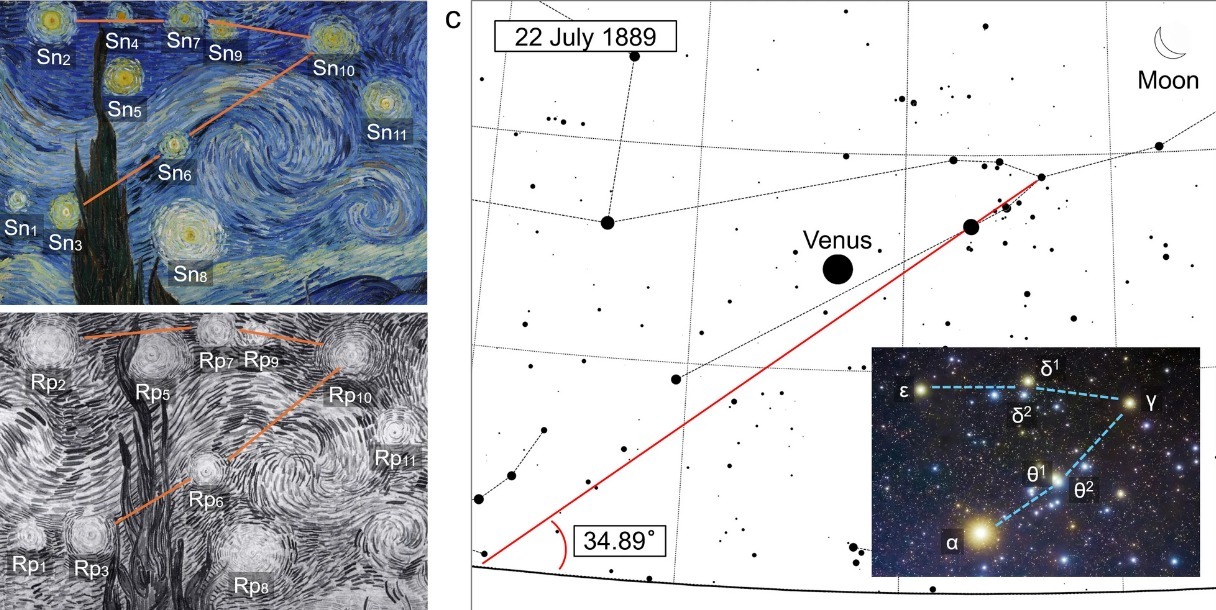
Their calculations suggest that the arrangement of celestial objects around dawn on July 22, 1889, closely resembles the sky depicted in the painting.
Moon, Venus and star cluster offer key clues
The researchers focused on three prominent features in the painting: the crescent moon in the upper-right corner, Venus towards the lower-left and a group of stars between them.
Their reconstruction identified the Hyades star cluster, located in the constellation Taurus, as a possible match for the V-shaped arrangement of stars near the centre of the painting.
The team compared the relative positions of the stars in the artwork with their calculated positions in the historical sky. A mathematical technique called Procrustes shape analysis helped account for differences in scale, rotation and placement.
The researchers concluded that Van Gogh may have observed a real celestial arrangement before translating it onto canvas with his distinctive artistic style.
Why the traditional June 1889 date is being questioned
Art historians have traditionally dated The Starry Night to June 1889, partly based on correspondence Van Gogh sent to his brother Theo around June 18, in which he referred to a new study of a starry sky.
However, the researchers argue that the moon's appearance and the positions of the stars during the middle of June do not match the painting as closely as the late-July sky.
They also examined Van Gogh's letters mentioning cicadas and compared them with historical weather records. According to the study, these clues are more consistent with the warmer conditions in July.
The team also reassessed the timing of a seizure that has traditionally been placed in mid-July. Its revised interpretation suggests that Van Gogh may have been able to observe the sky later that month, although the historical evidence does not establish the exact timing with certainty.
Experts urge caution over the findings
The proposed date remains a hypothesis rather than a definitive conclusion. Researchers acknowledge that Van Gogh may have combined observations from different nights with imagination and artistic interpretation.
Astronomers and art researchers have also cautioned that a painting is not a precise astronomical record. Artists can alter the size, orientation and position of celestial objects to suit a composition.
The study therefore does not establish that every star in The Starry Night corresponds to an actual position in the sky. Instead, it presents evidence that the painting's central star pattern may have been inspired by a real astronomical arrangement.
If the proposed timeline is correct, it could prompt fresh debate about when Van Gogh completed one of his most celebrated works and how closely he observed the natural world around him.


