

Trump Has No Regrets About Iran War, But US Middle Class is Paying For it

Summarized by AI; it may make mistakes. Check important info
Summarized by AI; it may make mistakes. Check important info

US President Donald Trump has continued to defend the war against Iran, arguing that the United States is in control of the Strait of Hormuz and that oil prices will eventually fall as the conflict moves towards a US victory.
But the economic impact of the conflict is already being felt by American households.
In an interview, Trump has maintained that the US is winning the war and has pointed to Washington’s control over the Strait of Hormuz and its expanding economic pressure on Iran.
He reportedly said that if he had it to do again, he would do exactly what he did. He also said that if there were no war, he would be cruising to midterm victory, but Iran would have achieved a nuclear weapon.
His administration has also intensified sanctions targeting Iran’s financial and oil networks, while warning countries and institutions that continue doing business with Tehran of potential penalties.
Yet, on the domestic front, higher energy prices are creating a very different picture.
$115 Billion In Additional Energy Costs
According to Fox Business, Moody’s Analytics Chief Economist Mark Zandi estimates that the Iran war has added around $115 billion to US consumer costs through higher gasoline, diesel and jet fuel prices.
Spread across American households, that works out to roughly $860 per household compared with what they would have spent if the war had not pushed energy prices higher, as per the report.
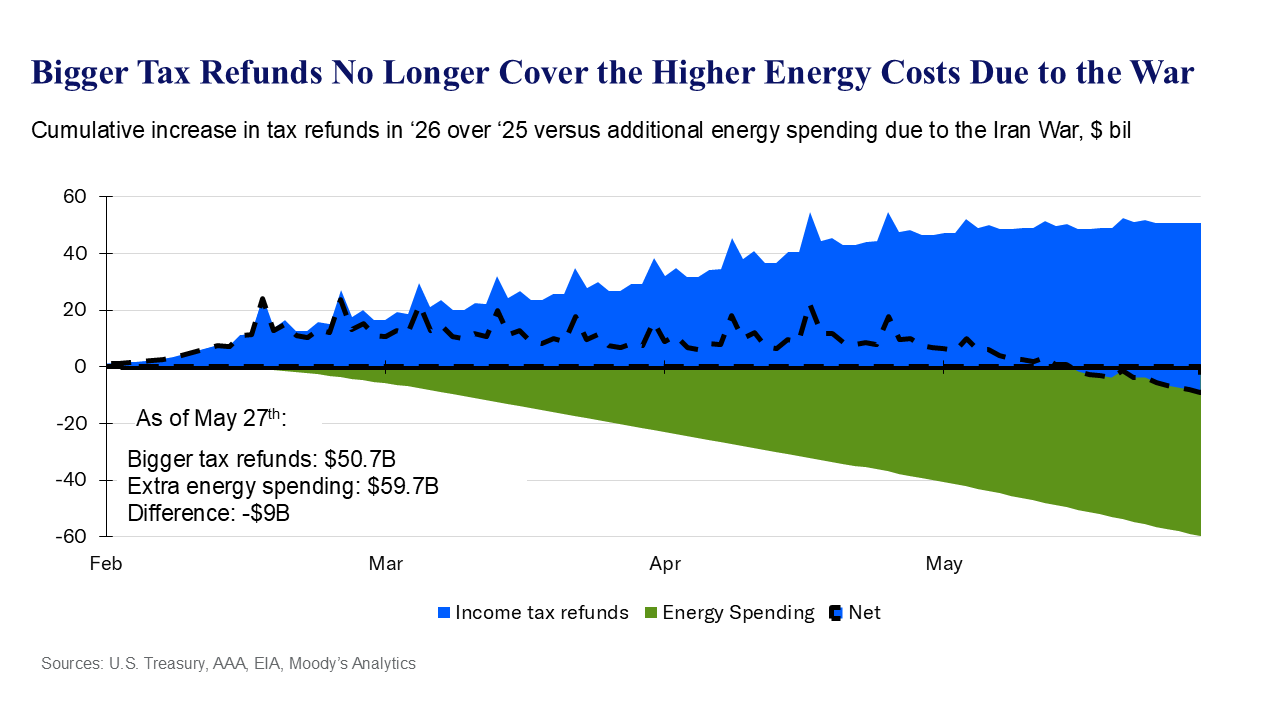
The impact is not limited to what Americans pay at petrol stations.
Higher diesel prices increase the cost of transporting goods, while more expensive jet fuel can push up airfares. That means the energy shock can feed into the wider cost of everyday goods and services.
Lower- And Middle-Income Americans Feel The Pressure
Zandi said lower- and middle-income households are bearing the heavier burden because they have less financial room to absorb higher energy costs.
Fox Business reported that US petrol prices have remained above $4 a gallon, adding pressure at a time when inflation has already reduced household purchasing power.
Higher-income households, by contrast, are generally better positioned to absorb the increase because of stronger incomes, lower debt burdens and investments that may benefit from rising asset prices, Zandi said.
The Hormuz Problem
The Strait of Hormuz remains central to the economic fallout.
Oil tanker traffic through the waterway is still well below pre-war levels, according to Zandi, keeping energy supplies tighter than before the conflict. He said alternative pipelines and increased production elsewhere could eventually provide relief, but those changes would take time.
That creates a gap between Washington’s political message and the immediate economic experience of American consumers.
Trump can argue that US military and economic pressure is weakening Iran and that oil prices will eventually come down. But until energy flows normalise, American households and businesses continue to absorb the cost of the disruption.


