

Scotland, Wales and Northern Ireland Unite on Independence as Leaders Sign Pact for Constitutional Change

Summarized by AI; it may make mistakes. Check important info
Summarized by AI; it may make mistakes. Check important info

Scotland, Wales and Northern Ireland’s pro-independence leaders have signed a memorandum of understanding in Cardiff, calling for constitutional change and the right of each nation to determine its own future.
The agreement was signed by Scottish National Party (SNP) leader and First Minister John Swinney, Plaid Cymru leader and Welsh First Minister Rhun ap Iorwerth, and Sinn Féin vice president and Northern Ireland First Minister Michelle O’Neill. Sinn Féin president Mary Lou McDonald also attended.
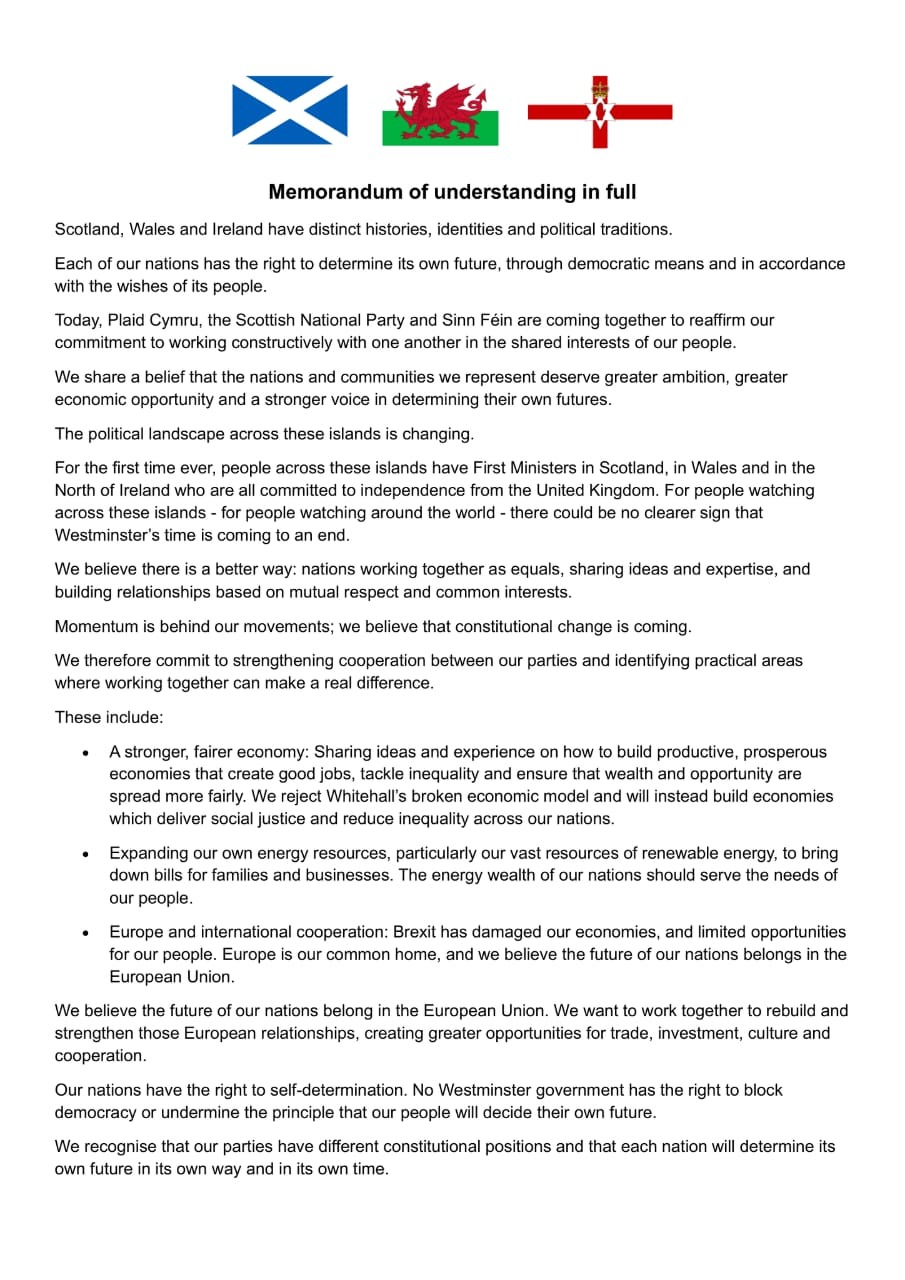
The leaders participated as party leaders rather than formally representing their devolved governments.
Pact Calls for Democratic Choice
The memorandum recognises the distinct histories and political traditions of Scotland, Wales and Ireland, while backing the right of people in each nation to decide their constitutional future through democratic means.
The parties have called for greater economic opportunities, stronger political representation and closer cooperation.
The agreement also highlights the fact that all three devolved administrations are now led by politicians whose parties support independence or major constitutional change.
‘Westminster’s Time Is Coming to an End’
The pact delivers a direct political challenge to Westminster, declaring that the current political landscape shows growing momentum for constitutional change.
The parties argue that Scotland, Wales and Northern Ireland should work together as equals rather than remain dependent on a Westminster-centred system.
However, they have not agreed on a common timetable. Each nation will pursue its constitutional future according to its own political circumstances.
Economy, Energy and Europe on Shared Agenda
The agreement goes beyond independence and sets out cooperation on economic policy, energy and international relations.
The parties want a fairer economic model focused on jobs, reducing inequality and spreading wealth and opportunity.
They also support greater use of renewable energy resources to help reduce costs and ensure energy wealth benefits local populations.
On Europe, the parties argue that Brexit has reduced economic opportunities and say they want stronger relationships with the European Union, including closer cooperation on trade, investment and culture.
Scotland Seeks Another Independence Vote
The pact comes as Swinney pushes for a route to another Scottish independence referendum.
Scotland voted 55% to 45% against independence in 2014. Swinney has called for a legal mechanism to allow another vote and said he expects a referendum within the next five years.
The UK Government continues to oppose a second Scottish independence referendum despite recent debate over whether changing public opinion could reopen the constitutional question.
Wales and Northern Ireland Follow Different Paths
Plaid Cymru’s rise to power has put Wales under a pro-independence First Minister, although the party’s approach currently places strong emphasis on greater powers, fair funding and economic control.
Northern Ireland faces a different constitutional process. Sinn Féin supports Irish reunification, while O’Neill’s participation in the Cardiff meeting has drawn criticism from Deputy First Minister Emma Little-Pengelly.
US President Donald Trump has also recently reiterated his support for Irish reunification, adding further attention to the issue.
What the Pact Means for the UK
The memorandum does not trigger any referendum or change the constitutional status of Scotland, Wales or Northern Ireland.
Its significance is political. The three pro-independence movements now have a shared platform covering self-determination, economic powers, energy and relations with Europe.
For Westminster, the challenge is no longer limited to Scotland. Three separate constitutional debates are developing at the same time, each with its own legal framework, political timetable and level of public support.
The Cardiff pact therefore strengthens cooperation between the independence movements while putting renewed pressure on the UK Government over the future of the Union.


