




At least 37 killed, over 500 injured as 7.8-magnitude earthquake jolts southern Philippines
Updated: Jun 9th, 2026


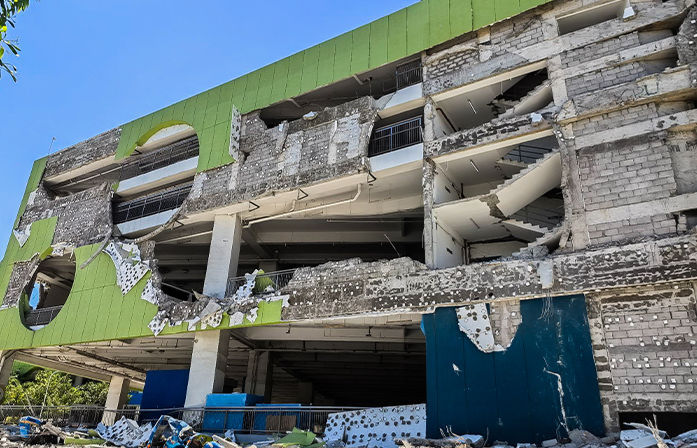
A powerful 7.8-magnitude earthquake struck the southern Philippines on Monday morning, killing at least 37 people, injuring more than 500 and displacing over 20,000 residents.
Rescue teams continued search operations on Tuesday amid fears that more people could be trapped beneath collapsed buildings. Official records showed four people remained missing.
The epicentre of the earthquake was located off the coast of Mindanao, the Philippines' second-most populous island. The strong tremors triggered tsunami fears and generated waves of up to 1.4 metres, prompting evacuations in coastal areas.
Authorities said the tsunami caused limited damage, affecting six huts in a coastal village. Smaller waves were also reported in parts of Indonesia and southern Japan.
However, the majority of casualties were caused by landslides and collapsing structures. In General Santos City, known as the Philippines' "tuna capital", 13 people were killed after being struck by falling debris. In Sarangani Province, a landslide buried several houses in a mountainous town, claiming 18 lives.
The earthquake struck on the first day of the new school term following a two-month summer break. Many students had gathered for morning flag-raising ceremonies when the tremors occurred, resulting in numerous injuries.
Preliminary government assessments indicated that around 2,000 houses and 117 government buildings suffered damage.
General Santos International Airport was closed following the earthquake, leading to the cancellation of 63 domestic flights.
Authorities said schools would remain closed until safety inspections of approximately 6,000 government school buildings were completed, citing concerns that aftershocks could further weaken damaged structures.
Experts said the earthquake was linked to movement along the Cotabato Trench and was the strongest to strike the country since 1976.
The region experienced a devastating 8.1-magnitude earthquake on August 17, 1976, which triggered a tsunami that killed an estimated 8,000 people. Another major earthquake measuring 7.8 struck the northern Philippines in 1990, leaving more than 1,000 people dead.
In the aftermath of the latest disaster, President Ferdinand Marcos Jr. dispatched senior defence officials from Manila to oversee rescue efforts and the distribution of relief supplies.
Several countries, including the United States, France, Japan and New Zealand, have expressed readiness to assist the Philippines in relief and recovery operations.
The Philippines lies along the Pacific "Ring of Fire", a seismically active region prone to frequent earthquakes and volcanic eruptions. The archipelago is also regularly affected by severe tropical storms and typhoons, making it one of the world's most disaster-prone nations.
