




Artemis II nears Moon, poised to set new record for deepest human spaceflight
Updated: Apr 6th, 2026


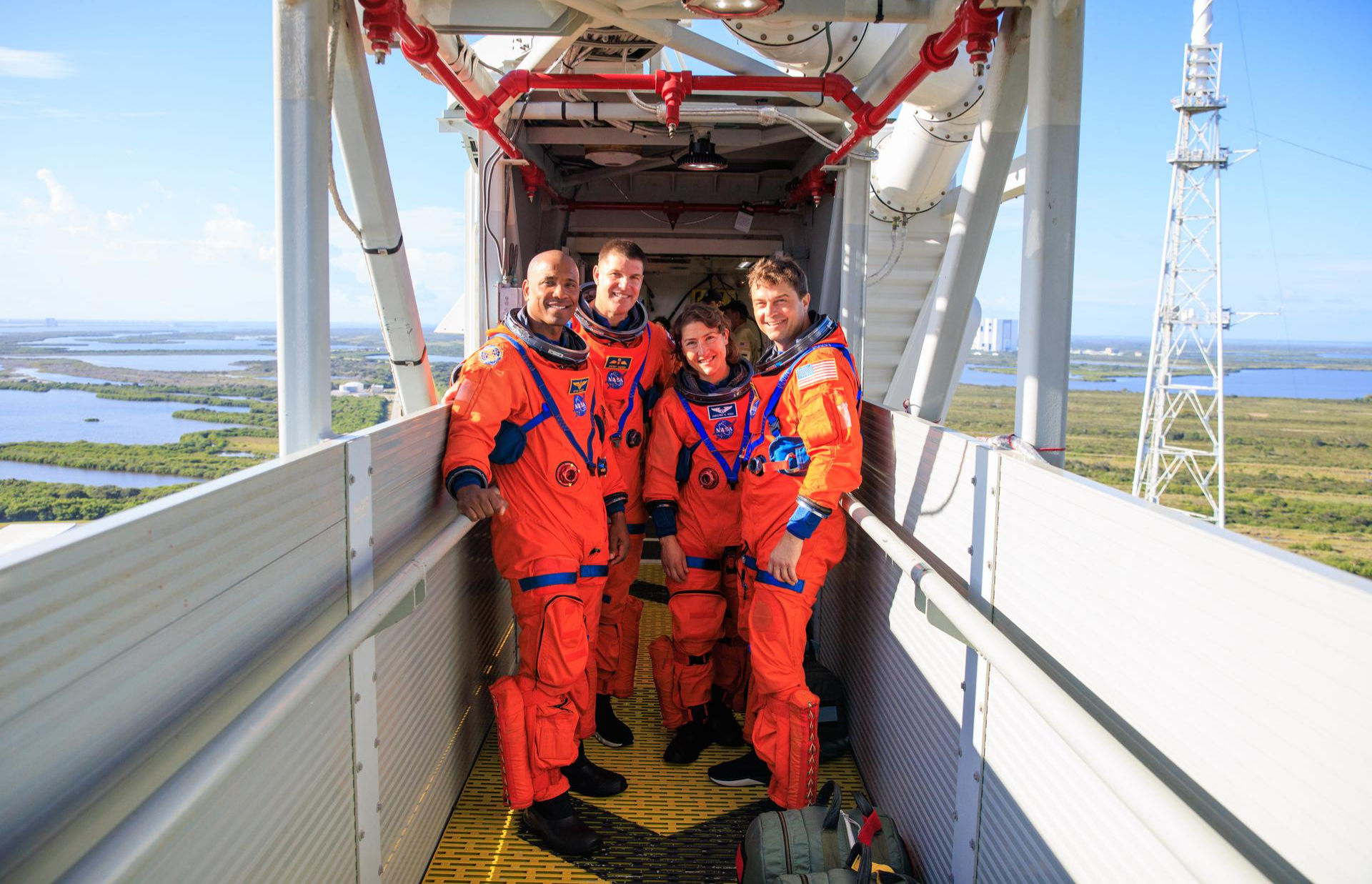 |
| (credit: NASA) |
In a landmark moment for space exploration, the Artemis II mission has reportedly entered the Moon’s gravitational sphere of influence, marking humanity’s return to deep space after more than five decades.
On April 6, the four-member crew moved beyond the familiar bounds of near-Earth orbit, venturing farther than any astronauts since the Apollo era.
The mission is likely to break the long-standing distance record held by Apollo 13, reaching approximately 406,773 kilometres from Earth, around 2,500 kilometres farther than the 1970 mission’s peak distance of 400,171 kilometres. This achievement highlights how far human spaceflight is once again pushing into uncharted territory.
As per reports, the crew is scheduled to begin its lunar flyby on April 7, circling the far side of the Moon before making the journey back home. Unlike missions confined to low-Earth orbit such as the International Space Station, which reportedly operates roughly 400 kilometres above Earth, Artemis II ventures far beyond, surpassing even the Moon’s average distance of about 384,633 kilometres.
A key feature of the mission is its “free-return trajectory,” a carefully calculated path that uses the Moon’s gravitational pull to guide the spacecraft back toward Earth. This approach serves as both an efficient navigation method and a built-in safety mechanism, ensuring the crew’s return even in the event of propulsion system failure.
Beyond technical milestones, Artemis II also represents a major scientific step. As the spacecraft travels beyond Earth’s magnetic field, its natural shield against harmful solar and cosmic radiation, the astronauts will be exposed to conditions not experienced by humans since the Apollo missions, as per reports.
The mission will conclude with a high-speed re-entry into Earth’s atmosphere, with the Orion spacecraft expected to travel at nearly 40,200 kilometres per hour. During this intense phase, its heat shield will endure temperatures of around 2,760 degrees Celsius, testing the limits of engineering and safety.
