

Africa, Latin America Appear Larger As UN Backs New World Map

Summarized by AI; it may make mistakes. Check important info
Summarized by AI; it may make mistakes. Check important info

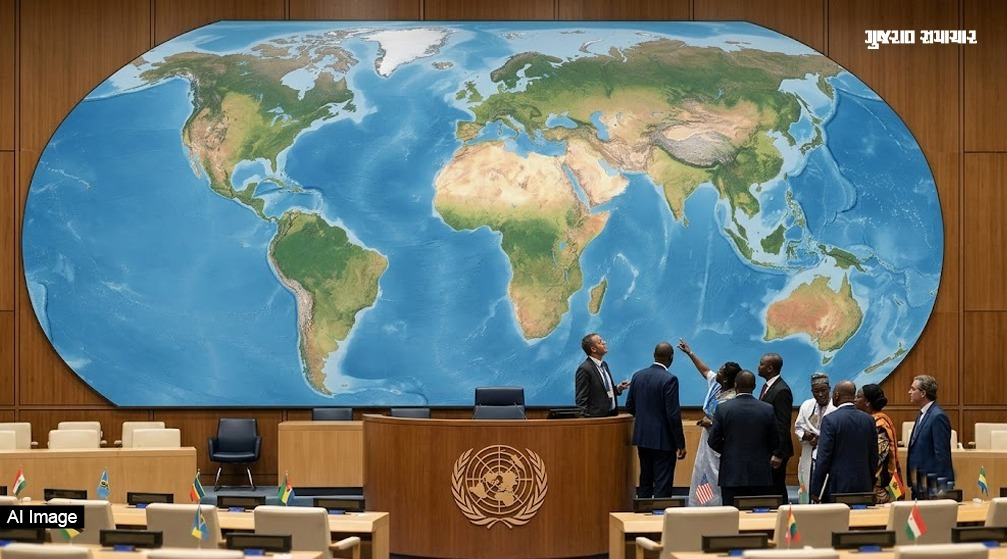
The United Nations General Assembly has adopted a resolution calling for greater use of the Equal Earth map projection, which presents the relative sizes of continents more accurately than the centuries-old Mercator projection. The resolution was backed by 164 countries, while the United States voted against it and six countries abstained.
Africa Appears Larger On New Map
The resolution says the Equal Earth projection improves the accuracy of the cartographic representation of the world and urges UN member states to use it instead of the traditional Mercator projection.
The Mercator projection, developed by Flemish cartographer Gerardus Mercator in 1569, was created primarily for maritime navigation. While it accurately preserves certain angles and shapes, it significantly distorts the relative size of landmasses as they move towards the poles.
As a result, Europe and North America appear disproportionately large, while Africa and South America appear smaller than their actual areas.
The Equal Earth projection, developed by a group of cartographers in 2018, preserves the relative surface areas of continents while attempting to retain their recognisable shapes.
Togo Says Maps Shape Global Perceptions
Togo, which sponsored the resolution, said maps play an important role in how people understand the world.
Foreign Minister Robert Dussey said maps "guide education, nourish the imagination, and influence collective perceptions", arguing that distorted representations can be carried from one generation to another.
The Equal Earth projection makes Africa, Latin America, South Asia and Oceania appear considerably larger in comparison with their depiction on the Mercator map.
Cartographer Bojan Savric said in 2025 that the projection preserves the relative surface areas of continents and, as far as possible, represents their shapes as they appear on a globe.
US Criticises UN Vote
The United States opposed the resolution, criticising the General Assembly for spending time on the issue.
US representative Yaryna Ferencevych said ahead of the vote that such initiatives were contributing to the loss of the institution's credibility.
She questioned the focus on map projections and their role in discussions around reparations and "cognitive justice", saying the UN should instead concentrate on what Washington considers genuine global problems.
France Drops Mercator Projection
France, which co-sponsored the resolution, announced that it would abandon the Mercator projection.
Foreign Minister Jean-Noel Barrot said the traditional map gives disproportionate visual prominence to countries such as the United States, Russia and China compared with Africa, Latin America and Southeast Asia.
He also pointed to the familiar distortion in which Greenland appears almost as large as Africa, despite Africa having a vastly greater land area.
"Changing maps obviously doesn't change the world," Barrot said, adding that correcting a distorted representation was "already an act of truth".
France's support for the initiative comes as it seeks to strengthen relations with African countries, including former French colonies where ties have become increasingly strained.


