





Y-chromosome testing at Gandhinagar FSL used to confirm father-son identities of AI171 crash victims
Updated: Jun 16th, 2025


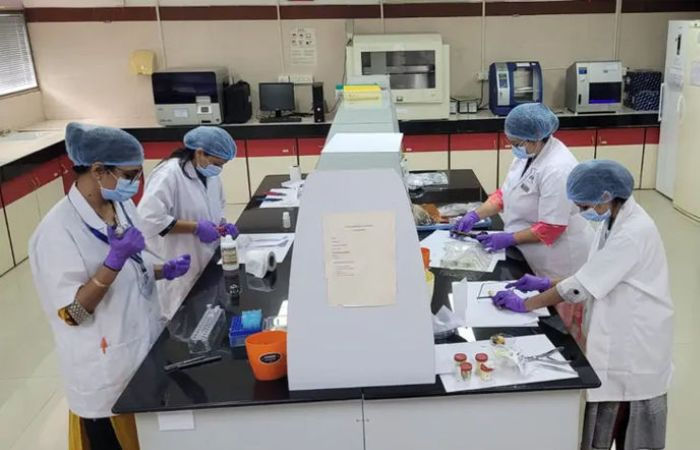
In the continuing efforts to identify victims of the Air India171 crash, forensic experts in Gujarat have begun using Y-chromosome testing to establish father–son relationships among the deceased. The move comes as authorities encounter cases where conventional DNA profiling alone cannot provide conclusive matches.
The AI171 crash, which killed 278 people, left many of the bodies so severely damaged that visual identification was impossible. Forensic DNA profiling has been underway at the Directorate of Forensic Science (FSL) in Gandhinagar for the past few days. The use of Y-chromosome testing marks a crucial addition to these efforts.
Why Y-chromosome testing is useful
The Y chromosome is passed down almost unchanged from father to son, making it a reliable marker in confirming male lineage. In mass casualty situations, it can help forensic teams identify male victims by comparing their DNA with that of surviving male relatives on the paternal side.
“In specific cases where a father–son relationship needs to be confirmed, Y-chromosome testing is used,” said H P Sanghvi, director of the Gandhinagar FSL. “It helps when other family members are unavailable, or when DNA samples do not provide complete matches.”
How DNA profiles are created
The standard DNA profiling process begins with collecting samples—either from surviving relatives or from the remains of the deceased. Two approaches are used:
Blood samples from relatives: These are comparatively easier to collect and analyse.
Samples from the deceased: These are far more complex and require careful extraction from tissue, bone or teeth.
When bones or teeth are available, they are first cleaned to remove contaminants and then ground into fine powder. This powdered material is processed using machines that isolate DNA at precise temperatures. The extracted DNA is then tested for quality (how intact it is) and quantity (how much DNA is present).
“If the quantity is too low or the quality is degraded, we have to repeat the entire procedure,” Sanghvi said. Only when a sample passes these checks can technicians prepare multiple copies of the DNA. These are then analysed using a sequencer machine, which generates the DNA profile by identifying and separating the strands.
Matching profiles and confirming identity
To confirm an identity, forensic experts compare 23 specific autosomal DNA markers between the remains and a family member. If the DNA sample does not meet this threshold — either due to degradation or absence of close relatives — alternative techniques, such as Y-chromosome Short Tandem Repeat (Y-STR) testing, are used to establish paternal relationships.
This allows forensic scientists to confirm matches along the paternal lines, helping to resolve cases where standard profiling is either incomplete or inconclusive.
Dedicated team handles handover to families
Once a victim’s identity is confirmed, a dedicated team at Civil Hospital manages the process of handing over the body to the next of kin. This team includes health department officials, police personnel and trained counsellors to support grieving families.
At the time of handover, families receive all necessary documentation—such as the death certificate, police investigation report, post-mortem report, and the DNA match report—as well as any personal belongings like jewellery recovered from the crash site.
Authorities say the combination of high-precision DNA profiling and targeted Y-chromosome testing has enabled rapid progress in the identification process, even under difficult conditions.